Faculty of Kinesiology and Physical Education, University of Toronto, Toronto, ON, Canada.
Department of Applied Human Sciences, University of Prince Edward Island, Charlottetown, PE, Canada.
J Cachexia Sarcopenia Muscle. 2018 Aug;9(4):747-754. doi: 10.1002/jcsm.12306. Epub 2018 May 14.
Age-related sarcopenia is accelerated by physical inactivity. Low-load resistance exercise (LLRE) counters inactivity-induced muscle atrophy in older adults, but changes in muscle fibre morphology are unstudied. We aimed to determine the impact of LLRE during short-term inactivity (step-reduction) on muscle fibre size and capillarity as well as satellite cell (SC) content in older skeletal muscle.
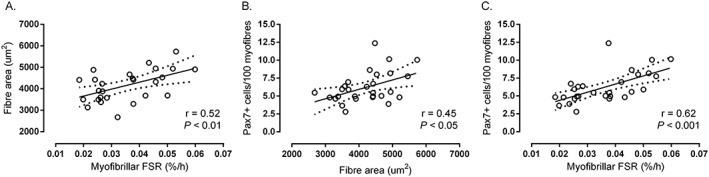
Fourteen older (71 years) male adults underwent 14 days of step reduction (<1500 steps/day) while performing six sessions of LLRE (30% maximal strength) with one leg (SR + EX) while the contralateral leg served as an untrained control (SR). Seven healthy ambulatory age-matched male adults (~69 years) served as a comparator group (COM). Muscle biopsies were taken from the vastus lateralis after 14 days, and immunohistochemical analysis was performed to determine muscle fibre cross-sectional area (CSA), myonuclear content, SC content (PAX7 cells), and total (C:F) and fibre type-specific (C:Fi) capillary-to-fibre ratios.
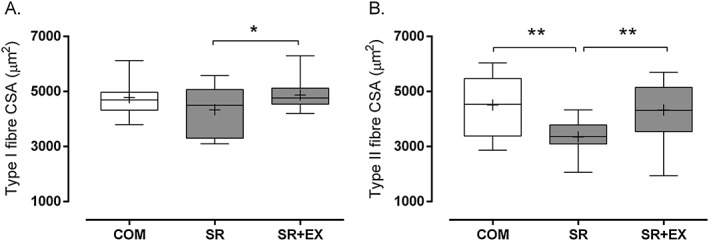
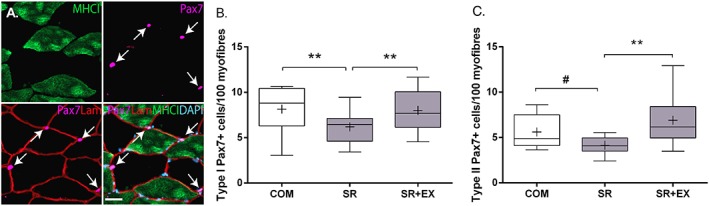
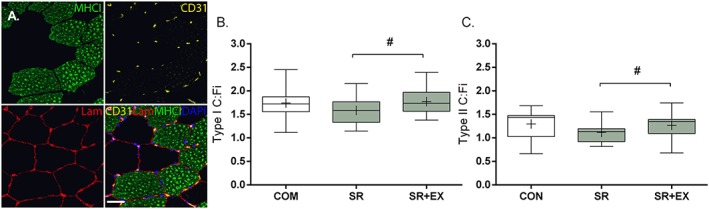
Type I and II fibre CSA was greater in SR + EX compared with SR. Whereas there were no differences across fibre types between SR + EX and CON, type II fibre CSA was significantly lower in SR compared with COM. Type II myonuclear domain was greater in SR + EX compared with COM and SR. Pax7 cells associated with type I and II fibres were lower in SR compared with SR + EX. Type II PAX7+ cells were also lower in SR compared with COM with a similar trend for type I fibres. There were trends for a lower C:Fi in SR compared with SR + EX for both fibre types with no differences for each compared with COM.
Minimal LLRE during a period of decreased physical activity is associated with greater muscle fibre CSA, SC content, and capillarization. These results support the use of LLRE as an effective countermeasure to inactivity-induced alterations in muscle morphology with age.
与年龄相关的肌肉减少症是由身体活动减少引起的。低负荷阻力运动(LLRE)可对抗老年人因不活动引起的肌肉萎缩,但肌肉纤维形态的变化尚未得到研究。我们旨在确定在短期不活动(减少步数)期间进行 LLRE 对老年骨骼肌的肌肉纤维大小和毛细血管以及卫星细胞(SC)含量的影响。
14 名老年(71 岁)男性参与者进行了 14 天的减少步数(<1500 步/天),同时进行了 6 次 LLRE(30%最大力量),其中一条腿(SR+EX),而另一条腿作为未训练的对照组(SR)。7 名健康的、年龄匹配的男性成年人(~69 岁)作为比较组(COM)。在 14 天后,从股外侧肌中取出肌肉活检,并进行免疫组织化学分析,以确定肌肉纤维横截面积(CSA)、肌核含量、SC 含量(PAX7 细胞)以及总(C:F)和纤维类型特异性(C:Fi)毛细血管与纤维的比例。
与 SR 相比,SR+EX 中的 I 型和 II 型纤维 CSA 更大。尽管 SR+EX 和 CON 之间的纤维类型没有差异,但与 COM 相比,SR 中的 II 型纤维 CSA 显著降低。与 COM 和 SR 相比,SR+EX 中的 II 型肌核域更大。与 SR+EX 相比,SR 中的 I 型和 II 型纤维与 PAX7 相关的细胞更少。与 COM 相比,SR 中的 II 型 PAX7+细胞也更少,而 I 型纤维也有类似的趋势。与 SR+EX 相比,SR 中两种纤维类型的 C:Fi 都有降低的趋势,但与 COM 相比,每种纤维类型的差异都不显著。
在减少身体活动的时期进行最小量的 LLRE 与更大的肌肉纤维 CSA、SC 含量和毛细血管化有关。这些结果支持将 LLRE 用作对抗与年龄相关的肌肉形态变化的有效对策。