Bekaert Sarah, Rawlings Maisie, Shariff Dominic, Sammut Dana, Cook Georgia
Faculty of Health and Life Sciences, Oxford Brookes University, Oxford, UK.
Centre for Healthcare and Communities, University of Coventry, Coventry, UK.
J Adv Nurs. 2025 May;81(5):2572-2585. doi: 10.1111/jan.16490. Epub 2024 Oct 1.
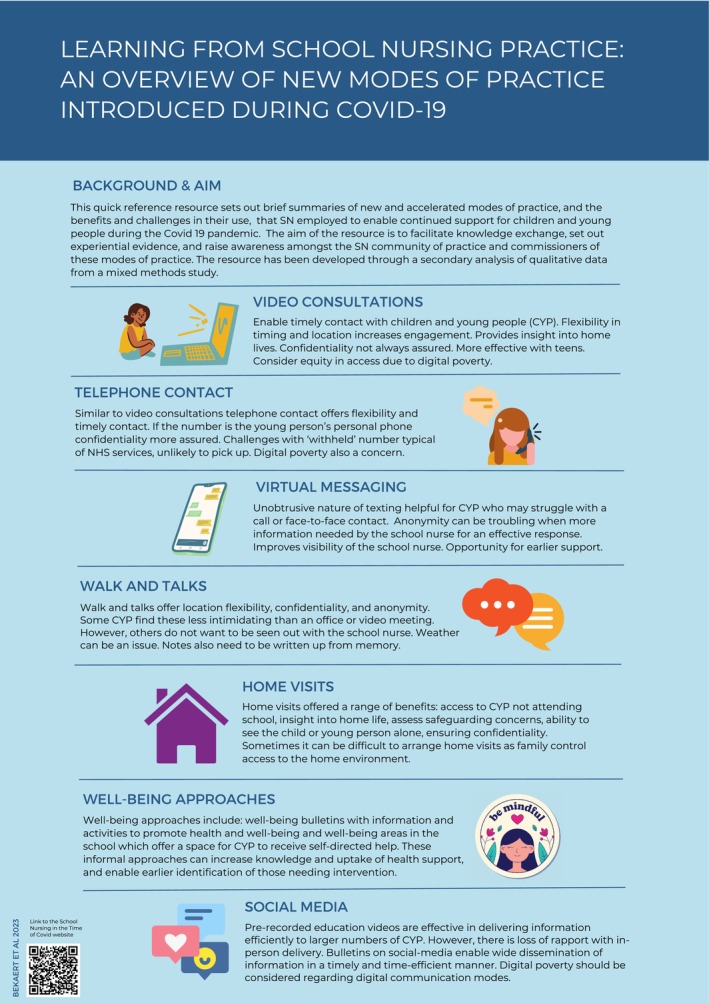
To identify new and accelerated modes of practice used by school nurses during the COVID pandemic. To create a quick reference infographic bringing together experiential evidence on the range and considerations regarding different modes of practice for use by the school nursing community of practice.
A descriptive qualitative secondary data analysis of open-ended questions in a survey, and focus groups with school nurses. The pragmatic aim was to focus on changes in school nurse modes of practice to ensure continued engagement with children and young people, and school nurses' experience of the benefits and challenges of these modes of practice.
Data were collected from 98 school nurse participants across a United Kingdom-wide survey (n78) in April to May 2022, and focus groups (n20) in June to July 2022, within the School Nursing in the Time of COVID project. Data from the seven open-ended questions in the survey and four questions from the focus group were analysed using the framework approach.
Modes of practice fell into two categories: individual assessment and support (video-calling platforms, telephone contact, virtual messaging, walk-and-talks and home visits) and group support (wellbeing approaches, social media). Considerations for these modes rooted in school nurses' experience are described. Interpretations were used to create the summarising evidence-based infographic as a quick reference resource for school nurses.
There was no 'one size fits all' approach. The modes used by school nurses were adopted or developed out of necessity or resource availability and in response to the specific needs of individuals or groups. The developed infographic provides a quick reference guide to deliver the expressed need for knowledge exchange within the school nursing community by participants in the original studies and can be used to inform current school nurse practice.
IMPLICATIONS FOR THE PROFESSION AND/OR PATIENT CARE: The developed evidence-based infographic has stand-alone value. It has the potential to raise awareness of the range of different strategies that can be used to facilitate and/or enhance engagement with children and young people, equip school nurses with knowledge to foster innovative and responsive practice and aid critical reflection in a complex post-pandemic landscape. The infographic is a unique resource and is a first step in knowledge exchange based on experiential learning. The resource will be used as the foundation for future work to develop a co-created training resource for school nurse students (undertaking the Specialist Community Public Health Nurses course) and/or continuing professional development resource for established school nurses.
This study has been conducted and reported in accordance with COREQ guidelines for qualitative research.
A consultation group was closely involved with the planning, conduct and analysis of the original studies. This group consisted of representatives from professional organisations SAPHNA (School and Public Health Nurses Association) and the CPHVA (Community Practitioners' and Health Visitors' Association), a school nurse and a member of the public. SAPHNA have continued in their consultative role for this study and has provided content and usability feedback regarding the infographic. Early findings have been presented to the SN community of practice, and feedback invited, through presentation separately at the CPHVA and SAPHNA annual conference.
识别学校护士在新冠疫情期间采用的新的和加速的实践模式。创建一份快速参考信息图表,汇集关于不同实践模式的范围及相关考量的经验证据,供学校护理实践社区使用。
对一项调查中的开放式问题以及与学校护士进行的焦点小组讨论进行描述性定性二次数据分析。实际目的是关注学校护士实践模式的变化,以确保持续与儿童和青少年接触,并了解学校护士对这些实践模式的益处和挑战的体验。
在“新冠疫情期间的学校护理”项目中,于2022年4月至5月从全英国范围内的一项调查(n = 78)中的98名学校护士参与者收集数据,并于2022年6月至7月从焦点小组(n = 20)收集数据。使用框架法对调查中的七个开放式问题和焦点小组中的四个问题的数据进行分析。
实践模式分为两类:个体评估与支持(视频通话平台、电话联系、虚拟信息传递、边走边谈和家访)和群体支持(健康促进方法、社交媒体)。描述了基于学校护士经验对这些模式的考量。通过解读来创建总结性的循证信息图表,作为学校护士的快速参考资源。
不存在“一刀切”的方法。学校护士采用或开发这些模式是出于必要或资源可用性,并响应个人或群体的特定需求。所开发的信息图表提供了一个快速参考指南,以满足原始研究参与者对学校护理社区内知识交流的明确需求,可用于为当前学校护士的实践提供信息。
对专业和/或患者护理的影响:所开发的循证信息图表具有独立价值。它有可能提高对可用于促进和/或增强与儿童和青少年接触的不同策略范围的认识,使学校护士具备培养创新和响应性实践的知识,并有助于在复杂的疫情后环境中进行批判性反思。该信息图表是一种独特的资源,是基于经验学习的知识交流的第一步。该资源将作为未来工作的基础,为学校护士学生(修读专科社区公共卫生护士课程)开发共同创建的培训资源和/或为在职学校护士开发持续专业发展资源。
本研究按照定性研究的COREQ指南进行并报告。
一个咨询小组密切参与了原始研究的规划、实施和分析。该小组由专业组织SAPHNA(学校和公共卫生护士协会)和CPHVA(社区从业者和健康访视员协会)的代表、一名学校护士和一名公众成员组成。SAPHNA在本研究中继续发挥咨询作用,并就信息图表提供了内容和可用性反馈。早期研究结果已分别在CPHVA和SAPHNA年会上进行展示,并向学校护理实践社区进行了汇报并征求反馈意见。