Department of Ophthalmology, Zhongshan Hospital Affiliated to Fudan University, Shanghai, China.
The Eye Hospital, School of Ophthalmology &Optometry, Wenzhou Medical University, Wenzhou, China.
Cell Death Dis. 2024 Oct 1;15(10):713. doi: 10.1038/s41419-024-07115-5.
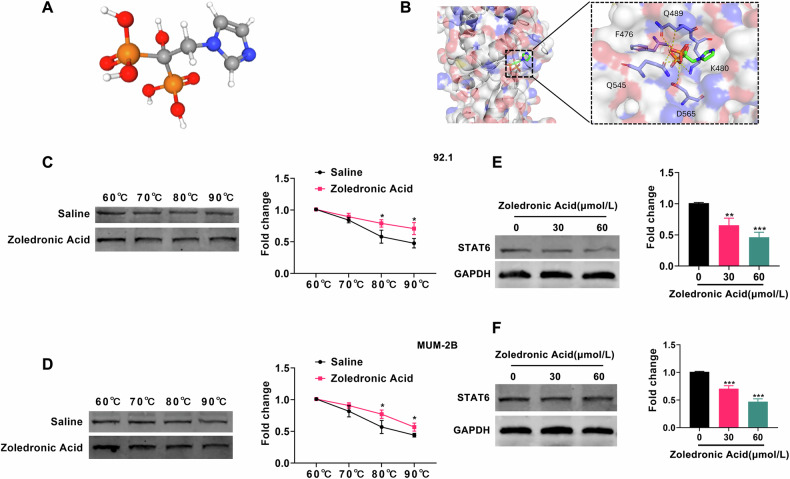
Compelling evidence has revealed a novel function of the STAT pathway in the pathophysiology of uveal melanoma (UM); however, its regulatory mechanisms remain unclear. Here, we analyzed the clinical prognostic value of STAT family genes in UM patients using bioinformatics approaches and found that high STAT6 expression is associated with poor prognosis. Furthermore, cellular experiments and a nude mouse model demonstrated that STAT6 promotes UM progression through the autophagy pathway both in vivo and in vitro. Next, RIP-PCR revealed that STAT6 protein binds to LINC01637 mRNA, which in turn regulates STAT6 expression to promote UM growth. Finally, molecular docking indicated that STAT6 is a target of Zoledronic Acid, which can delay UM tumorigenicity by inhibiting STAT6 expression. Taken together, our results indicate that the STAT6/LINC01637 axis promotes UM progression via autophagy and may serve as a potential therapeutic target for UM.
有强有力的证据表明 STAT 通路在葡萄膜黑色素瘤 (UM) 的病理生理学中具有新的功能;然而,其调节机制尚不清楚。在这里,我们通过生物信息学方法分析了 STAT 家族基因在 UM 患者中的临床预后价值,发现高 STAT6 表达与预后不良相关。此外,细胞实验和裸鼠模型表明,STAT6 通过自噬途径在体内和体外均促进 UM 的进展。接下来,RIP-PCR 揭示 STAT6 蛋白与 LINC01637 mRNA 结合,进而调节 STAT6 的表达以促进 UM 的生长。最后,分子对接表明 STAT6 是唑来膦酸的靶标,唑来膦酸通过抑制 STAT6 的表达可以延缓 UM 的致瘤性。总之,我们的研究结果表明,STAT6/LINC01637 轴通过自噬促进 UM 的进展,可能成为 UM 的潜在治疗靶点。