Department of Pharmaceutical Microbiology, University of Ibadan, Ibadan, Nigeria.
Department of Environmental Biotechnology, Graz University of Technology, Graz, Austria.
Sci Rep. 2024 Oct 1;14(1):22806. doi: 10.1038/s41598-024-68001-w.
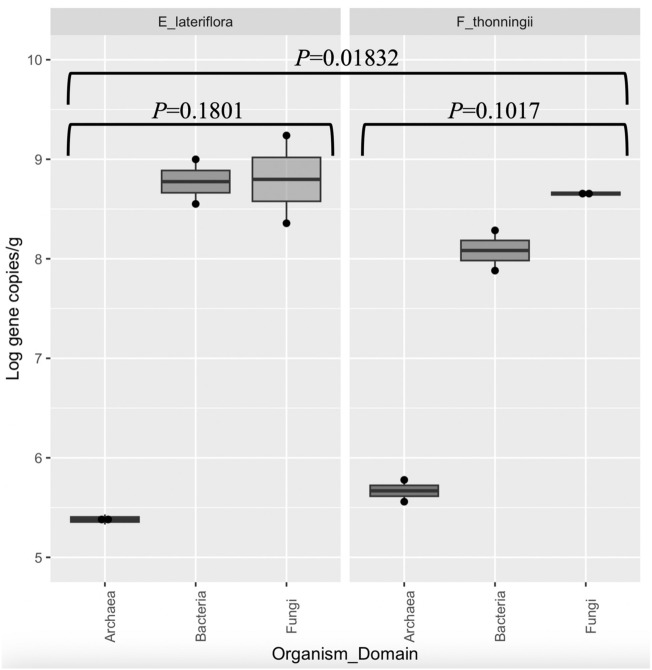
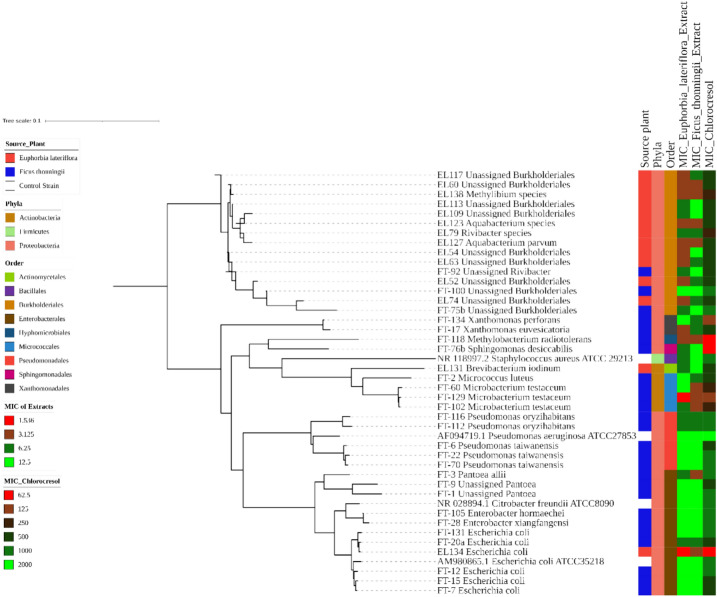
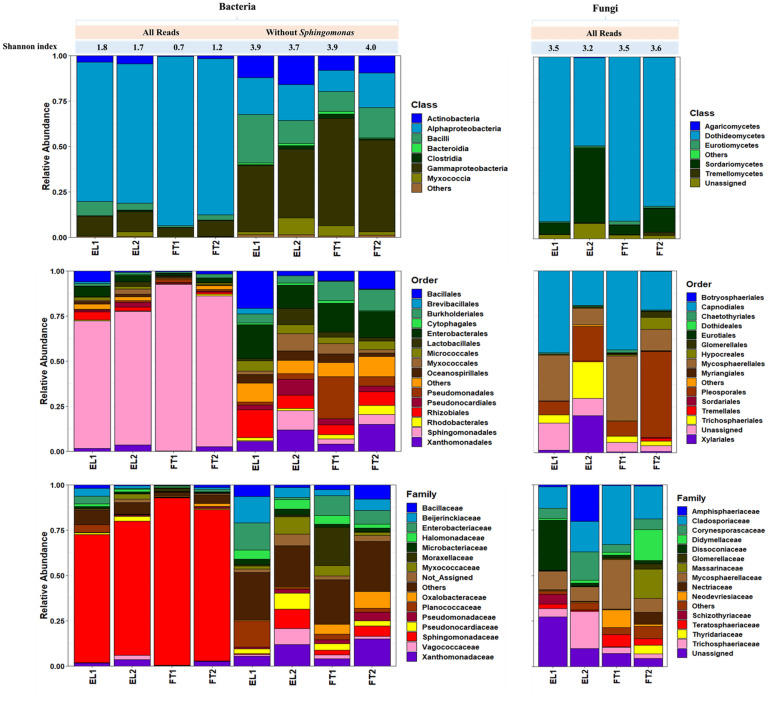
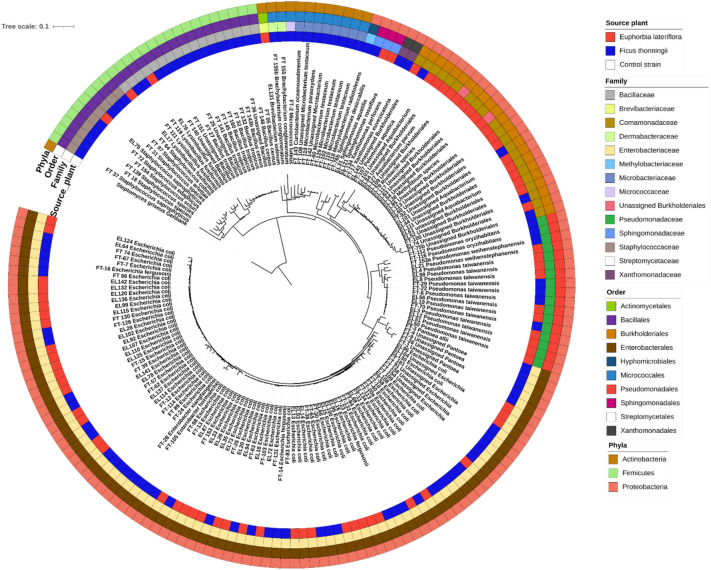
The microbiota of medicinal plants is known to be highly specific and can contribute to medicinal activity. However, the majority of plant species have not yet been studied. Here, we investigated the phyllosphere composition of two common Nigerian medicinal plants, Euphorbia lateriflora and Ficus thonningii, by a polyphasic approach combining analyses of metagenomic DNA and isolates. Microbial abundance estimated via qPCR using specific marker gene primers showed that all leaf samples were densely colonized, with up to 10 per gram of leaf, with higher bacterial and fungal abundance than Archaea. While no statistically significant differences between both plant species were found for abundance, amplicon sequencing of 16S rRNA and ITS genes revealed distinct microbiota compositions. Only seven of the 27 genera isolated were represented on both plants, e.g. dominant Sphingomonas spp., and numerous members of Xanthomonadaceae and Enterobacteriaceae. The most dominant fungal families on both plants were Cladosporiaceae, Mycosphaerellaceae and Trichosphaeriaceae. In addition, 225 plant-specific isolates were identified, with Pseudomonadota and Enterobacteriaceae being dominant. Interestingly, 29 isolates are likely species previously unknown, and 14 of these belong to Burkholderiales. However, a high proportion, 56% and 40% of the isolates from E. lateriflora and F. thonningii, respectively, were characterized as various Escherichia coli. The growth of most of the bacterial isolates was not influenced by extractable secondary metabolites of plants. Our results suggest that a specific and diverse microbial community inhabits the leaves of both E. lateriflora and F. thonningii, including potentially new species and producers of antimicrobials.
药用植物的微生物区系是高度特异的,并能促进药用活性。然而,大多数植物物种尚未被研究过。在这里,我们通过多相方法结合宏基因组 DNA 和分离物分析,研究了两种常见的尼日利亚药用植物,Euphorbia lateriflora 和 Ficus thonningii 的叶际组成。使用特定标记基因引物的 qPCR 估计微生物丰度表明,所有叶片样本都被密集定植,每克叶片高达 10 个,细菌和真菌丰度高于古菌。虽然两种植物之间的丰度没有统计学上的显著差异,但 16S rRNA 和 ITS 基因的扩增子测序显示出不同的微生物群落组成。在这两种植物上,只有 27 个属中的 7 个被代表,例如优势的 Sphingomonas spp.,以及许多 Xanthomonadaceae 和 Enterobacteriaceae 成员。两种植物上最主要的真菌科是 Cladosporiaceae、Mycosphaerellaceae 和 Trichosphaeriaceae。此外,鉴定出 225 种植物特异性分离株,其中以 Pseudomonadota 和 Enterobacteriaceae 为主。有趣的是,29 个分离株可能是以前未知的物种,其中 14 个属于 Burkholderiales。然而,E. lateriflora 和 F. thonningii 分别有 56%和 40%的分离株属于各种 Escherichia coli。大多数细菌分离株的生长不受植物可提取次生代谢物的影响。我们的结果表明,一种特定的、多样化的微生物群落栖息在 E. lateriflora 和 F. thonningii 的叶片中,包括潜在的新物种和抗菌剂的生产者。