Surov Alexey, Zimmermann Silke, Hinnerichs Mattes, Meyer Hans-Jonas, Aghayev Anar, Borggrefe Jan
Department of Radiology, Neuroradiology and Nuclear Medicine, Johannes Wesling University Hospital, Ruhr University Bochum, Hans-Nolte-Str. 1, 32429, Minden, Minden, Germany.
Institute of Laboratory Medicine, Clinical Chemistry and Molecular Diagnostics, University of Leipzig, Leipzig, Germany.
Respir Res. 2024 Oct 1;25(1):356. doi: 10.1186/s12931-024-02977-x.
Accurate prediction of short-term mortality in acute pulmonary embolism (APE) is very important. The aim of the present study was to analyze the prognostic role of radiomics values of epicardial adipose tissue (EAT) in APE.
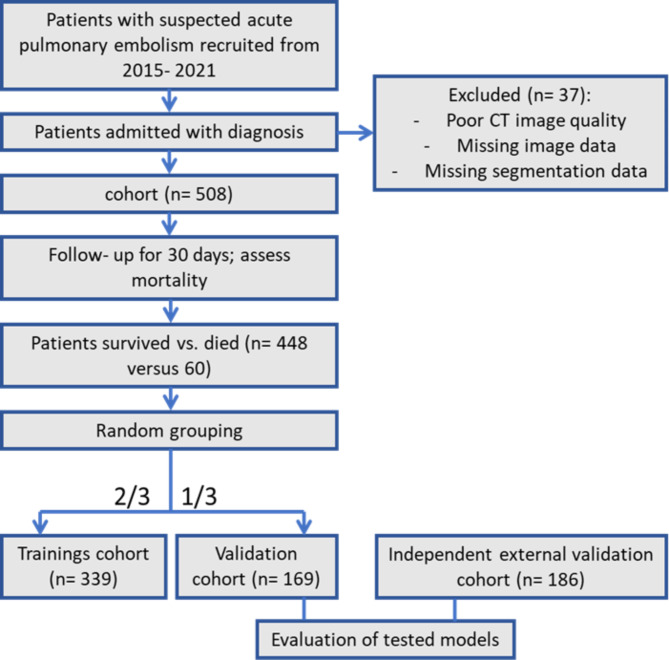
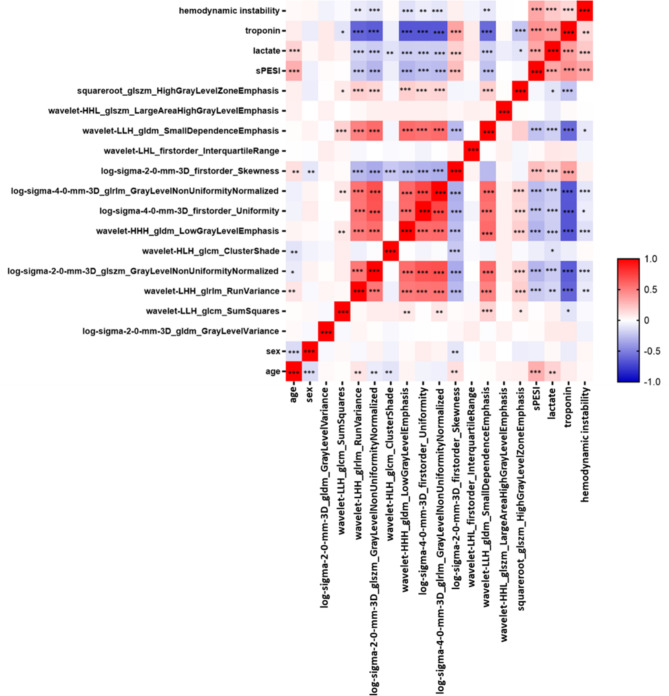
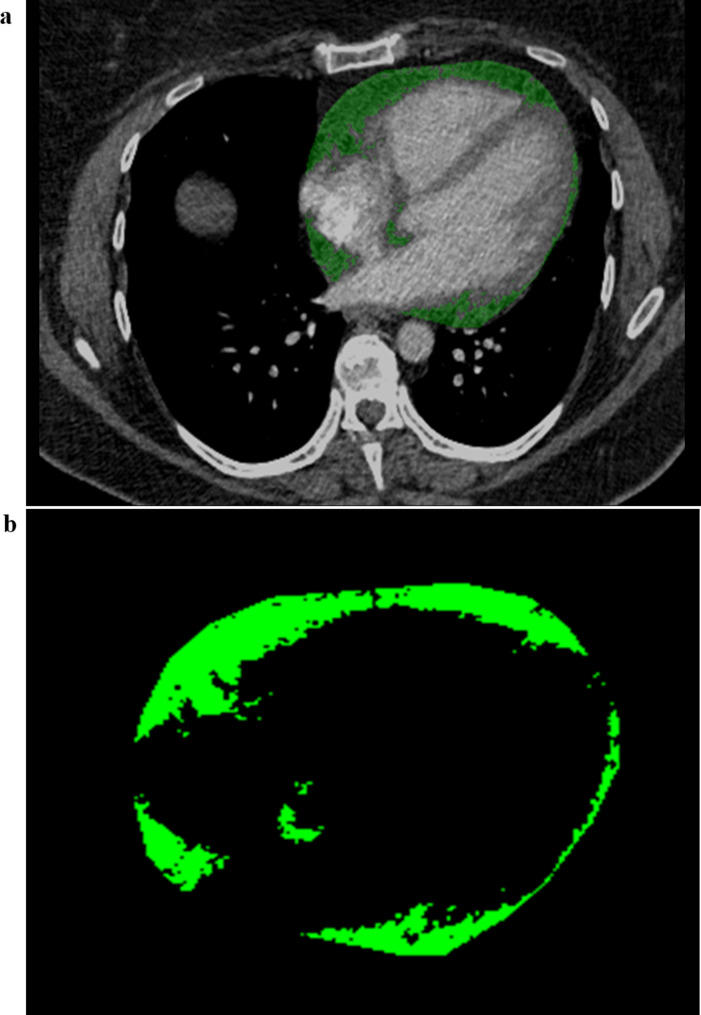
Overall, 508 patients were included into the study, 209 female (42.1%), mean age, 64.7 ± 14.8 years. 4.6%and 12.4% died (7- and 30-day mortality, respectively). For external validation, a cohort of 186 patients was further analysed. 20.2% and 27.7% died (7- and 30-day mortality, respectively). CTPA was performed at admission for every patient before any previous treatment on multi-slice CT scanners. A trained radiologist, blinded to patient outcomes, semiautomatically segmented the EAT on a dedicated workstation using ImageJ software. Extraction of radiomic features was applied using the pyradiomics library. After correction for correlation among features and feature cleansing by random forest and feature ranking, we implemented feature signatures using 247 features of each patient. In total, 26 feature combinations with different feature class combinations were identified. Patients were randomly assigned to a training and a validation cohort with a ratio of 7:3. We characterized two models (30-day and 7-day mortality). The models incorporate a combination of 13 features of seven different image feature classes.
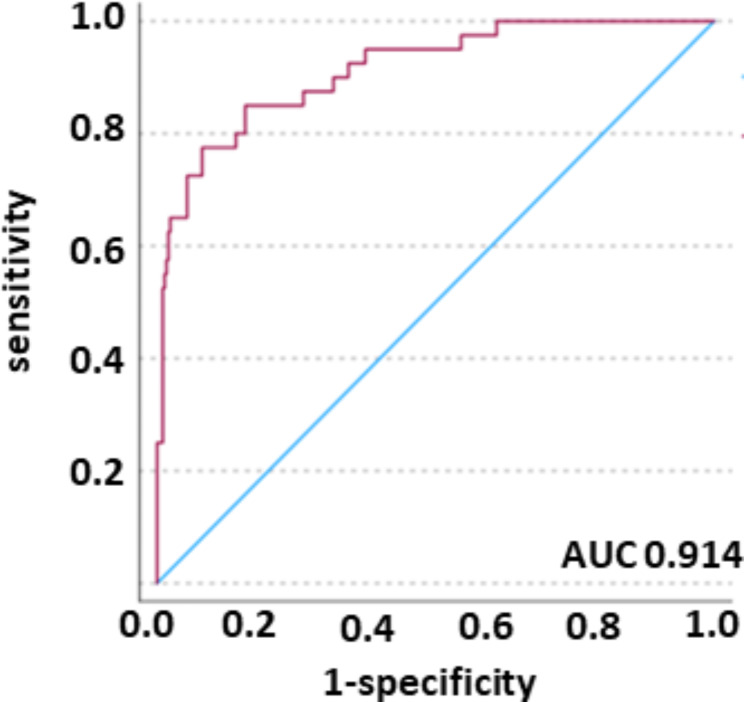
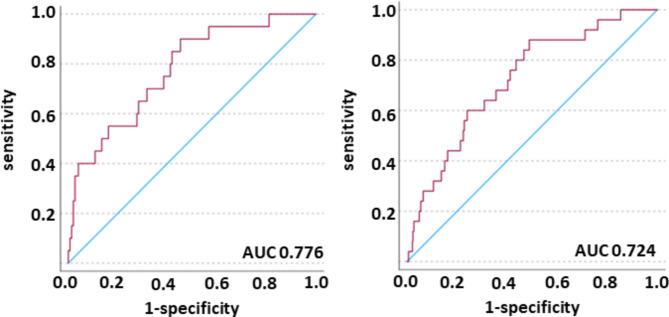
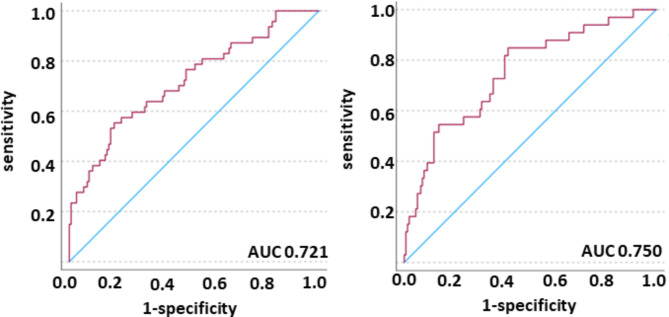
We fitted the characterized models to a validation cohort (n = 169) in order to test accuracy of our models. We observed an AUC of 0.776 (CI 0.671-0.881) and an AUC of 0.724 (CI 0.628-0.820) for the prediction of 30-day mortality and 7-day mortality, respectively. The overall percentage of correct prediction in this regard was 88% and 79% in the validation cohorts. Lastly, the AUC in an independent external validation cohort was 0.721 (CI 0.633-0.808) and 0.750 (CI 0.657-0.842), respectively.
Radiomics parameters of EAT are strongly associated with mortality in patients with APE.
Not applicable.
准确预测急性肺栓塞(APE)患者的短期死亡率非常重要。本研究旨在分析心外膜脂肪组织(EAT)的影像组学特征值在APE中的预后作用。
本研究共纳入508例患者,其中女性209例(42.1%),平均年龄64.7±14.8岁。4.6%和12.4%的患者死亡(分别为7天和30天死亡率)。为进行外部验证,进一步分析了186例患者的队列。20.2%和27.7%的患者死亡(分别为7天和30天死亡率)。所有患者在入院后且在接受任何治疗前均在多层CT扫描仪上进行了CT肺动脉造影(CTPA)。一名对患者预后不知情的训练有素的放射科医生在专用工作站上使用ImageJ软件半自动分割EAT。使用pyradiomics库提取影像组学特征。在对特征之间的相关性进行校正并通过随机森林进行特征清理和特征排序后,我们使用每位患者的247个特征实现了特征签名。总共确定了26种具有不同特征类别组合的特征组合。患者以7:3的比例随机分配到训练队列和验证队列。我们对两个模型(30天和7天死亡率)进行了特征描述。这些模型包含七个不同图像特征类别的13个特征的组合。
我们将已描述特征的模型应用于验证队列(n = 169)以测试模型的准确性。对于30天死亡率和7天死亡率的预测,我们观察到的曲线下面积(AUC)分别为0.776(95%置信区间[CI] 0.671 - 0.881)和0.724(CI 0.628 - 0.820)。在这方面,验证队列中的总体正确预测百分比分别为88%和79%。最后,在独立的外部验证队列中,AUC分别为0.721(CI 0.633 - 0.808)和0.750(CI 0.657 - 0.842)。
EAT的影像组学参数与APE患者的死亡率密切相关。
不适用。