Pacanowski Carly R, Skubisz Christine, Borton David, Ryding Rachel
Department of Health Behavior and Nutrition Sciences, University of Delaware, 26 N College Avenue, Newark, DE, 19712, USA.
Department of Natural and Applied Sciences, Bentley University, Waltham, MA, USA.
J Eat Disord. 2024 Oct 1;12(1):153. doi: 10.1186/s40337-024-01056-2.
Emerging adulthood is a transitory period in which disordered eating (DE) manifests; collecting data on the prevalence of DE among this population as well as demographic and behavioral correlates are important public health goals.
Data from an annual survey of undergraduate students at a large state university from 2019 to 2022 were analyzed, allowing researchers to compare prevalence and correlates before and after the onset of the COVID-19 pandemic using two brief screeners: the SCOFF and Eating Disorder Screener for Primary Care (ESP). We hypothesized that rates of DE would be greater after the onset of COVID-19 as compared to before. We also hypothesized that those identifying as women, reporting higher alcohol or drug use, and contemplating suicide would have greater odds of reporting symptoms consistent with DE.
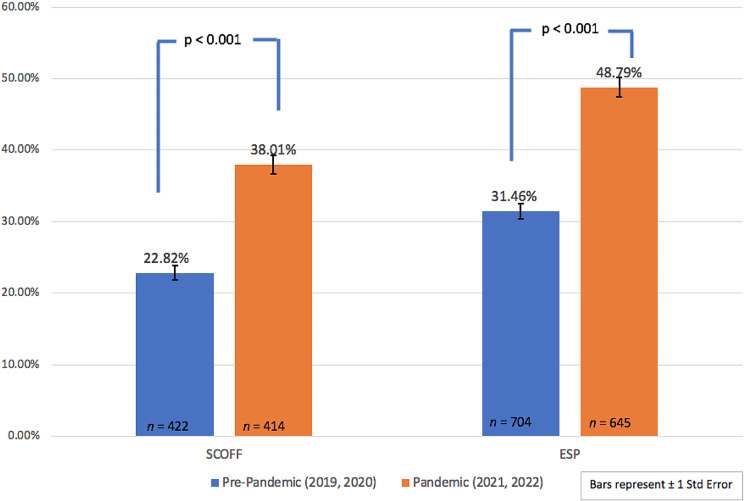
DE was significantly lower in pre-pandemic years compared to pandemic years: ESP pre = 38.01%(n = 704), pandemic = 48.79%(n = 645), p < 0.001; SCOFF pre = 22.82%(n = 422), pandemic = 31.46%(n = 414), p < 0.001. Logistic regressions showed women and students who contemplated suicide reported significantly greater DE, regardless of screener or time period. Inconsistent relationships were found between DE and current substance use.
These findings may inform targeted interventions for those most vulnerable to disordered eating.
青年期是饮食失调开始显现的过渡阶段;收集该人群中饮食失调的患病率以及人口统计学和行为相关性的数据是重要的公共卫生目标。
对一所大型州立大学2019年至2022年本科生年度调查的数据进行了分析,使研究人员能够使用两种简短筛查工具(SCOFF和初级保健饮食失调筛查工具(ESP))比较2019冠状病毒病大流行开始前后的患病率及相关性。我们假设,与大流行前相比,2019冠状病毒病大流行开始后饮食失调的发生率会更高。我们还假设,那些自我认定为女性、报告较高酒精或药物使用量以及有自杀念头的人报告与饮食失调相符症状的几率会更高。
与大流行期间相比,大流行前几年饮食失调的发生率显著更低:ESP大流行前=38.01%(n=704),大流行期间=48.79%(n=645),p<0.001;SCOFF大流行前=22.82%(n=422),大流行期间=31.46%(n=414),p<0.001。逻辑回归显示,无论使用哪种筛查工具或处于哪个时间段,女性和有自杀念头的学生报告的饮食失调情况显著更严重。在饮食失调与当前物质使用之间发现了不一致的关系。
这些发现可能为针对那些最易出现饮食失调的人群的有针对性干预措施提供参考。