Wu Fiona, Ibarburu Gema H, Grimes Caris
Department of General Surgery, East Sussex Healthcare NHS Trust Conquest Hospital, The Ridge Hastings UK.
TriNetX Parque Empresarial Prado del Espino Madrid Spain.
Health Sci Rep. 2024 Sep 29;7(10):e70107. doi: 10.1002/hsr2.70107. eCollection 2024 Oct.
The coronavirus disease 2019 (COVID-19) pandemic has affected the management of inflammatory bowel disease (IBD) patients. Elective operations and surveillance endoscopies were postponed for IBD patients to preserve healthcare resources and to prevent the spread of COVID-19. This study aimed to describe the trends and outcomes of IBD surgery during the pandemic.
This was a retrospective propensity score-matched analysis using data extracted from TriNetX, a multi-institutional research database. IBD patients admitted for surgery were identified between March 2019 to February 2020 (prepandemic) and March 2020 to February 2023 (pandemic). The monthly volume of IBD surgical procedures was compared during the pandemic to the prepandemic period. After matching, the risk of adverse outcomes following IBD surgery was compared between the 3 years of the pandemic compared to the prepandemic cohort.
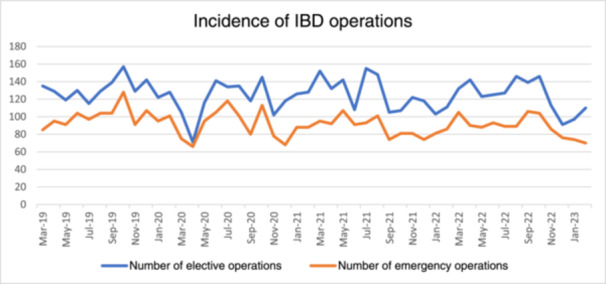
There was a reduction in both elective and emergency IBD operations during the pandemic. These trends were not significant. After matching, the risks of returning to theaters and hospital readmission were comparable across the 3 years of the pandemic. In the first and second years of the pandemic, elective patients were at a greater risk of mortality (risk ratio [RR], 2; 95% confidence interval [CI], 1.160-3.448 and RR, 1.778; 95% CI, 1.003-3.150, respectively) and the emergency cohort had a higher risk of critical care admission (RR, 1.759; 95% CI, 1.126-2.747 and RR, 1.742; 95% CI, 1.131-2.682, respectively).
Our study highlights the impact of the COVID-19 pandemic on the management of IBD patients undergoing surgery. These results provide insights into the management of IBD surgery during times of crisis and can help guide decision-making and resource allocation for IBD patients requiring surgical intervention.
2019年冠状病毒病(COVID-19)大流行影响了炎症性肠病(IBD)患者的管理。为了保存医疗资源并防止COVID-19传播,IBD患者的择期手术和监测性内镜检查被推迟。本研究旨在描述大流行期间IBD手术的趋势和结果。
这是一项回顾性倾向评分匹配分析,使用从多机构研究数据库TriNetX中提取的数据。确定2019年3月至2020年2月(大流行前)和2020年3月至2023年2月(大流行期间)因手术入院的IBD患者。将大流行期间IBD手术的月手术量与大流行前时期进行比较。匹配后,比较大流行的3年与大流行前队列中IBD手术后不良结局的风险。
大流行期间择期和急诊IBD手术均减少。这些趋势不显著。匹配后,大流行的3年中返回手术室和再次入院的风险相当。在大流行的第一年和第二年,择期患者的死亡风险更高(风险比[RR]分别为2;95%置信区间[CI]为1.160 - 3.448和RR为1.778;95% CI为1.003 - 3.150),急诊队列进入重症监护的风险更高(RR分别为1.759;95% CI为1.126 - 2.747和RR为1.742;95% CI为1.131 - 2.682)。
我们的研究突出了COVID-19大流行对接受手术的IBD患者管理的影响。这些结果为危机时期IBD手术的管理提供了见解,并有助于指导需要手术干预的IBD患者的决策制定和资源分配。