Truong Camille, Gabbarini Luciano A, Moretto Alicia, Escobar Julio M, Smith Matthew E
Royal Botanic Gardens Victoria Melbourne Victoria Australia.
Departamento de Ciencia y Tecnología, Centro de Bioquímica y Microbiología de Suelos Universidad Nacional de Quilmes Bernal Argentina.
Ecol Evol. 2024 Sep 29;14(10):e70299. doi: 10.1002/ece3.70299. eCollection 2024 Oct.
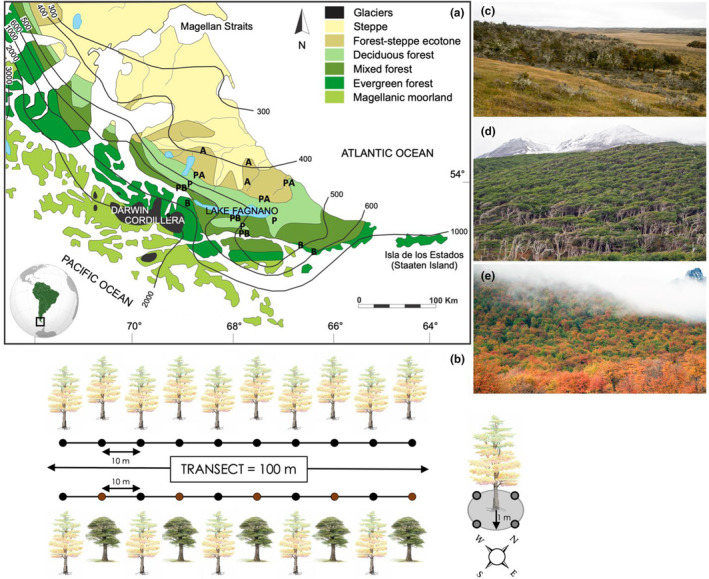
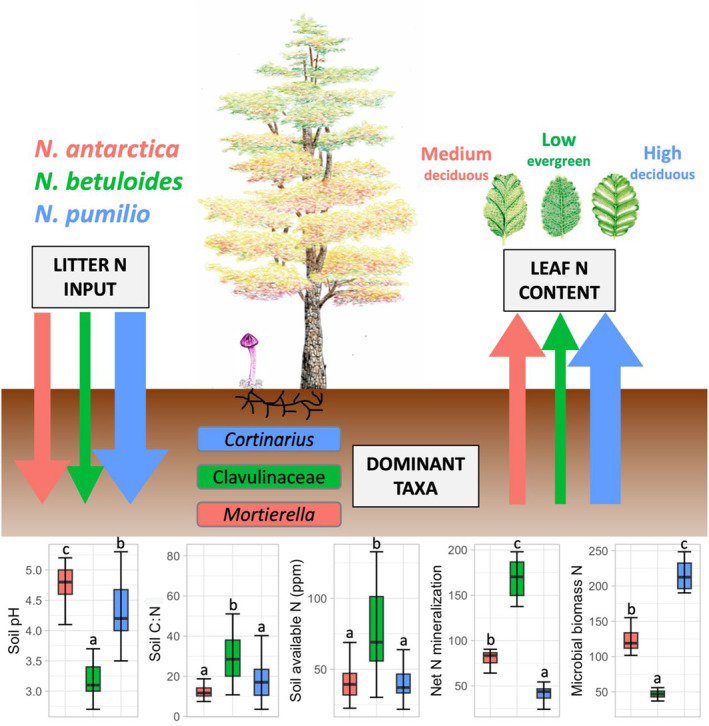
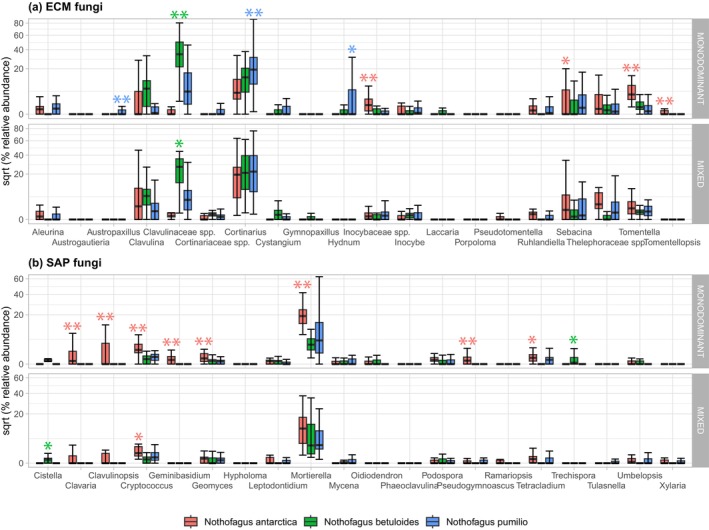
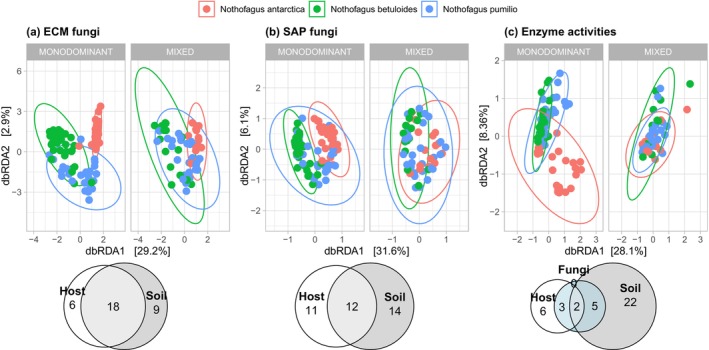
Subantarctic forests are the southernmost forests in the world, with negligible atmospheric nitrogen (N) deposition. Most paradigms about the role of ectomycorrhizal (ECM) fungi in N cycling and plant N uptake at high latitudes have been tested in boreal coniferous forests, while in the southern hemisphere, ECM hosts are primarily angiosperms. Using ITS1 meta-barcoding, we characterized ECM and saprotrophic fungal communities in evergreen and deciduous forests forming monodominant and mixed stands in the archipelago of Tierra del Fuego (Chile and Argentina). We assessed the N economy of by correlating host species with fungal relative abundances, edaphic variables, net N mineralization, microbial biomass N and the activity of eight extracellular soil enzymes activities. The N economy of deciduous forests was strikingly similar to boreal coniferous forests, with the lowest inorganic N availability and net N mineralization, in correlation to higher relative abundances of ECM fungi with enzymatic capacity for organic N mobilization (genus ). In contrast, the N economy of evergreen forests was predominantly inorganic and correlated with ECM lineages from the family Clavulinaceae, in acidic soils with poor drainage. Grassy understory vegetation in deciduous forests likely promoted saprotrophic fungi (i.e., genus ) in correlation with higher activities of carbon-degrading enzymes. Differences between hosts did not persist in mixed forests, illustrating the range of soil fertility of these ECM angiosperms and the underlying effects of soil and climate on distribution and N cycling in southern Patagonia.
亚南极森林是世界上最南端的森林,大气氮(N)沉降可忽略不计。关于外生菌根(ECM)真菌在高纬度地区氮循环和植物氮吸收中作用的大多数范例已在北方针叶林中得到验证,而在南半球,ECM宿主主要是被子植物。利用ITS1元条形码技术,我们对火地岛群岛(智利和阿根廷)形成单一优势林和混交林的常绿林和落叶林中的ECM和腐生真菌群落进行了特征分析。我们通过将宿主物种与真菌相对丰度、土壤变量、净氮矿化、微生物生物量氮以及八种细胞外土壤酶活性相关联,评估了氮经济状况。落叶林的氮经济状况与北方针叶林惊人地相似,无机氮有效性和净氮矿化率最低,这与具有有机氮动员酶能力的ECM真菌(属)相对丰度较高有关。相比之下,常绿林的氮经济主要是无机的,并且与来自棒瑚菌科的ECM谱系相关,存在于排水不良的酸性土壤中。落叶林下的草本植被可能促进了腐生真菌(即属)的生长,这与碳降解酶的较高活性相关。宿主之间的差异在混交林中并不持续,这说明了这些ECM被子植物的土壤肥力范围以及土壤和气候对巴塔哥尼亚南部ECM分布和氮循环的潜在影响。