Tyagi Ashima, Srivastava Nikhil, Rana Vivek, Kaushik Noopur, Goel Sumit, Khera Amit K
Department of Pediatric and Preventive Dentistry, Swami Vivekanand Subharti University, Meerut, Uttar Pradesh, India.
Department of Pediatric and Preventive Dentistry, Subharti Dental College, Meerut, Uttar Pradesh, India.
Int J Clin Pediatr Dent. 2024 May;17(5):558-564. doi: 10.5005/jp-journals-10005-2860.
Age assessment is useful in various fields of dentistry due to its ability to influence the planning of dental treatments. Dental age estimation methods are specifically based on age-related variables observed in two-dimensional (2D) radiographs in the dentition in terms of the time of emergence and are considered reliable in determining the chronological age; however, the inevitable problems of orientation errors found in 2D can be eliminated using cone beam computed tomography (CBCT).
This study aimed to compare the accuracy of different radiological dental age estimation methods using CBCT in relation to the chronological age of children.
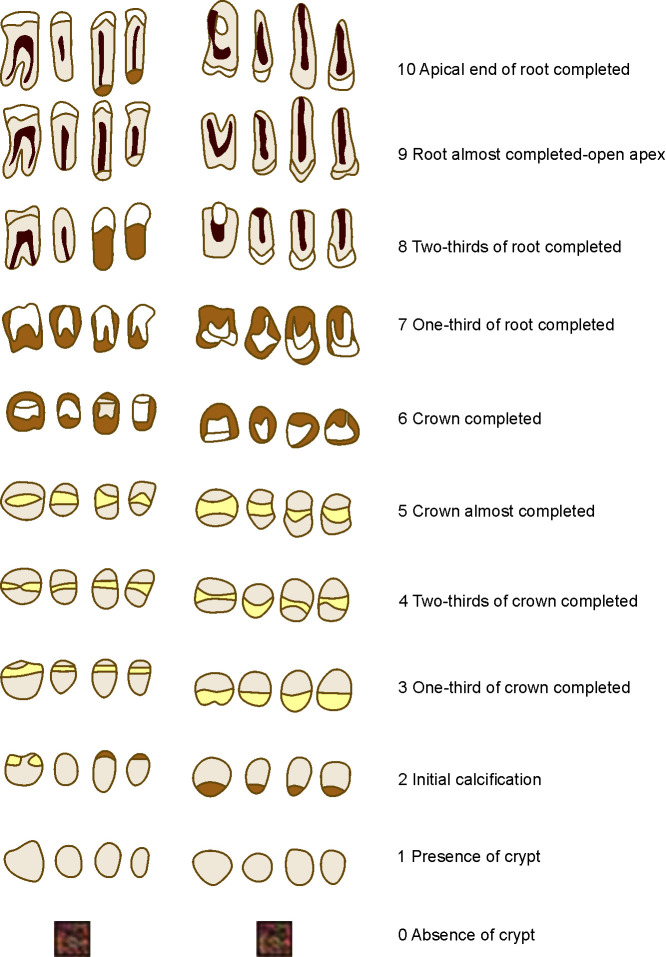
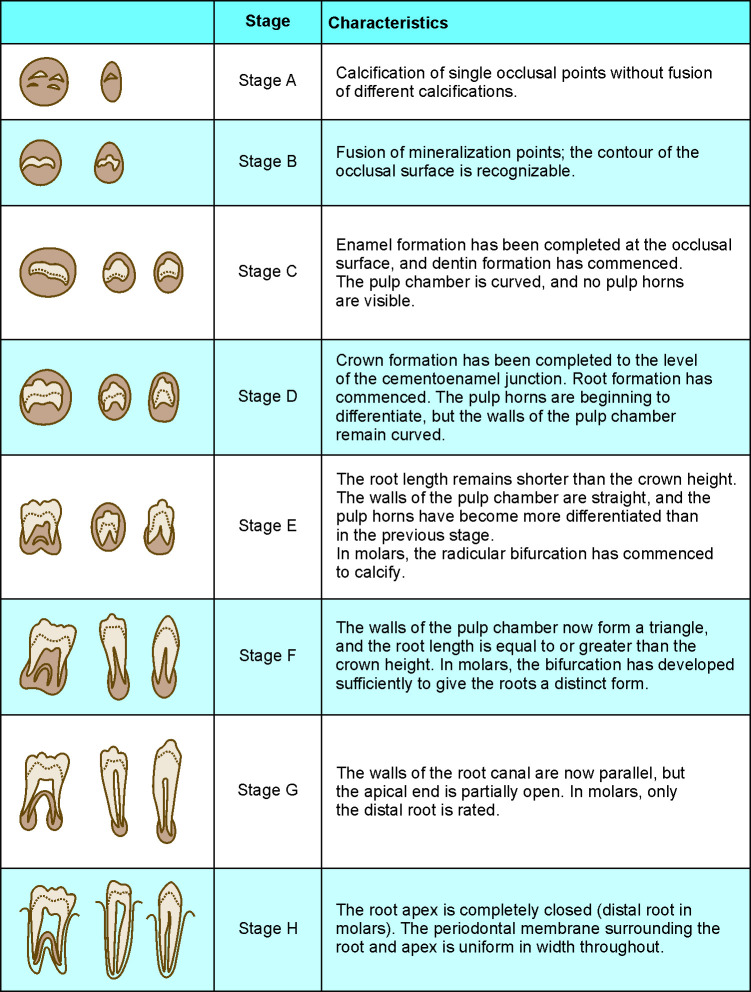
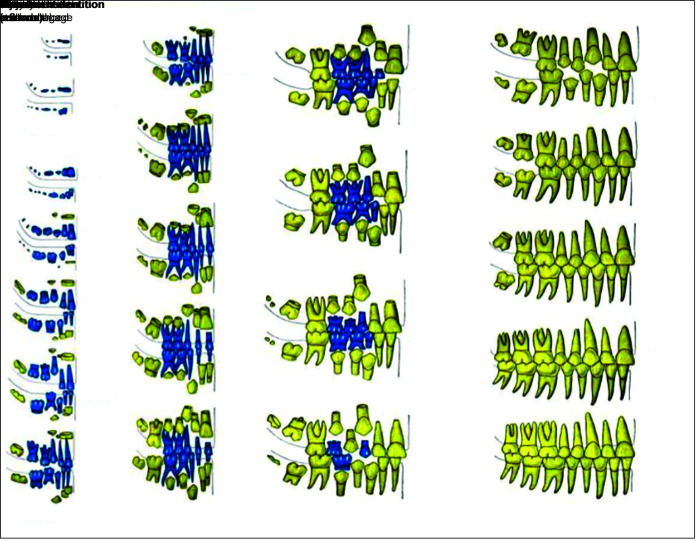
A total of 100 CBCT images of patients in the age-group of 8-15 years requiring orthodontic treatment were obtained from December 2019 to August 2022. The exact chronological age was determined through valid proof, that is, aadhar card or birth certificate. The dental age of the children was assessed using all four methods-Nolla's method (NM), Demirjian method (DM), Schour and Massler (S&M), and Cameriere method (CM).
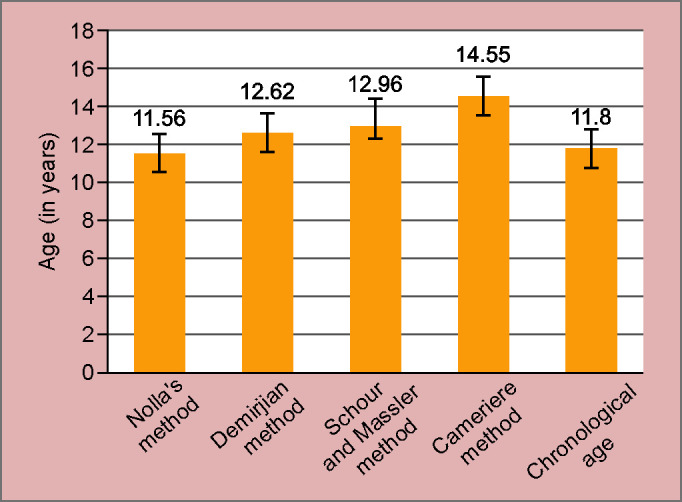
The results found that NM underestimated the mean age by 0.24 years, while DM overestimated the mean age by 0.82 years. Both showed statistically significant differences based on the standard deviation (SD) ( < 0.05). S&M and CM also overestimated the mean age by 1.16 years and 2.75 years respectively, but with statistically nonsignificant differences ( > 0.05).
Among the four tested radiographic methods, the best accuracy was found with NM, which tended to underestimate but was closest to the chronological age. CBCT provided better age estimation values without image distortion.
Tyagi A, Srivastava N, Rana V, Accuracy of Different Dental Age Estimation Methods Using Cone Beam Computed Tomography: A Comparative Study. Int J Clin Pediatr Dent 2024;17(5):558-564.
年龄评估在牙科的各个领域都很有用,因为它能够影响牙科治疗计划。牙科年龄估计方法具体基于在牙列的二维(2D)X线片上观察到的与年龄相关的变量,如萌出时间,并且在确定实际年龄方面被认为是可靠的;然而,二维中不可避免的方向误差问题可以使用锥形束计算机断层扫描(CBCT)来消除。
本研究旨在比较使用CBCT的不同放射学牙科年龄估计方法相对于儿童实际年龄的准确性。
2019年12月至2022年8月期间,共获取了100例8 - 15岁需要正畸治疗患者的CBCT图像。通过有效证明,即身份证或出生证明确定确切的实际年龄。使用所有四种方法评估儿童的牙科年龄——诺拉法(NM)、德米尔坚法(DM)、舒尔和马斯勒法(S&M)以及卡梅里埃法(CM)。
结果发现,NM将平均年龄低估了0.24岁,而DM将平均年龄高估了0.82岁。基于标准差(SD),两者均显示出统计学上的显著差异(<0.05)。S&M和CM也分别将平均年龄高估了1.16岁和2.75岁,但差异无统计学意义(>0.05)。
在四种测试的放射学方法中,NM的准确性最高,它倾向于低估但最接近实际年龄。CBCT提供了更好的年龄估计值且无图像失真。
Tyagi A, Srivastava N, Rana V, 使用锥形束计算机断层扫描的不同牙科年龄估计方法的准确性:一项比较研究。《国际临床儿科牙科杂志》2024;17(5):558 - 564。