Michailidis Antonios, Panos Athanasios, Samoladas Efthimios, Dimou Georgios, Mingou Georgia, Kosmoliaptsis Panagiotis, Arvaniti Maria, Giankoulof Christos, Petsatodis Evangelos
Department of Interventional Radiology, Georgios Papanikolaou General Hospital of Thessaloniki, Thessaloniki 57010, Greece.
Department of 1 Orthopaedic Clinic, Georgios Papanikolaou General Hospital of Thessaloniki, Aristotle University of Thessaloniki, Thessaloniki 57010, Greece.
World J Radiol. 2024 Sep 28;16(9):389-397. doi: 10.4329/wjr.v16.i9.389.
Osteoid osteoma is a benign bone tumor with characteristic clinical symptomatology. The selected method for its treatment is percutaneous radiofrequency ablation. However, percutaneous cryoablation is an alternative method with certain advantages.
To evaluate percutaneous computed tomography (CT)-guided cryoablation for the treatment of osteoid osteoma in young patients and adults.
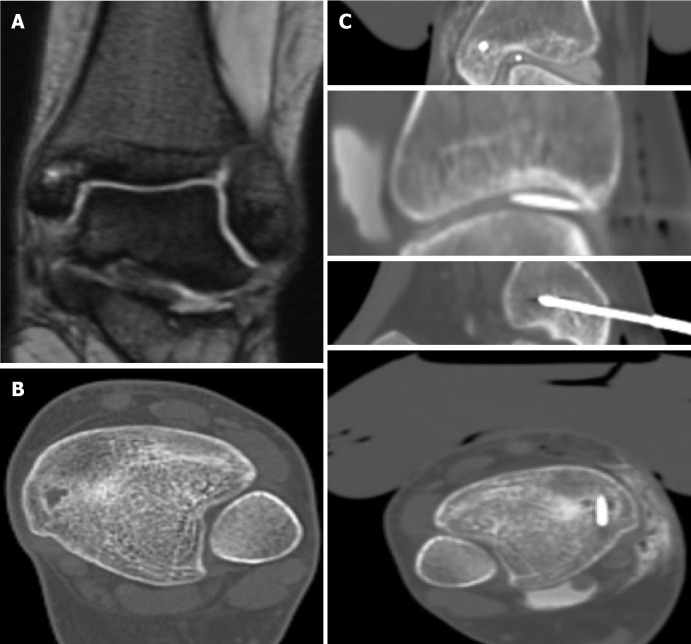
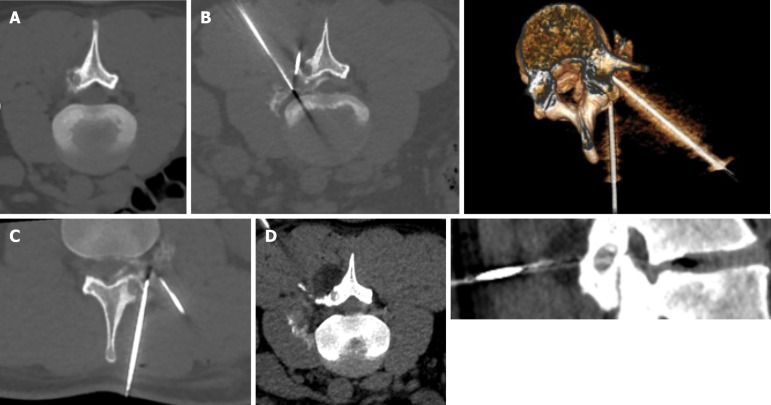
A total of 25 patients were treated with percutaneous CT- guided cryoablation for osteoid osteomas between October 2020 and March 2023 at a single institution. All patients were above 14-years-old (mean age, 24-years-old), and all procedures were performed under local anesthesia. Of the 25 patients, 8 were female and 17 were male. Tumor sites included the femur ( = 9), medial malleolus ( = 4), sacral ala ( = 4), facets ( = 4), humerus ( = 3), and tibia ( = 1). One cryoprobe was used in each procedure and, when possible, the lesion was covered by the ice-ball using an extraosseous position without penetrating the nidus. All necessary thermal protective techniques were used depending on the anatomical structure at risk.
All patients treated had complete response (100% clinical success rate) starting on the day of the procedure. Technical success was achieved in all cases. Visual analog scale (VAS) scores at 1 year were 0, compared to a mean VAS score of 8.5 ± 1 (SD) before the procedure. No recurrences were reported at the 1-year follow-up and no complications were observed. In 11/25 cases, an extraosseous position of the cryoprobe was used with less procedural time achieving technical and clinical success and no complications with less patient discomfort. All patients were discharged from the hospital on the same day as the procedure.
Cryoablation of osteoid osteomas is an efficacious and safe procedure with durable clinical results. Its greatest advantage is that the procedure can be performed under local anesthesia using an extraosseous position of the cryoprobe when possible.
骨样骨瘤是一种具有特征性临床症状的良性骨肿瘤。其首选治疗方法是经皮射频消融。然而,经皮冷冻消融是一种具有某些优势的替代方法。
评估经皮计算机断层扫描(CT)引导下冷冻消融治疗青少年和成人骨样骨瘤的效果。
2020年10月至2023年3月期间,在一家机构对25例骨样骨瘤患者进行了经皮CT引导下冷冻消融治疗。所有患者年龄均在14岁以上(平均年龄24岁),所有手术均在局部麻醉下进行。25例患者中,女性8例,男性17例。肿瘤部位包括股骨(9例)、内踝(4例)、骶骨翼(4例)、关节面(4例)、肱骨(3例)和胫骨(1例)。每次手术使用一根冷冻探针,尽可能通过骨外位置使冰球覆盖病变,而不穿透瘤巢。根据有风险的解剖结构采用所有必要的热保护技术。
所有接受治疗的患者在手术当天开始均获得完全缓解(临床成功率100%)。所有病例均取得技术成功。1年时视觉模拟量表(VAS)评分为0,而手术前平均VAS评分为8.5±1(标准差)。1年随访时未报告复发,也未观察到并发症。在25例中的11例中,采用了冷冻探针的骨外位置,手术时间更短,实现了技术和临床成功,无并发症,患者不适感更小。所有患者均在手术当天出院。
骨样骨瘤的冷冻消融是一种有效且安全的手术,临床效果持久。其最大优势在于,该手术可在局部麻醉下进行,尽可能采用冷冻探针的骨外位置。