Ohi Kazutaka, Nishizawa Daisuke, Saito Taiga, Goto Taichi, Kubota Itsuki, Shinoda Tomoya, Fujikane Daisuke, Hasegawa Junko, Sato Naomi, Tanioka Fumihiko, Sugimura Haruhiko, Ikeda Kazutaka, Shioiri Toshiki
Department of Psychiatry, Gifu University Graduate School of Medicine, Gifu, Japan.
Department of General Internal Medicine, Kanazawa Medical University, Ishikawa, Japan.
Transl Psychiatry. 2024 Oct 2;14(1):404. doi: 10.1038/s41398-024-03105-5.
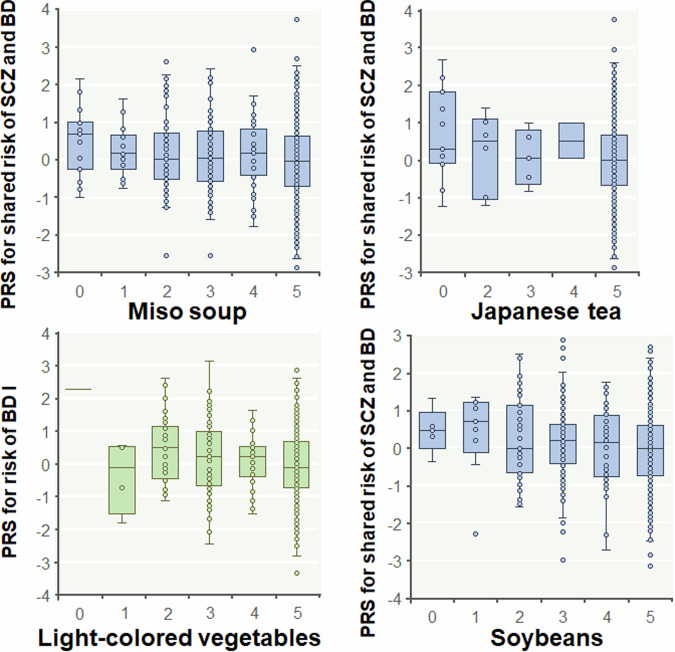
Dietary habits may impact the prevention and management of schizophrenia (SCZ) and bipolar disorder (BD), and genetic and environmental factors can influence both these habits and these disorders. This study investigated the effects of genetic predispositions to SCZ and BD on current dietary habits among older adults with lifestyle-related diseases, potentially offering insights for preventive mental health strategies. A cohort of 730 older patients who were diagnosed with or suspected of having lifestyle-related diseases was assessed for eight current dietary categories: miso soup, Japanese tea, green and yellow vegetables, light-colored vegetables, fruits, pickles, meats, and soybeans. Polygenic risk scores (PRSs) for the risk of SCZ and BD, including BD types I and II, the shared risk of SCZ and BD, and the differentiation of SCZ from BD, were calculated utilizing data from large-scale genome-wide association studies (GWASs). Our findings revealed that PRSs for SCZ and BD risk significantly influenced specific dietary habits, particularly decreased consumption of nutrient-rich foods such as light-colored vegetables (SCZ, R = 0.0096, p = 3.54 × 10; BD, R = 0.0074, p = 9.09 × 10) and soybeans (SCZ, R = 0.0061, p = 0.019; BD, R = 0.014, p = 8.38 × 10). Notable differences in dietary effects were observed between PRSs for BD I and BD II, with a more pronounced impact associated with BD I (e.g., light-colored vegetables, BD I, R = 0.015, p = 3.11 × 10; BD II, p > 0.05). Moreover, shared genetic factors for SCZ and BD were correlated with lower intakes of miso soup (R = 0.013, p = 1.21 × 10), Japanese tea (R = 0.0092, p = 5.59 × 10), light-colored vegetables (R = 0.010, p = 2.92 × 10), and soybeans (R = 0.014, p = 3.13 × 10). No significant correlations were found between PRSs for differentiating SCZ from BD and any dietary patterns (p > 6.25 × 10). Genetic risks shared by individuals with SCZ and BD may influence dietary choices in older adults, emphasizing the potential for dietary modifications as part of comprehensive strategies for the prevention of the SCZ and BD onset, as well as for the treatment of individuals at risk of or diagnosed with SCZ and BD.
饮食习惯可能会影响精神分裂症(SCZ)和双相情感障碍(BD)的预防与管理,而遗传和环境因素会对这些饮食习惯以及这两种疾病产生影响。本研究调查了SCZ和BD的遗传易感性对患有生活方式相关疾病的老年人当前饮食习惯的影响,这可能为预防性心理健康策略提供见解。对730名被诊断患有或疑似患有生活方式相关疾病的老年患者进行了评估,涉及当前的八个饮食类别:味噌汤、日本茶、绿色和黄色蔬菜、浅色蔬菜、水果、泡菜、肉类和大豆。利用大规模全基因组关联研究(GWAS)的数据,计算了SCZ和BD风险的多基因风险评分(PRSs),包括I型和II型BD、SCZ和BD的共同风险以及SCZ与BD的区分。我们的研究结果显示,SCZ和BD风险的PRSs显著影响特定的饮食习惯,特别是富含营养的食物摄入量减少,如浅色蔬菜(SCZ,R = 0.0096,p = 3.54×10;BD,R = 0.0074,p = 9.09×10)和大豆(SCZ,R = 0.0061,p = 0.019;BD,R = 0.014,p = 8.38×10)。观察到I型BD和II型BD的PRSs在饮食影响方面存在显著差异,I型BD的影响更为明显(例如,浅色蔬菜,I型BD,R = 0.015,p = 3.11×10;II型BD,p>0.05)。此外,SCZ和BD的共同遗传因素与味噌汤(R = 0.013,p = 1.21×10)、日本茶(R = 0.0092,p = 5.59×10)、浅色蔬菜(R = 0.010,p = 2.92×10)和大豆(R = 0.014,p = 3.13×10)的摄入量较低相关。在区分SCZ与BD的PRSs和任何饮食模式之间未发现显著相关性(p>6.25×10)。SCZ和BD患者共有的遗传风险可能会影响老年人的饮食选择,这强调了饮食调整作为预防SCZ和BD发病以及治疗有SCZ和BD风险或已被诊断患有SCZ和BD的个体的综合策略一部分的潜力。