de Laat Vincent, Topal Halit, Spotbeen Xander, Talebi Ali, Dehairs Jonas, Idkowiak Jakub, Vanderhoydonc Frank, Ostyn Tessa, Zhao Peihua, Jacquemyn Maarten, Wölk Michele, Sablina Anna, Augustyns Koen, Vanden Berghe Tom, Roskams Tania, Daelemans Dirk, Fedorova Maria, Topal Baki, Swinnen Johannes V
Laboratory of Lipid Metabolism and Cancer, KU Leuven and Leuven Cancer Institute (LKI), Leuven, Belgium.
Abdominal Surgical Oncology, University Hospitals Leuven, KU Leuven and Leuven Cancer Institute (LKI), Leuven, Belgium.
Nat Commun. 2024 Oct 2;15(1):8540. doi: 10.1038/s41467-024-52978-z.
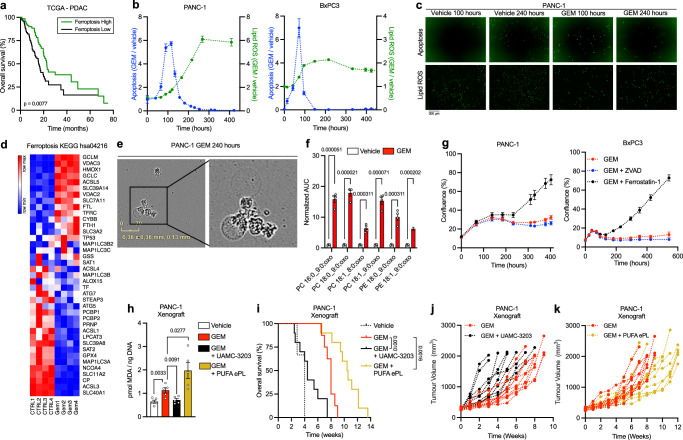
A spontaneously occurring temperature increase in solid tumors has been reported sporadically, but is largely overlooked in terms of cancer biology. Here we show that temperature is increased in tumors of patients with pancreatic ductal adenocarcinoma (PDAC) and explore how this could affect therapy response. By mimicking this observation in PDAC cell lines, we demonstrate that through adaptive changes in lipid metabolism, the temperature increase found in human PDAC confers protection to lipid peroxidation and contributes to gemcitabine resistance. Consistent with the recently uncovered role of p38 MAPK in ferroptotic cell death, we find that the reduction in lipid peroxidation potential following adaptation to tumoral temperature allows for p38 MAPK inhibition, conferring chemoresistance. As an increase in tumoral temperature is observed in several other tumor types, our findings warrant taking tumoral temperature into account in subsequent studies related to ferroptosis and therapy resistance. More broadly, our findings indicate that tumoral temperature affects cancer biology.
实体瘤中自发出现的温度升高已有零星报道,但在癌症生物学方面大多被忽视。在此,我们表明胰腺导管腺癌(PDAC)患者的肿瘤中温度会升高,并探讨这如何影响治疗反应。通过在PDAC细胞系中模拟这一观察结果,我们证明,通过脂质代谢的适应性变化,人类PDAC中发现的温度升高赋予了对脂质过氧化的保护作用,并导致吉西他滨耐药。与最近发现的p38丝裂原活化蛋白激酶(p38 MAPK)在铁死亡性细胞死亡中的作用一致,我们发现适应肿瘤温度后脂质过氧化潜能的降低使得p38 MAPK受到抑制,从而产生化疗耐药性。由于在其他几种肿瘤类型中也观察到肿瘤温度升高,我们的研究结果表明在随后与铁死亡和治疗耐药性相关的研究中需要考虑肿瘤温度。更广泛地说,我们的研究结果表明肿瘤温度会影响癌症生物学。