Yakimov Boris, Buiankin Kirill, Denisenko Georgy, Bardadin Ilia, Pavlov Oleg, Shitova Yuliya, Yuriev Alexey, Pankratieva Lyudmila, Pukhov Alexander, Shkoda Andrey, Shirshin Evgeny
Faculty of Physics, M.V.Lomonosov Moscow State University, 1-2 Leninskie Gory, 119234, Moscow, Russia.
Laboratory of Clinical Biophotonics, Biomedical Science and Technology Park, Sechenov First Moscow State Medical University, Trubetskaya 8, Moscow, 119048, Russia.
Sci Data. 2024 Oct 2;11(1):1070. doi: 10.1038/s41597-024-03895-9.
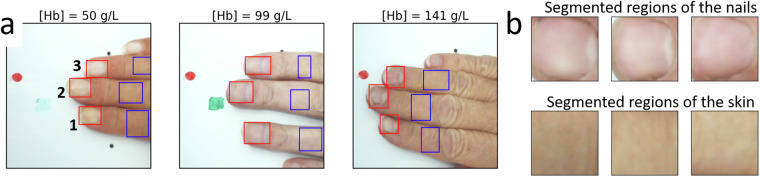
Anaemia, a decrease in total concentration of haemoglobin (Hb) in blood, affects substantial percentage of the population worldwide. Currently, the gold standard for determining the Hb level is the invasive analysis of venous blood. Yet, more and more research groups demonstrate the possibility of non-invasive Hb assessment using white light imaging of tissue sites where Hb is the main chromophore, in particular, fingernails. Despite the promising declarations, non-invasive Hb assessment via RGB-imaging is still poorly used in practice. The main reason is the difficulty in establishing the true accuracy of the methods presented in different works since they are tested on private datasets collected under different experimental conditions. Here we present an open dataset containing RGB images of skin and fingernails for patients with a known level of Hb, thus providing a single benchmark for researchers and engineers in the field, aimed at fostering translation of non-invasive imaging methods to the bedside.
贫血是指血液中血红蛋白(Hb)的总浓度降低,影响着全球相当大比例的人口。目前,测定Hb水平的金标准是对静脉血进行侵入性分析。然而,越来越多的研究团队证明,利用Hb作为主要发色团的组织部位(特别是指甲)的白光成像进行无创Hb评估是可行的。尽管有这些前景广阔的声明,但通过RGB成像进行无创Hb评估在实践中的应用仍然很少。主要原因是难以确定不同研究中所提出方法的真正准确性,因为这些方法是在不同实验条件下收集的私人数据集上进行测试的。在此,我们展示了一个开放数据集,其中包含已知Hb水平患者的皮肤和指甲的RGB图像,从而为该领域的研究人员和工程师提供了一个统一的基准,旨在推动无创成像方法应用于临床床边。