Instituto Nacional de Saúde, Ministério da Saúde, Maputo, Mozambique.
U.S. Military HIV Research Program, CIDR, Walter Reed Army Institute of Research, 6720A Rockledge Drive, Suite 400 Silver Spring, Bethesda, MD, 20817, USA.
BMC Public Health. 2024 Oct 2;24(1):2692. doi: 10.1186/s12889-024-20032-8.
Sub-Saharan Africa has a high burden of HIV, particularly among female sex workers (FSW) and men who have sex with men (MSM). Future clinical trials to evaluate vaccines and other interventions to prevent HIV will need to enroll populations with high HIV incidence. We conducted an observational study of HIV incidence among men and women with multiple sexual partners-including MSM and FSW-in Maputo, Mozambique, in order to prepare the country to conduct future efficacy trials of candidate HIV vaccines and other HIV prevention products.
We conducted a prospective observational HIV incidence study in Maputo, Mozambique, that enrolled adults aged 18-35 years, without HIV, who had two or more sexual partners in the preceding three months. Recruitment strategies prioritized participation of MSM and FSW. Participants were followed for 24 months with HIV-1 testing every 3 months and staff-administered behavioral questionnaires every 6 months. Cox proportional hazard modeling was used to estimate hazard ratios (HRs) and 95% confidence intervals (CIs) for factors potentially associated with HIV acquisition.
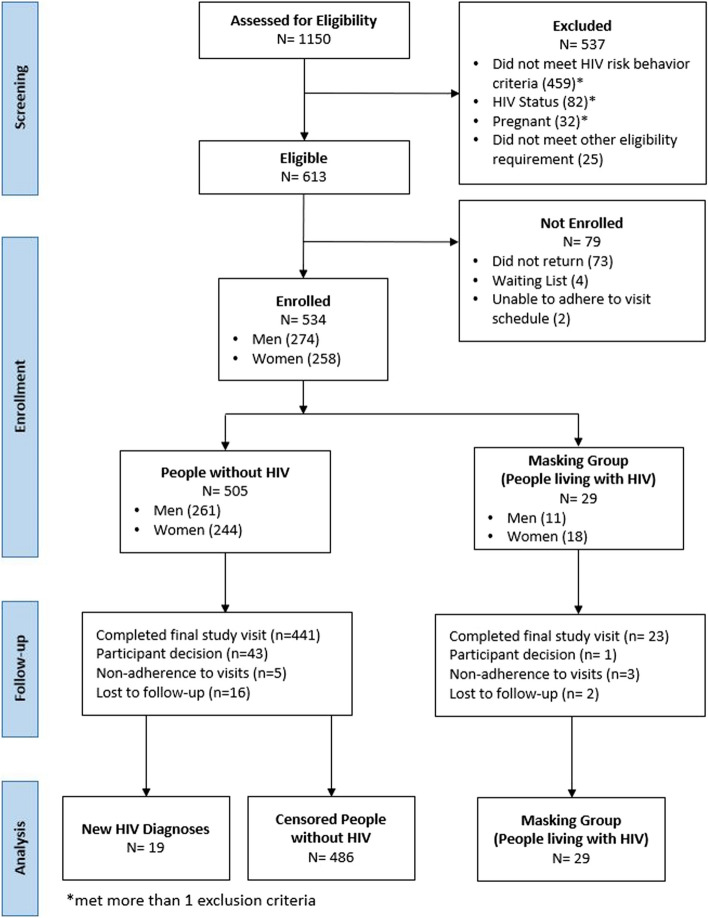
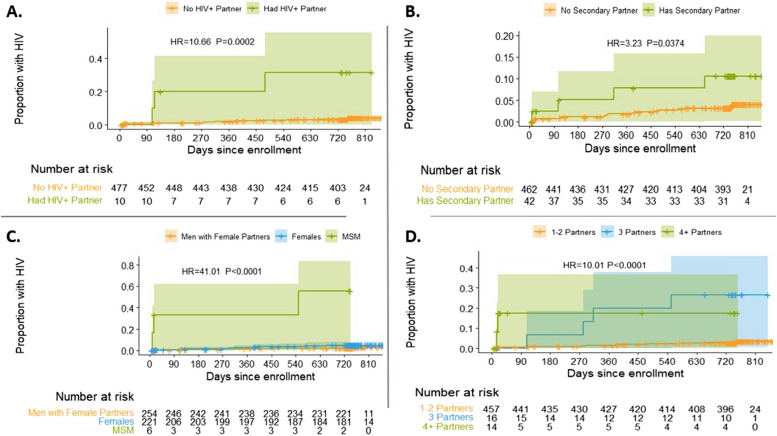
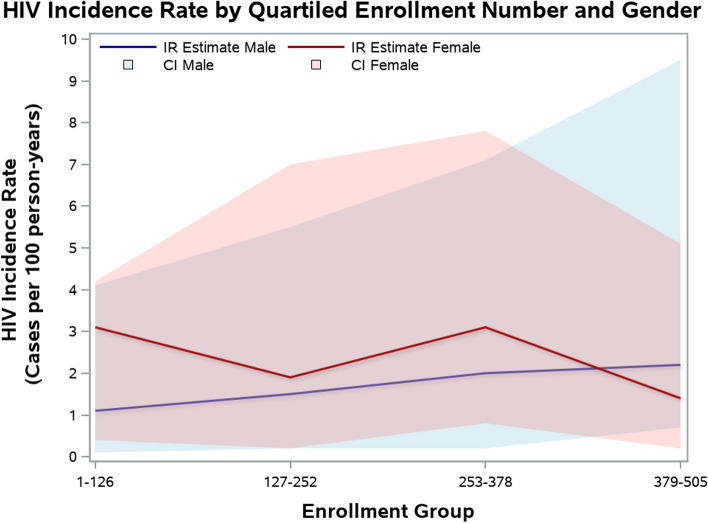
From January 2014 to October 2017, 505 adults without HIV were enrolled with median age of 21 years (interquartile range:19-24); 41% were female and 82% were single. There were 19 HIV seroconversions (10 female and 9 male) during 943 person-years (PY) of observation (overall HIV incidence 2.02/100PY; 95%CI 1.21-3.15). The highest HIV incidence was observed among sex workers (2.08/100PY; 95%CI 0.25-7.52) and MSM (19.18/100PY; 95%CI 3.96-56.06). Increased hazard of incident HIV was observed among participants who were MSM (HR = 27.95, 95%CI 4.39-117.94), p = 0.0004), reported three or more sexual partners at enrollment (HR = 7.39, 95%CI 1.64-33.25, p = 0.009), and indicated ever having a sexual partner living with HIV (HR = 9.64, 95%CI 2.23-41.71, p = 0.002).
Our findings may inform inclusion criteria for upcoming clinical trials of HIV prevention interventions, including vaccine candidates, which may prioritize enrollment of MSM, people with more than three sexual partners, and people with sexual partners who are living with HIV. These same populations are in need of further intervention to reduce HIV incidence.
撒哈拉以南非洲地区 HIV 负担沉重,尤其是在女性性工作者(FSW)和男男性行为者(MSM)中。未来评估预防 HIV 的疫苗和其他干预措施的临床试验将需要招募 HIV 发病率较高的人群。我们在莫桑比克马普托对具有多个性伴侣的男性和女性(包括 MSM 和 FSW)进行了 HIV 发病率的观察性研究,以便为该国开展候选 HIV 疫苗和其他 HIV 预防产品的未来疗效试验做准备。
我们在莫桑比克马普托进行了一项前瞻性 HIV 发病率观察研究,招募了年龄在 18-35 岁之间、无 HIV、过去三个月内有两个或两个以上性伴侣的成年人。招募策略优先考虑 MSM 和 FSW 的参与。参与者在 24 个月内每 3 个月进行一次 HIV-1 检测,每 6 个月进行一次工作人员管理的行为问卷调查。使用 Cox 比例风险模型估计与 HIV 获得相关的潜在因素的风险比(HR)和 95%置信区间(CI)。
从 2014 年 1 月至 2017 年 10 月,共有 505 名无 HIV 的成年人入组,中位年龄为 21 岁(四分位距 19-24);41%为女性,82%为单身。在 943 人年(PY)的观察期间,有 19 例 HIV 血清转化(10 例女性,9 例男性)(总 HIV 发病率为 2.02/100PY;95%CI 1.21-3.15)。最高的 HIV 发病率见于性工作者(2.08/100PY;95%CI 0.25-7.52)和 MSM(19.18/100PY;95%CI 3.96-56.06)。MSM(HR=27.95,95%CI 4.39-117.94,p=0.0004)、入组时报告有三个或三个以上性伴侣(HR=7.39,95%CI 1.64-33.25,p=0.009)和报告有 HIV 阳性性伴侣(HR=9.64,95%CI 2.23-41.71,p=0.002)的参与者 HIV 发病率显著升高。
我们的发现可能为包括疫苗候选物在内的 HIV 预防干预措施的未来临床试验提供纳入标准,这些试验可能优先招募 MSM、性伴侣超过三个的人群以及与 HIV 阳性性伴侣的人群。这些人群也需要进一步的干预措施来降低 HIV 发病率。