Viegas Edna Omar, Tembe Nelson, Macovela Eulália, Gonçalves Emília, Augusto Orvalho, Ismael Nália, Sitoe Nádia, De Schacht Caroline, Bhatt Nilesh, Meggi Bindiya, Araujo Carolina, Sandström Eric, Biberfeld Gunnel, Nilsson Charlotta, Andersson Sören, Jani Ilesh, Osman Nafissa
Instituto Nacional de Saúde, Maputo, Mozambique; Department of Laboratory Medicine, Karolinska Institutet, Huddinge, Sweden; Faculdade de Medicina, Universidade Eduardo Mondlane, Maputo, Mozambique.
Faculdade de Medicina, Universidade Eduardo Mondlane, Maputo, Mozambique; Hospital Central de Maputo, Maputo, Mozambique.
PLoS One. 2015 Mar 23;10(3):e0121452. doi: 10.1371/journal.pone.0121452. eCollection 2015.
Prevalence of HIV in Mozambique among individuals aged 15-49 years is 11.5%. The HIV prevalence is higher in women than in men across the country, peaking at ages 25-29 years and 35-39 years, respectively. In this study, we aimed at determining the prevalence and incidence of HIV, prevalence of Hepatitis B (HBV), and prevalence of syphilis in youths. We also characterized a cohort of youths for future participation in phase I/II HIV vaccine trials.
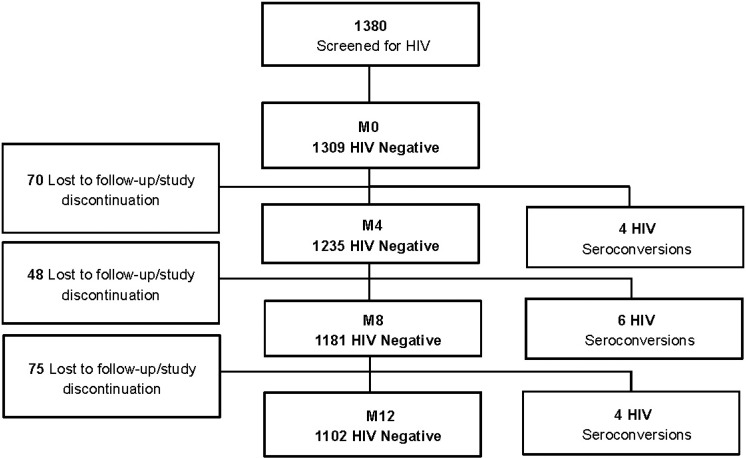
The study was conducted at a youth clinic in Maputo Central Hospital from August 2009 to October 2011. Youths of both genders aged 18-24 years (n = 1380) were screened for HIV using a sequential algorithm of two immunochromatographic assays, HBV using an enzyme linked immunosorbant test, and syphilis using a treponemal immunochromatographic strip test. The HIV seronegative participants (n = 1309) were followed-up for 12 months with quarterly study visits. The clinical and behavioral data were collected using structured questionnaires. The HIV seroconversions were confirmed by a molecular assay.
The study population was female dominant (76.8%). All participants had a formal education, with 44.6% studying for technical or higher education degrees. The mean age at sexual debut was 16.6 years (SD: ± 1.74), with 85.6% reporting more than one sexual partner in life. The screening showed the prevalence of HIV, HBV, and syphilis at 5.1% (95% CI: 3.97-6.31), 12.2% (95% CI 10.5%-14.0%), and 0.36% (95% CI 0.15%-0.84%), respectively. The HIV incidence rate was found to be 1.14/100 person years (95% CI: 0.67-1.92). Retention rates were stable throughout the study being 85.1% at the last visit.
Incidence of HIV in this cohort of youths in Maputo was relatively low. Also, the prevalence of HIV and syphilis was lower than the national values in this age group. However, the HBV prevalence was higher than in previous reports in the country.
莫桑比克15至49岁人群中的艾滋病毒感染率为11.5%。全国范围内,女性的艾滋病毒感染率高于男性,分别在25至29岁和35至39岁达到峰值。在本研究中,我们旨在确定青少年中艾滋病毒的感染率和发病率、乙型肝炎(HBV)的感染率以及梅毒的感染率。我们还对一组青少年进行了特征描述,以便他们未来参与I/II期艾滋病毒疫苗试验。
该研究于2009年8月至2011年10月在马普托中心医院的一家青少年诊所进行。对18至24岁的青年男女(n = 1380)进行筛查,使用两种免疫层析测定的序贯算法检测艾滋病毒,使用酶联免疫吸附试验检测HBV,使用梅毒螺旋体免疫层析试纸条检测梅毒。对艾滋病毒血清阴性的参与者(n = 1309)进行为期12个月的随访,每季度进行一次研究访视。使用结构化问卷收集临床和行为数据。艾滋病毒血清转化通过分子检测进行确认。
研究人群以女性为主(76.8%)。所有参与者都接受过正规教育,44.6%的人正在攻读技术或高等教育学位。首次性行为的平均年龄为16.6岁(标准差:±1.74),85.6%的人报告一生中拥有不止一个性伴侣。筛查显示艾滋病毒、HBV和梅毒的感染率分别为5.1%(95%置信区间:3.97 - 6.31)、12.2%(95%置信区间10.5% - 14.0%)和0.36%(95%置信区间0.15% - 0.84%)。艾滋病毒发病率为1.14/100人年(95%置信区间:0.67 - 1.92)。在整个研究过程中,保留率保持稳定,最后一次访视时为85.1%。
马普托的这组青少年中艾滋病毒的发病率相对较低。此外,艾滋病毒和梅毒的感染率低于该年龄组的全国水平。然而,HBV感染率高于该国先前的报告。