Zareh Hamed, Shahriary Alireza, Razei Ali, Ameri Rouhollah, Fasihi-Ramandi Mahdi, Aghamollaei Hossein
Recombinant Proteins Department, Breast Cancer Research Center, Motamed Cancer Institute, ACECR, Tehran, Iran.
Chemical Injuries Research Center, Systems Biology and Poisonings Institute, Baqiyatallah University of Medical Sciences, Tehran, Iran.
J Ophthalmic Vis Res. 2024 Sep 16;19(3):273-283. doi: 10.18502/jovr.v19i3.13689. eCollection 2024 Jul-Sep.
Sulfur mustard (SM) is a potent blistering agent. This alkylating chemical agent has extremely toxic effects on the eye. MMP-2 and MMP-9 are the two most important matrix metalloproteinase enzymes involved in the pathology of chemical eye injuries. Curcumin is regarded as a natural anti-inflammatory agent. This study aims to compare the anti-inflammatory effects of curcumin versus doxycycline on chemically induced corneal injuries.
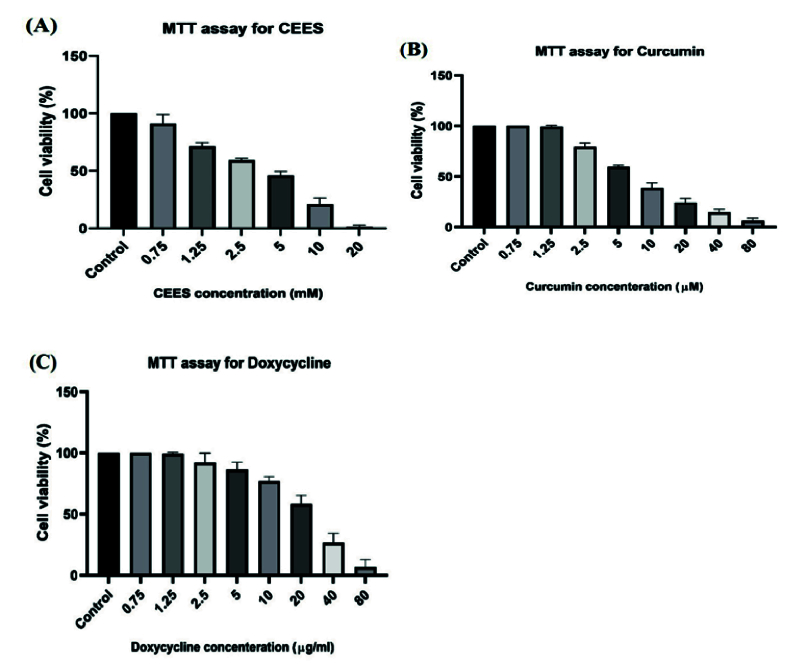
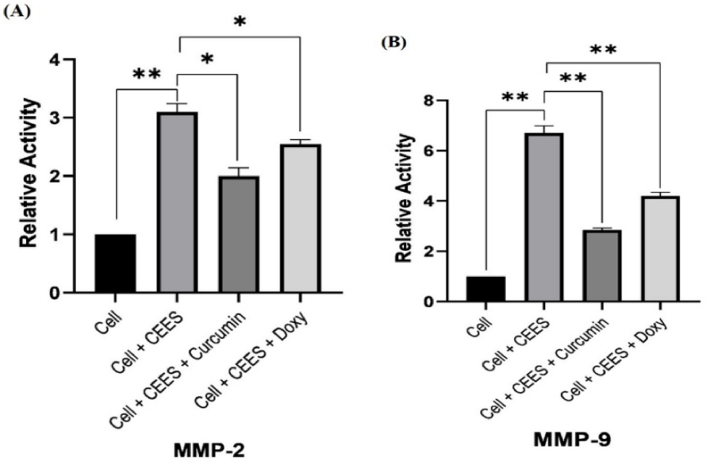
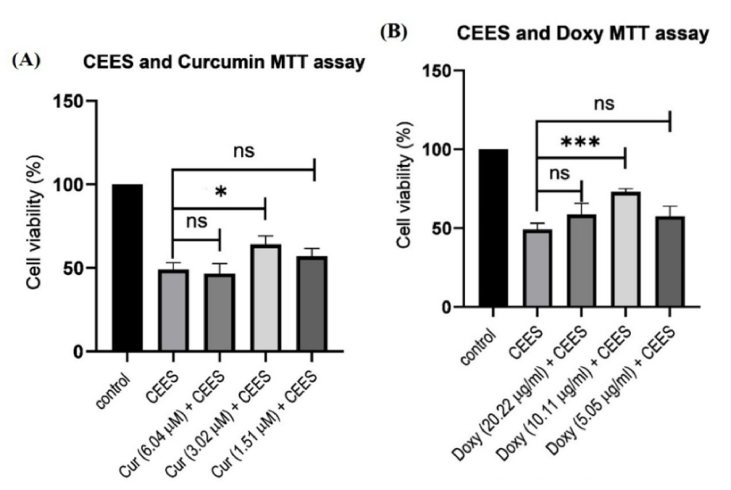
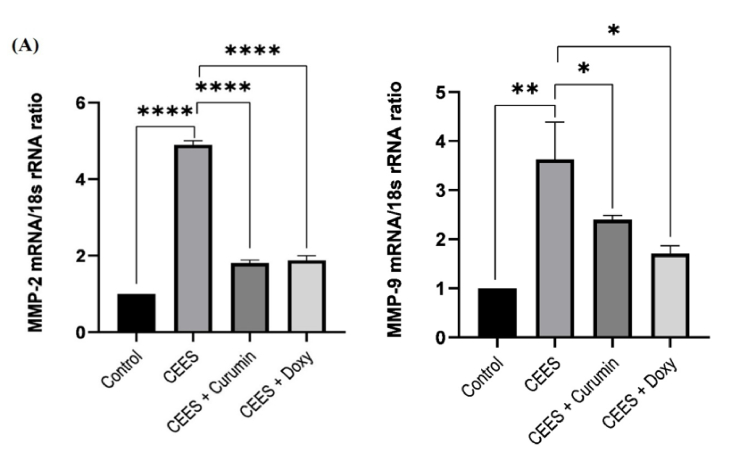
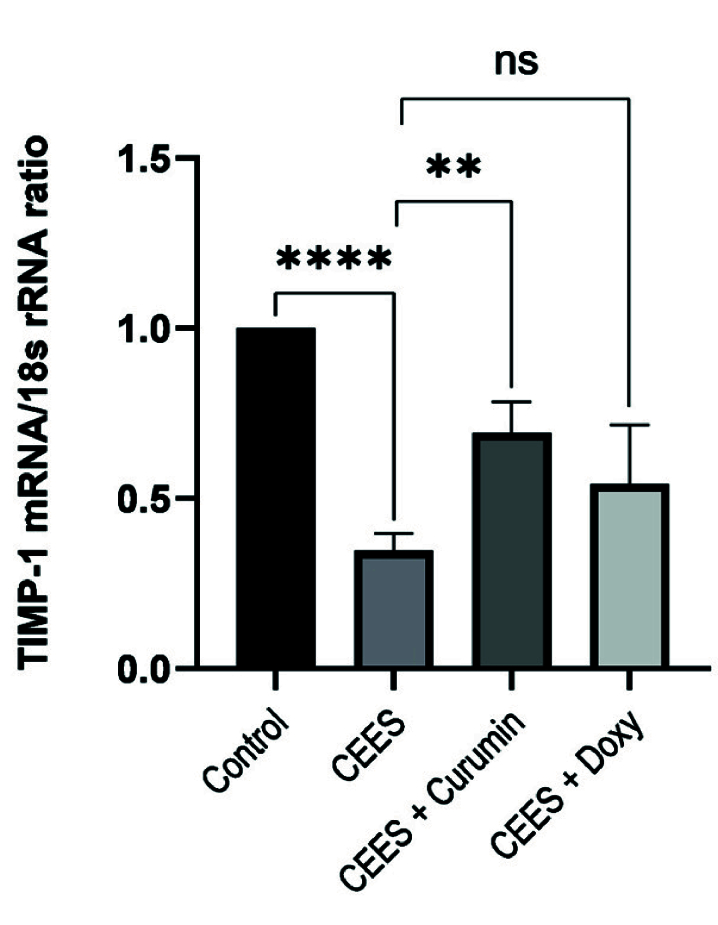
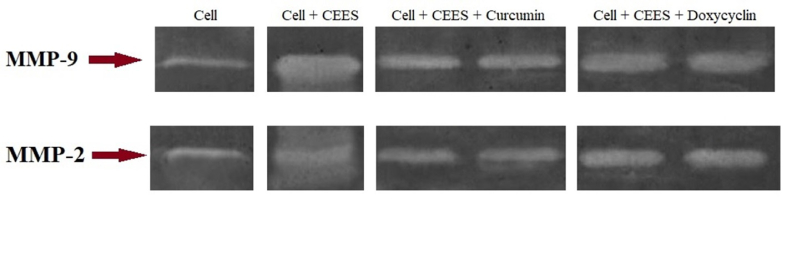
The HCE-2 cell line was used as a model for corneal cells. The effective concentrations of 2-chloroethyl ethyl sulfide (CEES) - as an analog of SM - doxycycline, and curcumin were determined using the MTT assay. The gene expression of , , and tissue inhibitors of metalloproteinase (TIMP-1) was evaluated by the real-time PCR method. Also, the activity of MMP-2 and MMP-9 enzymes was determined by zymography.
The expression of the MMP-2 and MMP-9 genes increased 5- and 3.3-fold after exposure to CEES, respectively. Following the treatment with curcumin and doxycycline, MMP-2 expression decreased significantly. Also, after treatment with curcumin and doxycycline, the MMP-9 expression decreased 2.5- and 1.6-fold, respectively. The reduction in activity was 32% for MMP-2 and 56% for MMP-9 after treatment with curcumin. The corresponding values were 12% and 40% following doxycycline treatment. There was no significant difference between the effects of curcumin and doxycycline on reducing MMP-2 expression, but the difference was statistically significant in the case of MMP-9.
Doxycycline and curcumin can inhibit MMP expression and activity in chemically exposed corneal cells. Curcumin has a greater ability than doxycycline to inhibit MMP-2 and MMP-9 enzymes; however, the difference is statistically significant only in the case of MMP-9. After further validation, these substances can be introduced as anti- inflammatory agents to treat corneal chemical burns.
硫芥(SM)是一种强效的发泡剂。这种烷基化化学剂对眼睛具有极强的毒性作用。基质金属蛋白酶-2(MMP-2)和基质金属蛋白酶-9(MMP-9)是参与化学性眼外伤病理过程的两种最重要的基质金属蛋白酶。姜黄素被视为一种天然抗炎剂。本研究旨在比较姜黄素与强力霉素对化学诱导的角膜损伤的抗炎作用。
使用HCE-2细胞系作为角膜细胞模型。采用MTT法测定2-氯乙基乙硫醚(CEES,作为SM的类似物)、强力霉素和姜黄素的有效浓度。通过实时聚合酶链反应(PCR)法评估MMP-2、MMP-9和金属蛋白酶组织抑制剂-1(TIMP-1)的基因表达。此外,通过酶谱法测定MMP-2和MMP-9酶的活性。
暴露于CEES后,MMP-2和MMP-9基因的表达分别增加了5倍和3.3倍。用姜黄素和强力霉素处理后,MMP-2的表达显著降低。此外,用姜黄素和强力霉素处理后,MMP-9的表达分别降低了2.5倍和1.6倍。姜黄素处理后,MMP-2的活性降低了32%,MMP-9的活性降低了56%。强力霉素处理后的相应值分别为12%和40%。姜黄素和强力霉素在降低MMP-2表达方面的效果无显著差异,但在MMP-9方面差异具有统计学意义。
强力霉素和姜黄素可抑制化学暴露的角膜细胞中MMP的表达和活性。姜黄素比强力霉素具有更强的抑制MMP-2和MMP-9酶的能力;然而,仅在MMP-9的情况下差异具有统计学意义。经过进一步验证后,这些物质可作为抗炎剂用于治疗角膜化学烧伤。