Conway Christopher C, Grogans Shannon E, Anderson Allegra S, Islam Samiha, Craig Logan E, Wedlock Jazmine, Hur Juyoen, DeYoung Kathryn A, Shackman Alexander J
Department of Psychology, Fordham University, Bronx, New York, USA.
Department of Psychology, University of Maryland, College Park, MD 20742 USA.
Clin Psychol Sci. 2024 Sep;12(5):823-839. doi: 10.1177/21677026231205270. Epub 2023 Oct 24.
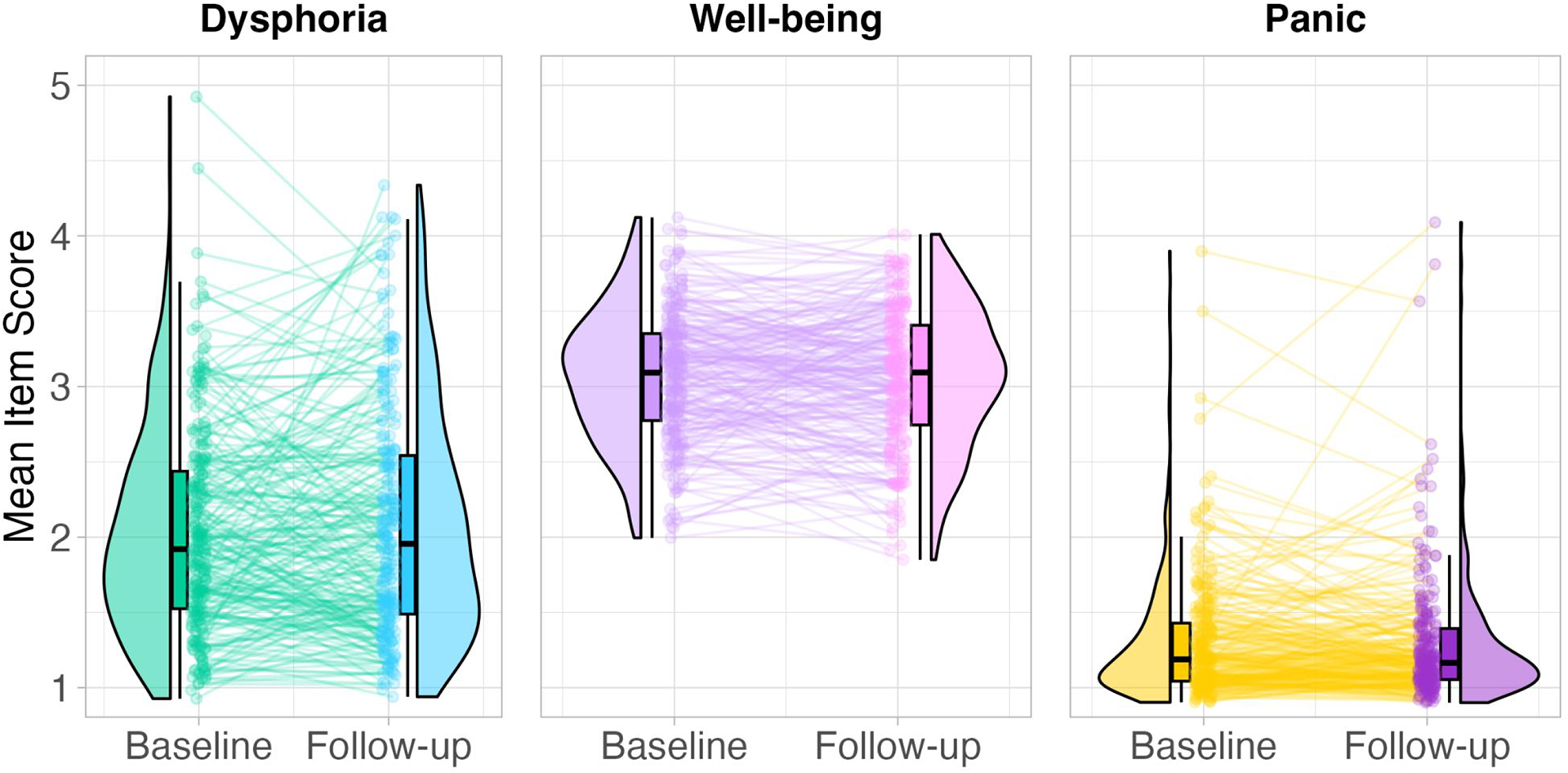
Elevated levels of Neuroticism/Negative Emotionality (N/NE) and, less consistently, lower levels of Extraversion/Positive Emotionality (E/PE) confer risk for pathological depression and anxiety. To date, most prospective-longitudinal research has narrowly focused on traditional diagnostic categories, creating uncertainty about the precise nature of these prospective associations. Adopting an explicitly hierarchical-dimensional approach, we examined the association between baseline variation in personality and longitudinal changes in broad and narrow internalizing-symptom dimensions in 234 emerging adults followed for 2.5 years, during the transition from older adolescence to early adulthood. N/NE was uniquely associated with increases in broadband internalizing-the core cognitive and affective symptoms that cut across the emotional disorders-and unrelated to the narrower dimensions of positive affect and anxious arousal that differentiate specific internalizing presentations. Variation in E/PE and several other Big Five traits was cross-sectionally, but not prospectively, related to longitudinal changes in specific internalizing symptoms. Exploratory personality-facet-level analyses provided preliminary evidence of more granular associations between personality and longitudinal changes in internalizing symptoms. These observations enhance the precision of models linking personality to internalizing illness; highlight the centrality of N/NE to increases in transdiagnostic internalizing symptoms during a key developmental chapter; and set the stage for developing more effective prevention and treatment strategies.
神经质/消极情绪(N/NE)水平升高,以及不太一致的外向性/积极情绪(E/PE)水平降低,会增加患病理性抑郁和焦虑的风险。迄今为止,大多数前瞻性纵向研究都狭义地聚焦于传统诊断类别,这使得这些前瞻性关联的确切性质存在不确定性。我们采用明确的层次维度方法,在234名从青少年晚期过渡到成年早期的新兴成年人中,研究了人格基线变化与广泛和狭义内化症状维度纵向变化之间的关联,随访时间为2.5年。N/NE与宽带内化(即跨越情绪障碍的核心认知和情感症状)的增加具有独特关联,且与区分特定内化表现的积极情感和焦虑唤醒的狭义维度无关。E/PE和其他几个大五人格特质的变化与特定内化症状的纵向变化存在横断面关联,但无前瞻性关联。探索性人格特质层面分析为人格与内化症状纵向变化之间更细化的关联提供了初步证据。这些观察结果提高了将人格与内化疾病联系起来的模型的精确性;突出了N/NE在关键发育阶段跨诊断内化症状增加中的核心地位;并为制定更有效的预防和治疗策略奠定了基础。