Ahden Shubhdeep V, Zatar Wasim, Herrmann David N, Dorsey E Ray, George Benjamin P
From the University of Rochester Medical Center, NY.
Neurol Educ. 2024 Mar 13;3(1):e200118. doi: 10.1212/NE9.0000000000200118. eCollection 2024 Mar.
To identify trends in educational debt for US medical school graduates entering neurology and compare debt to anticipated compensation.
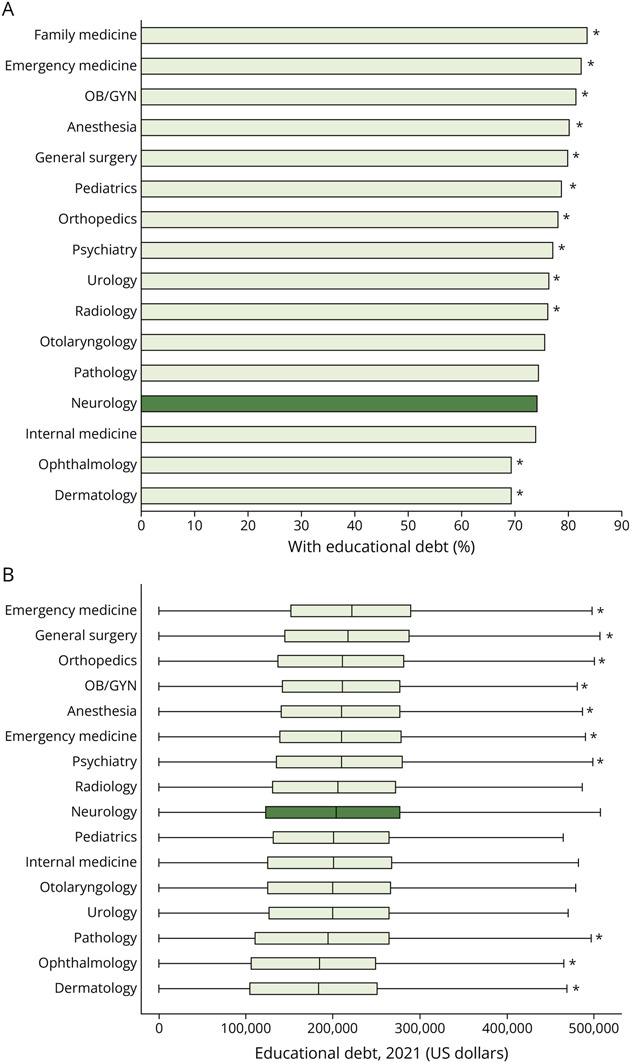
Data of 148 accredited medical schools were obtained from the Association of American Medical Colleges Graduation and Matriculating Student Questionnaires to identify self-reported educational debt for graduates pursuing neurology training. Trends were assessed in a 2-year interval from 2010 to 2021. Descriptive statistics were used to assess characteristics associated with debt. Dollar amounts were adjusted to 2021 US dollars. Total compensation by subspecialty from the 2021 American Academy of Neurology Compensation and Productivity Survey was used to calculate debt-to-income ratios by subspecialty.
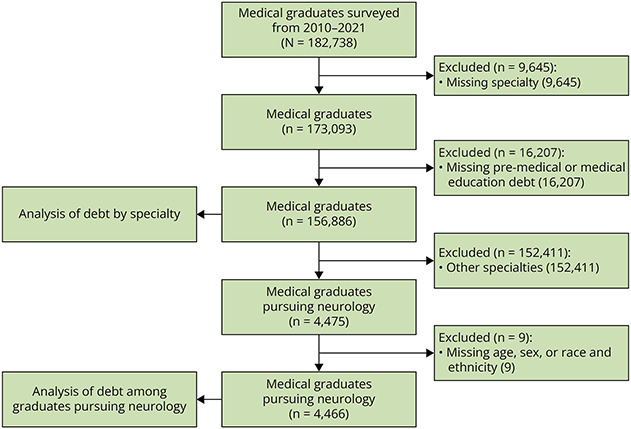
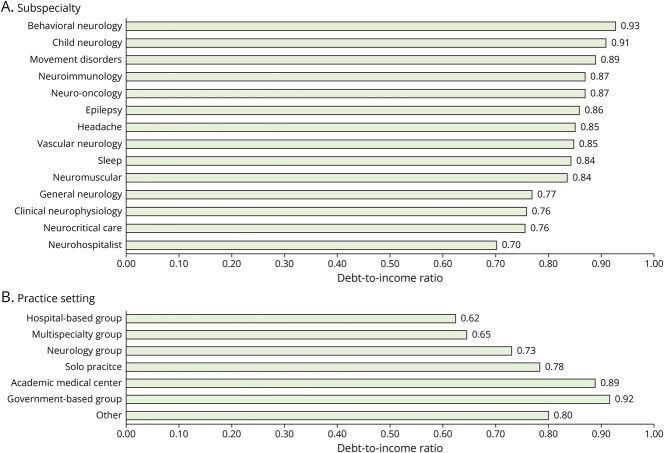
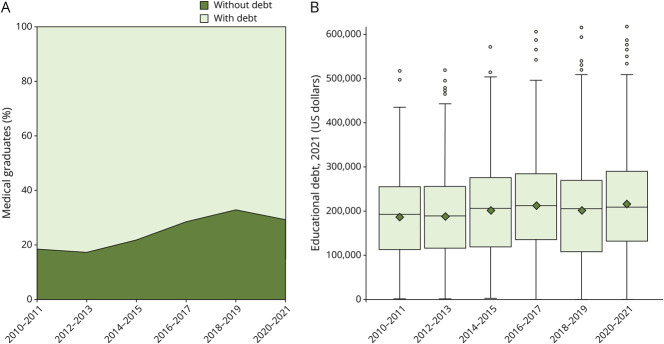
There were 182,738 responses recorded from medical graduates from 2010 to 2021, of which 4,466 planned on neurology training. The percentage of medical graduates entering neurology with debt decreased from 82% in 2010-2011 to 71% in 2020-2021. Among indebted, the median educational debt increased 9% from $192,613 (interquartile range [IQR] $140,908) in 2010-2011 to $209,396 (IQR $159,128) in 2020-2021 ( < 0.001). Medical graduates with debt more often reported family income in the bottom 3 quintiles of US household income (18% with debt vs 7% without debt; < 0.001). Graduates from self-identified race and ethnicity groups who are underrepresented in medicine (URiM) were more likely to have debt (15% vs 9%; < 0.001) and had greater debt when compared with graduates not self-identifying as URiM (median $211,616 [IQR $152,760] vs $202,379 [IQR $153,340]; < 0.001). In 2021, 46% of indebted neurology-bound graduates indicated plans to use Public Service Loan Forgiveness, which increased from 16% in 2010. In 2021, the median debt for neurology graduates represented between 70% and 93% of total annual compensation with the highest debt-to-income ratios among behavioral neurology (0.93), child neurology (0.91), and movement disorders (0.89).
The burden of educational debt for neurology-bound graduates is increasingly concentrated among those from lower-income families and racial and ethnic groups who are URiM. Subspecialties that often manage patients in the outpatient setting, as compared with those that are primarily inpatient/procedural, may have greater debt with respect to their compensation. Nearly half of 2021 graduates pursuing neurology plan to use tax-payer funds for loan forgiveness.
确定进入神经病学领域的美国医学院毕业生的教育债务趋势,并将债务与预期薪酬进行比较。
从美国医学院协会毕业和入学学生调查问卷中获取148所认证医学院的数据,以确定追求神经病学培训的毕业生自我报告的教育债务。在2010年至2021年期间,以两年为间隔评估趋势。使用描述性统计来评估与债务相关的特征。金额已调整为2021年美元。利用2021年美国神经病学学会薪酬与生产力调查中各亚专业的总薪酬来计算各亚专业的债务收入比。
2010年至2021年期间,医学毕业生记录了182,738份回复,其中4,466人计划进行神经病学培训。背负债务进入神经病学领域的医学毕业生比例从2010 - 2011年的82%降至2020 - 2021年的71%。在有债务的人群中,教育债务中位数从2010 - 2011年的192,613美元(四分位间距[IQR]为140,908美元)增加了9%,至2020 - 2021年的209,396美元(IQR为159,128美元)(<0.001)。有债务的医学毕业生更常报告家庭收入处于美国家庭收入最低的三个五分位数(有债务的为18%,无债务的为7%;<0.001)。来自医学领域代表性不足的自我认定种族和族裔群体的毕业生更有可能背负债务(15%对9%;<0.001),并且与未自我认定为代表性不足群体的毕业生相比,债务更高(中位数为211,616美元[IQR为152,760美元]对202,379美元[IQR为153,340美元];<0.001)。2021年,46%有债务且打算从事神经病学的毕业生表示计划使用公共服务贷款免除计划,这一比例从2010年的16%有所增加。2021年,神经病学毕业生的债务中位数占年度总薪酬的70%至93%之间,行为神经病学(0.93)、儿童神经病学(0.91)和运动障碍(0.89)的债务收入比最高。
计划从事神经病学的毕业生的教育债务负担越来越集中在低收入家庭以及医学领域代表性不足的种族和族裔群体中。与主要为住院/程序性的亚专业相比,那些通常在门诊环境中管理患者的亚专业在薪酬方面可能背负更大的债务。2021年近一半计划从事神经病学的毕业生打算使用纳税人资金来免除贷款。