Bartoli Francesco, Cavaleri Daniele, Riboldi Ilaria, Crocamo Cristina, de Filippis Renato, Zandonella Callegher Riccardo, Paglia Giuseppe, Albert Umberto, De Fazio Pasquale, Carrà Giuseppe
School of Medicine and Surgery, University of Milano-Bicocca, Monza, Italy.
Department of Health Sciences, University "Magna Graecia" of Catanzaro, Catanzaro, Italy.
Alpha Psychiatry. 2024 Aug 1;25(4):555-560. doi: 10.5152/alphapsychiatry.2024.241549. eCollection 2024 Aug.
Treatment-resistant depression (TRD) affects around 20-30% of people with major depressive disorder. In 2019, esketamine nasal spray was approved for TRD by both the US Food and Drug Administration and the European Medicines Agency. While its clinical efficacy and safety are proven, the mechanisms underlying its antidepressant effect remain unclear. The use of metabolomics may allow understanding the metabolic effects of esketamine and predicting biological features associated with clinical response in TRD. Nonetheless, there is a lack of studies exploring the predictive value of metabolomics. The Resistant Depression Response to Esketamine Assessing Metabolomics (ReDREAM) project aims at identifying metabolic biosignatures that may represent novel correlates of response to esketamine treatment.
This is the protocol of an observational, prospective study.
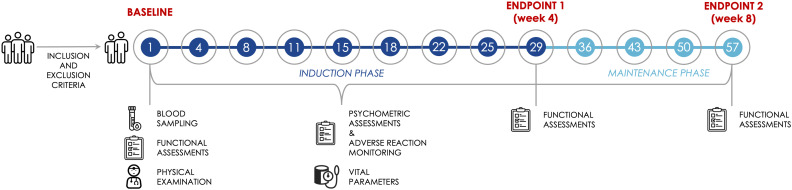
We plan to select 60 people with TRD from 3 clinical sites in Italy. The participants will be administered with esketamine nasal spray, following standard clinical practice, twice a week for 4 weeks ("induction phase"), then once a week for 4 additional weeks ("maintenance phase"). We will test the correlations between baseline metabolic profile and depressive symptom improvement at study endpoints (weeks 4 and 8) and we will explore the likelihood of different metabolic phenotypes between responders and non-responders.
An involvement of energy metabolism, amino acid metabolism, urea cycle, and nitric oxide synthesis in response to treatment with esketamine nasal spray is hypothesized.
Unbiased data from untargeted metabolomics associated with clinical changes after esketamine treatment may contribute to define new paradigms for precision psychiatry-oriented, personalized care of TRD.
难治性抑郁症(TRD)影响着约20%-30%的重度抑郁症患者。2019年,艾氯胺酮鼻喷雾剂被美国食品药品监督管理局和欧洲药品管理局批准用于治疗TRD。虽然其临床疗效和安全性已得到证实,但其抗抑郁作用的潜在机制仍不清楚。代谢组学的应用可能有助于了解艾氯胺酮的代谢作用,并预测与TRD临床反应相关的生物学特征。尽管如此,目前缺乏探索代谢组学预测价值的研究。艾氯胺酮评估代谢组学难治性抑郁症反应(ReDREAM)项目旨在识别可能代表对艾氯胺酮治疗反应新关联的代谢生物标志物。
这是一项观察性前瞻性研究的方案。
我们计划从意大利的3个临床地点选取60名TRD患者。参与者将按照标准临床实践接受艾氯胺酮鼻喷雾剂治疗,每周两次,共4周(“诱导期”),然后每周一次,再持续4周(“维持期”)。我们将测试基线代谢谱与研究终点(第4周和第8周)抑郁症状改善之间的相关性,并探索反应者和无反应者之间不同代谢表型的可能性。
假设能量代谢、氨基酸代谢、尿素循环和一氧化氮合成参与了艾氯胺酮鼻喷雾剂治疗的反应。
来自非靶向代谢组学的无偏数据与艾氯胺酮治疗后的临床变化相关,可能有助于为以精准精神病学为导向的TRD个性化护理定义新的范例。