Department of Nephrology, University of Hong Kong-Shenzhen Hospital, Shenzhen, China.
Department of Nephrology, Shenzhen Hospital of Southern Medical University, Shenzhen, China.
Clin Exp Med. 2024 Oct 3;24(1):236. doi: 10.1007/s10238-024-01494-x.
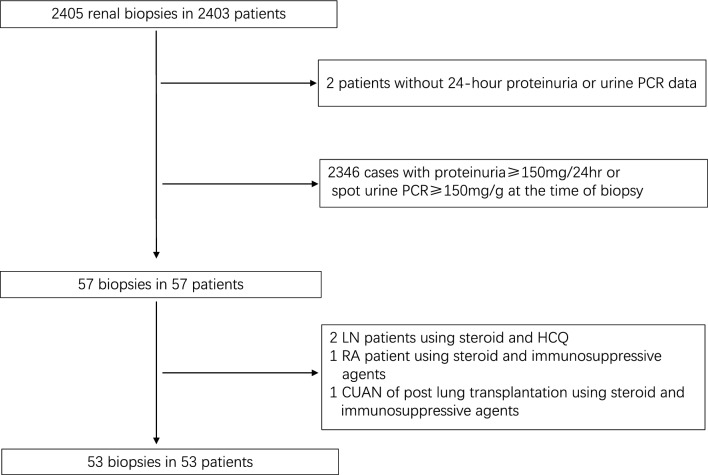
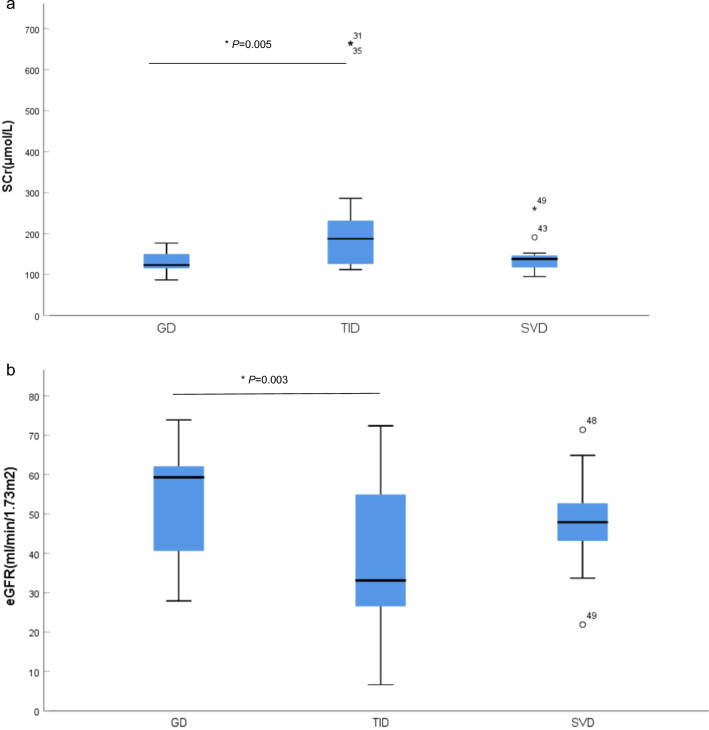
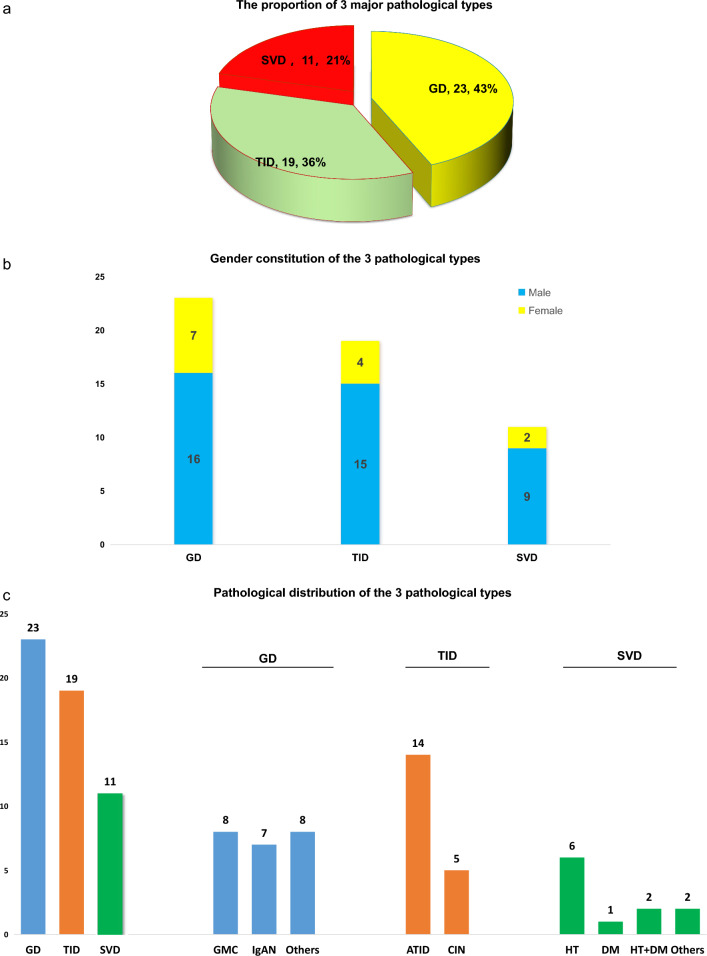
Proteinuria is a biomarker of kidney injury that typically results from glomerular and/or tubulointerstitial disease. Whereas kidney impairment with normal urinary protein excretion is usually less focused and understudied. We conducted a retrospective review of the renal histopathology of the patients with variable degrees of unexplained renal insufficiency but with normal range proteinuria between 2014 and 2024 of three university teaching hospitals in Shenzhen city of Southern China. Patients with kidney dysfunction of undetermined or uncertain etiology and with normal urinary protein excretion (defined by a 24hr urinary protein excretion < 150 mg or spot urinary protein to creatinine ratio [PCR] < 150 mg/g) were enrolled and analyzed. In a total of 2405 patients, 53 (2.2%) fulfilled the inclusion criteria (male/female 40/13, age 47.3 ± 14.3 years) with a mean eGFR of 46.6 ± 16.8 ml/min per 1.73 m. Glomerular disease (GD) was the most frequent pathological finding identified in 23 (43.4%) patients, while 19 (35.8%) cases showed tubulointerstitial disease (TID) and 11 (20.8%) patients exhibited small vascular disease (SVD). Patients in the TID had the lowest mean eGFR and the highest numerical 24hr urinary protein excretion among the three groups. The incidence of acute kidney injury was significantly higher in TID than in other two groups. The patients in the SVD group had the highest fraction of underlying hypertension. Kidney dysfunction with normal range proteinuria may be related with, in descending order of probablity, glomerular, tubulointerstitial and small vascular diseases. Renal biopsies were proved useful in informing therapeutic choice, long-term management and in predicting prognosis in this setting.
蛋白尿是肾脏损伤的生物标志物,通常由肾小球和/或肾小管间质疾病引起。而肾脏损害伴正常尿蛋白排泄通常不太受关注和研究较少。我们对 2014 年至 2024 年期间中国南部深圳市三家大学教学医院的不同程度不明原因肾功能不全但蛋白尿正常范围(定义为 24 小时尿蛋白排泄量<150mg 或点尿蛋白与肌酐比[PCR] <150mg/g)的患者的肾组织病理学进行了回顾性分析。纳入并分析了病因不确定或不明且尿蛋白正常排泄(定义为 24 小时尿蛋白排泄量<150mg 或点尿蛋白与肌酐比[PCR] <150mg/g)的肾功能不全患者。在总共 2405 例患者中,有 53 例(2.2%)符合纳入标准(男/女 40/13,年龄 47.3±14.3 岁),平均 eGFR 为 46.6±16.8ml/min/1.73m。肾小球疾病(GD)是最常见的病理发现,在 23 例(43.4%)患者中发现,19 例(35.8%)患者显示肾小管间质疾病(TID),11 例(20.8%)患者表现为小血管疾病(SVD)。TID 患者的平均 eGFR 最低,三组中 24 小时尿蛋白排泄量最高。TID 组急性肾损伤的发生率明显高于其他两组。SVD 组患者中潜在高血压的比例最高。蛋白尿正常范围的肾功能不全可能与肾小球、肾小管间质和小血管疾病有关,概率依次降低。在这种情况下,肾活检有助于告知治疗选择、长期管理和预测预后。