Romruen Orapan, Kaewprachu Pimonpan, Sai-Ut Samart, Kingwascharapong Passakorn, Karbowiak Thomas, Zhang Wanli, Rawdkuen Saroat
Food Science and Technology Program, School of Agro-Industry, Mae Fah Luang University, Chiang Rai, 57100, Thailand.
Faculty of Agro-Industry, Chiang Mai University, Samut Sakhon, 74000, Thailand.
Sci Rep. 2024 Oct 4;14(1):23038. doi: 10.1038/s41598-024-74004-4.
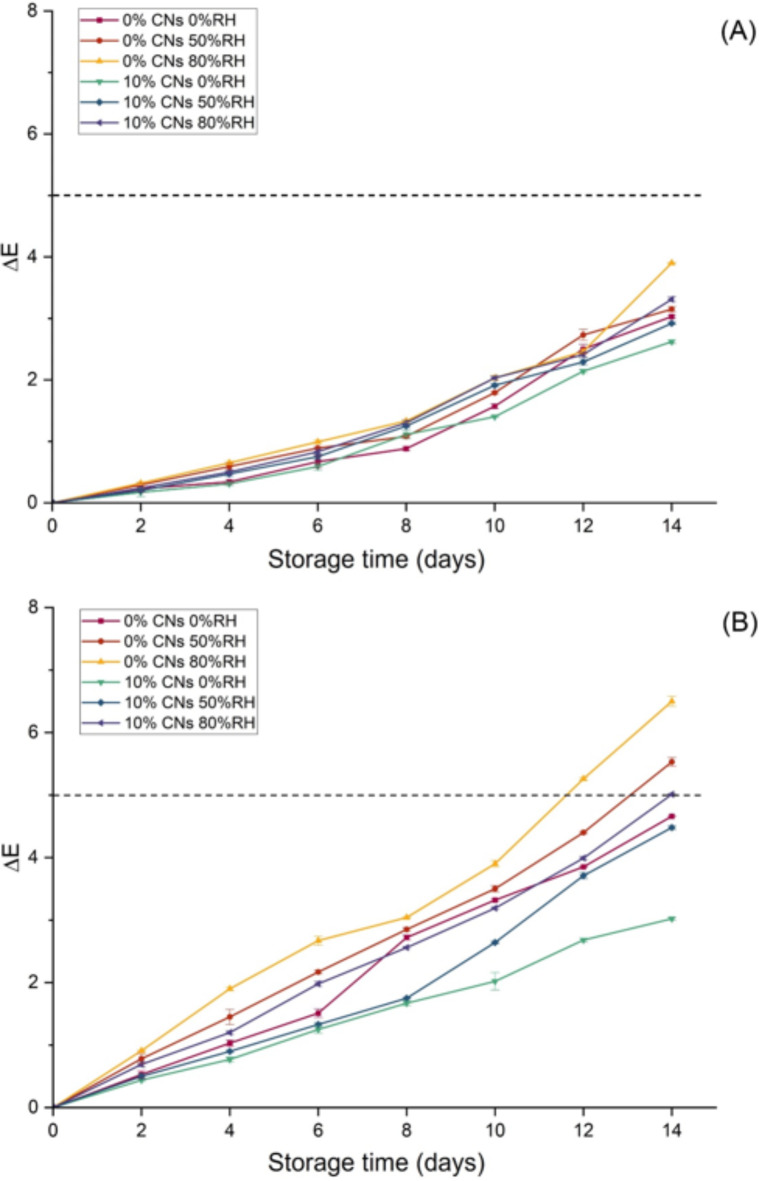
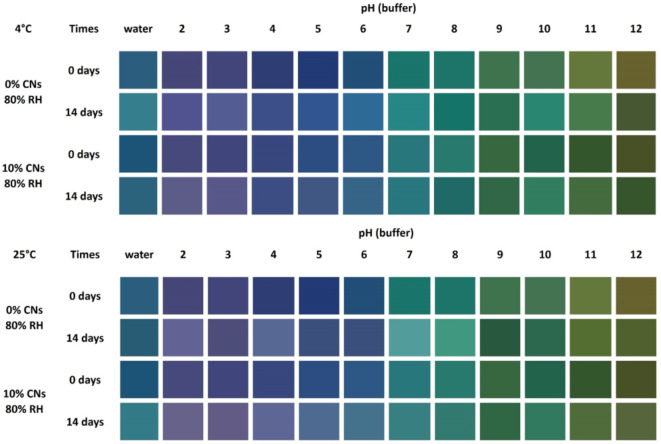
This study aimed to investigate the behavior of smart bilayer films under various temperature and relative humidity (RH). Smart bilayer films were fabricated using sodium alginate with incorporated butterfly pea anthocyanin and agar containing catechin-lysozyme. Cellulose nanospheres were added at concentrations of 0% and 10% w/w of the film and subjected to test at 4 °C and 25 °C, considering different RHs (0%, 50%, and 80%). The results showed that RH had a greater impact on the mechanical properties than temperature, leading to a decrease in tensile strength and an increase in elongation at break with higher RH. The films displayed increased strength but reduced flexibility at low temperatures. Oxygen permeability was negatively affected by increasing RH, while water vapor barrier properties were better at 25 °C than at 4 °C. In terms of color stability, the temperature played a more important role, with both types of smart bilayer films retaining their color stability throughout 14-day storage at 4 °C, even maintaining their ability to change color with pH. However, the films stored at 25 °C exhibited lower color stability and showed potential for color change with varying pH levels, but with lower intensity. The findings of this study demonstrate the significant impact of temperature and RH on the functional properties of smart bilayer films, with and without the addition of cellulose nanospheres. Such smart bilayer films have great potential for various applications, particularly in food packaging, where maintaining color, mechanical, and barrier properties under varying environmental conditions is crucial.
本研究旨在探究智能双层膜在不同温度和相对湿度(RH)条件下的行为。采用含有蝶豆花花青素的海藻酸钠和含有儿茶素 - 溶菌酶的琼脂制备智能双层膜。以0%和10%(w/w)的膜浓度添加纤维素纳米球,并在4℃和25℃下进行测试,同时考虑不同的相对湿度(0%、50%和80%)。结果表明,相对湿度对机械性能的影响大于温度,随着相对湿度的升高,拉伸强度降低,断裂伸长率增加。薄膜在低温下强度增加但柔韧性降低。氧气透过率受相对湿度增加的负面影响,而水蒸气阻隔性能在25℃时比在4℃时更好。在颜色稳定性方面,温度起更重要的作用,两种类型的智能双层膜在4℃下储存14天期间均保持其颜色稳定性,甚至保持其随pH值变色的能力。然而,在25℃下储存的薄膜表现出较低的颜色稳定性,并且在不同pH值水平下显示出变色的可能性,但变色强度较低。本研究结果表明,温度和相对湿度对添加和未添加纤维素纳米球的智能双层膜的功能特性有显著影响。这种智能双层膜在各种应用中具有巨大潜力,特别是在食品包装领域,在不同环境条件下保持颜色、机械和阻隔性能至关重要。