Sohany Mouluda, Tawakkal Intan Syafinaz Mohamed Amin, Ariffin Siti Hajar, Shah Nor Nadiah Abdul Karim, Yusof Yus Aniza
Department of Process and Food Engineering, Faculty of Engineering, University Putra Malaysia, Serdang 43400, Malaysia.
Department of Food Engineering and Technology, Faculty of Engineering, Hajee Mohammad Danesh Science and Technology University, Dinajpur 5200, Bangladesh.
Foods. 2021 Aug 26;10(9):2005. doi: 10.3390/foods10092005.
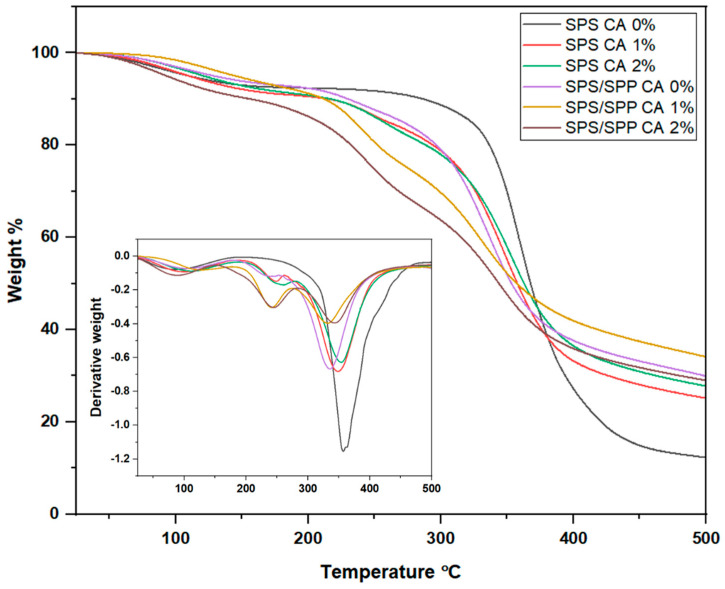
In food packaging, smart indicator films based on natural resources have greatly attracted researchers to minimize the environmental issues as well as to satisfy consumer preferences for food safety. In this research, pH-sensitive films were prepared using purple-fleshed sweet potato starch (SPS) and sweet potato peel (SPP). Two categories of the film (i) SPS and (ii) SPS/SPP, were fabricated via solvent casting technique, incorporating different concentrations of commercial purple sweet potato anthocyanin (CA) at 0%, 1%, 1.5%, and 2% (/) and the physicochemical, mechanical, thermal, and morphological properties of the films were investigated. The thickness, water solubility, and swelling degree of the films increased with the increment of CA, whereas there were no significant changes in the water content (WC) of the films. Water vapor permeability (WVP) was decreased for SPS films while statistically similar for SPS/SPP films. The addition of CA reduced the tensile strength (TS) and tensile modulus (TM) yet increased the elongation at break (EaB) of the films as compared to films without CA. The FTIR results confirmed the immobilization of anthocyanin into the film. In SEM images, roughness in the surfaces of the CA-associated films was observed. A reduction of thermal stability was found for the films with anthocyanin except for the SPS/SPP CA 2% film. Furthermore, the CA-associated films showed a remarkable color response when subjected to pH buffers (pH 1 to 12) and successfully monitored chicken freshness. The fastest color migration was observed in acidic conditions when the films were immersed into aqueous, acidic, low fat, and fatty food simulants. The findings of this work demonstrated that the developed pH indicator films have the potential to be implemented as smart packaging to monitor food freshness and quality for safe consumption.
在食品包装领域,基于天然资源的智能指示膜极大地吸引了研究人员,以尽量减少环境问题,并满足消费者对食品安全的偏好。在本研究中,使用紫肉甘薯淀粉(SPS)和甘薯皮(SPP)制备了pH敏感膜。通过溶剂浇铸技术制备了两类膜:(i)SPS和(ii)SPS/SPP,并加入了0%、1%、1.5%和2%(/)不同浓度的商业紫甘薯花青素(CA),研究了膜的物理化学、机械、热和形态学性质。膜的厚度、水溶性和溶胀度随CA含量的增加而增加,而膜的含水量(WC)没有显著变化。SPS膜的水蒸气透过率(WVP)降低,而SPS/SPP膜的水蒸气透过率在统计学上相似。与不含CA的膜相比,添加CA降低了膜的拉伸强度(TS)和拉伸模量(TM),但增加了膜的断裂伸长率(EaB)。FTIR结果证实了花青素固定在膜中。在扫描电子显微镜图像中,观察到与CA相关的膜表面存在粗糙度。除了SPS/SPP CA 2%膜外,含花青素的膜的热稳定性降低。此外,与CA相关的膜在pH缓冲液(pH 1至12)作用下表现出显著的颜色响应,并成功监测了鸡肉的新鲜度。当膜浸泡在水性、酸性、低脂和高脂食品模拟物中时,在酸性条件下观察到最快的颜色迁移。这项工作的结果表明,所开发的pH指示膜有潜力作为智能包装来监测食品的新鲜度和质量,以确保安全消费。