Research Department of Behavioral Science and Health, University College London, London, UK.
Centre for Epidemiological Research in Nutrition and Health, University of São Paulo, São Paulo, Brazil.
Eur J Nutr. 2024 Dec;63(8):3149-3160. doi: 10.1007/s00394-024-03496-7. Epub 2024 Oct 4.
(i) Characterize ultra-processed food (UPF) intakes in toddlerhood and mid-childhood, including identifying principal UPF sub-groups and associations with nutrient profile; (ii) explore stability and change in UPF intake between toddlerhood and mid-childhood.
Data were from children in the UK Gemini twin cohort at 21 months (n = 2,591) and 7 years (n = 592) of age. UPF intakes were estimated using diet diaries and Nova classification. Complex samples general linear or logistic regression models were used to explore associations between UPF intake, UPF sub-groups and nutrients, and changes in intake over time.
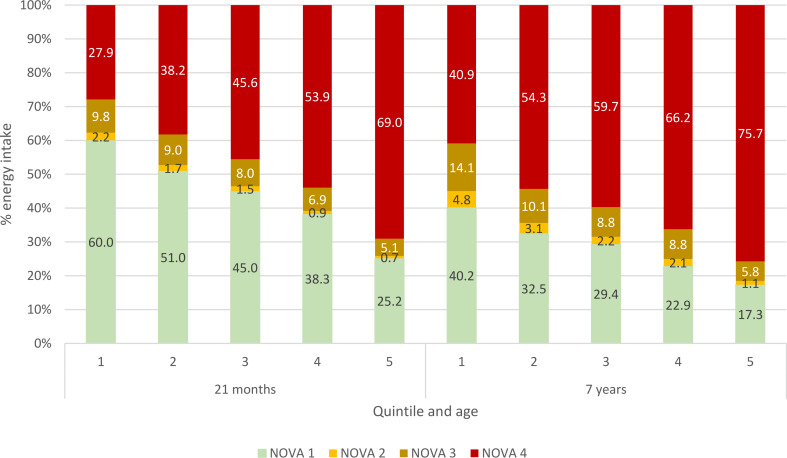
The contribution of UPF to total energy was 46.9% (± 14.7) at 21 months and 59.4% (± 12.5) at 7 years. Principal UPF sub-groups were yogurts, higher-fiber breakfast cereals, and wholegrain breads in toddlerhood, and puddings and sweet cereal products and white breads in mid-childhood. At both ages, mean free sugar and sodium intakes exceeded recommended maximums and higher UPF consumption was associated with consuming more of each nutrient (P < 0.001). UPF intake was negatively associated with fat, saturated fat and protein intake in toddlerhood, and fiber intake in mid-childhood (P < 0.001). Being in the highest UPF intake quintile in toddlerhood was predictive of being in the highest quintile in mid-childhood (OR 9.40, 95%CI 3.94-22.46).
UPF accounted for nearly half of toddlers' energy, increasing to 59% in mid-childhood. Higher UPF consumers had higher intakes of free sugar and sodium. UPF intake in toddlerhood was predictive of mid-childhood intake. Effective policies are needed to reduce UPF intakes in the early years.
(i)描述幼儿期和儿童中期超加工食品(UPF)的摄入量,包括确定主要 UPF 亚组及其与营养状况的关联;(ii)探索幼儿期和儿童中期之间 UPF 摄入量的稳定性和变化。
数据来自英国双子座双胞胎队列在 21 个月(n=2591)和 7 岁(n=592)时的儿童。使用饮食日记和 Nova 分类法估计 UPF 的摄入量。采用复杂样本一般线性或逻辑回归模型,探讨 UPF 摄入量、UPF 亚组和营养素之间的关系,以及随时间变化的摄入量变化。
21 个月时,UPF 对总能量的贡献率为 46.9%(±14.7),7 岁时为 59.4%(±12.5)。幼儿期的主要 UPF 亚组是酸奶、高纤维早餐麦片和全麦面包,而儿童中期的主要 UPF 亚组是布丁、甜麦片产品和白面包。在这两个年龄段,平均游离糖和钠的摄入量都超过了建议的最大值,较高的 UPF 摄入量与每种营养素的摄入量增加有关(P<0.001)。在幼儿期,UPF 摄入量与脂肪、饱和脂肪和蛋白质摄入呈负相关,与儿童中期的纤维摄入呈负相关(P<0.001)。在幼儿期摄入最高 UPF 摄入量五分位组的儿童,在儿童中期摄入最高五分位组的可能性更大(OR 9.40,95%CI 3.94-22.46)。
UPF 占幼儿期能量的近一半,在儿童中期增加到 59%。较高的 UPF 消费者的游离糖和钠摄入量较高。幼儿期的 UPF 摄入量可预测儿童中期的摄入量。需要采取有效的政策来减少幼儿期的 UPF 摄入量。