Department of Neuromedicine and Movement Sciences, Faculty of Medicine and Health Sciences, NTNU, Norwegian University of Science and Technology, Trondheim, 7491, Norway.
NorHEAD - Norwegian Centre for Headache Research, NTNU, Trondheim, Norway.
J Headache Pain. 2024 Oct 3;25(1):166. doi: 10.1186/s10194-024-01879-z.
Patients with migraine are vulnerable to insufficient sleep, but the impact of sleep restriction is largely unknown. In addition, the importance of sleep may be different in patients with migraine who mostly have attack onsets during sleep, so called sleep-related migraine, compared to patients with non-sleep-related migraine. In this study we investigate the effect of sleep restriction on endogenous pain modulation in patients with migraine and healthy controls. We also compared the effect of sleep restriction in sleep-related and in non-sleep-related migraine.
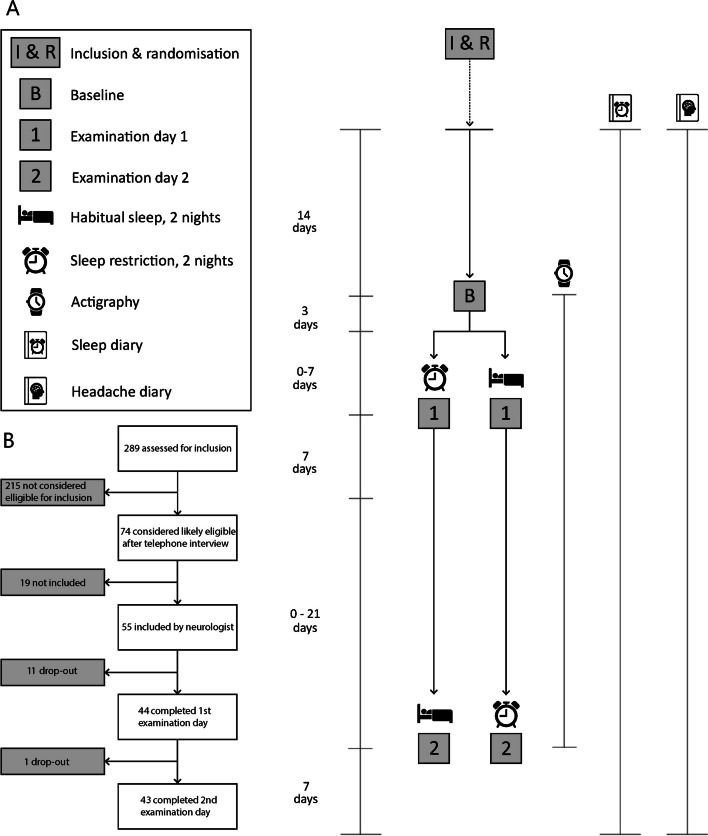
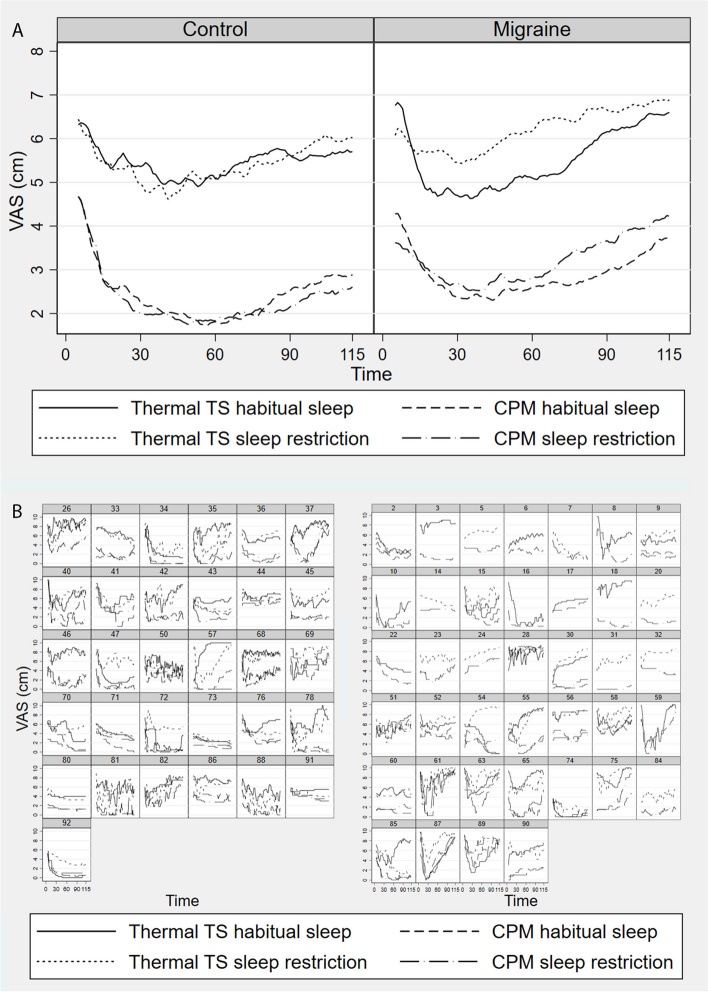
Measurements were conducted in 39 patients with migraine between attacks and 31 controls, once after habitual sleep and once after two consecutive nights of partial sleep restriction. There were 29 and 10 patients with non-sleep-related and sleep-related migraine respectively. Test stimulus was 2-min tonic noxious heat to the left volar forearm. Temporal summation was calculated as the regression coefficient for rated pain in the late part of this 2-min stimulation. Conditioning stimulus was right hand-immersion in 7 °C water. Conditioned pain modulation was defined as the difference in rated pain with and without the conditioning stimulus and was calculated for temporal summation and mean rated pain for the test stimulus. The effect of sleep restriction on temporal summation and conditioned pain modulation was compared in migraine subjects and controls using two-level models with recordings nested in subjects.
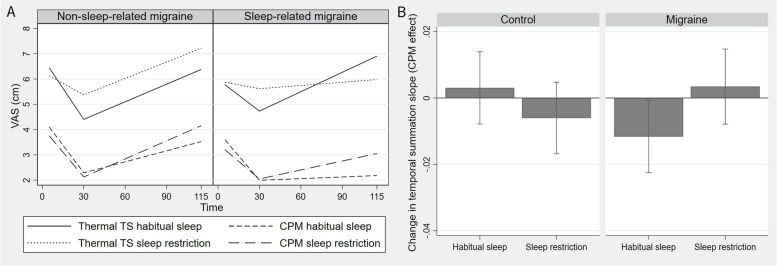
Conditioned pain modulation for temporal summation of heat pain tended to be reduced after sleep restriction in patients with migraine compared to controls (p = 0.060) and, in an exploratory analysis, was reduced more after sleep restriction in sleep-related than in non-sleep-related migraine (p = 0.017). No other differences between groups after sleep restriction were found for temporal summation or conditioned pain modulation.
Patients with migraine may have a subtly altered endogenous pain modulation system. Sleep restriction may have an increased pronociceptive effect on this system, suggesting a mechanism for vulnerability to insufficient sleep in migraine. This effect seems to be larger in sleep-related migraine than in non-sleep-related migraine.
偏头痛患者容易睡眠不足,但睡眠限制的影响在很大程度上尚不清楚。此外,对于大多数发作发生在睡眠期间的偏头痛患者(即所谓的与睡眠相关的偏头痛)与非与睡眠相关的偏头痛患者相比,睡眠的重要性可能有所不同。在这项研究中,我们研究了睡眠限制对偏头痛患者和健康对照者内源性疼痛调节的影响。我们还比较了睡眠限制对与睡眠相关和非与睡眠相关偏头痛的影响。
在发作间期的 39 名偏头痛患者和 31 名对照者中进行了测量,一次是在习惯性睡眠后,另一次是在连续两个晚上的部分睡眠限制后。其中分别有 29 名和 10 名患者为非与睡眠相关和与睡眠相关的偏头痛。测试刺激为左掌心 2 分钟的持续有害热刺激。在该 2 分钟刺激的后期,计算疼痛评分的回归系数作为时间总和。条件刺激为右手浸入 7°C 的水中。条件性疼痛调制定义为有和没有条件刺激时的疼痛评分差异,并为时间总和和测试刺激的平均疼痛评分计算。使用两水平模型和嵌套在受试者中的记录来比较偏头痛患者和对照组中睡眠限制对时间总和和条件性疼痛调制的影响。
与对照组相比,偏头痛患者的热痛时间总和的条件性疼痛调制在睡眠限制后趋于降低(p=0.060),并且在探索性分析中,与非睡眠相关的偏头痛相比,睡眠限制后睡眠相关的偏头痛的降低更为明显(p=0.017)。在睡眠限制后,两组之间在时间总和或条件性疼痛调制方面没有发现其他差异。
偏头痛患者可能有一个微妙改变的内源性疼痛调节系统。睡眠限制可能对该系统产生更强的促痛作用,这表明偏头痛患者对睡眠不足的易感性存在一种机制。这种影响在与睡眠相关的偏头痛中似乎比在非与睡眠相关的偏头痛中更大。