Department of Renal Transplantation, The First Affiliated Hospital of Zhengzhou University, Zhengzhou, Henan, 450052, China.
BGI College & Henan Institute of Medical and Pharmaceutical Sciences, Zhengzhou University, Daxuebei Road No. 40, Zhengzhou, 450052, China.
Orphanet J Rare Dis. 2024 Oct 3;19(1):366. doi: 10.1186/s13023-024-03379-4.
The growing body of research on kidney disease in children has identified a broad spectrum of genetic etiologies.
We conducted a prospective study to evaluate the efficacy of an optimized genetic test and subclinical changes in a real-world context before kidney transplantation. All cases involved recipients under the age of 18 who underwent whole exome sequencing (ES) between 2013 and 2022.
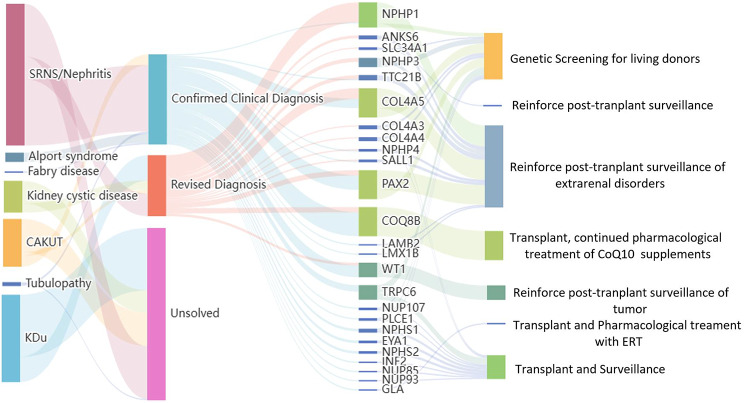
The study population included 244 children, with a median age of 13.1 years at transplantation. ES provided a molecular genetic diagnosis in 114 (46.7%) probands with monogenic variants in 15 known disease-causing genes. ES confirmed the suspected clinical diagnosis in 74/244 (30.3%) cases and revised the pre-exome clinical diagnoses in 40/244 (16.4%) cases. ES also established a specific underlying cause for kidney failure for 19 patients who had previously had an unknown etiology. Genetic diagnosis influenced clinical management in 88 recipients (36.1%), facilitated genetic counseling for 18 families (7.4%), and enabled comprehensive assessment of living donor candidates in 35 cases (14.3%).
Genetic diagnosis provides critical insights into the pathogenesis of kidney disease, optimizes clinical strategies concerning risk assessment of living donors, and enhances disease surveillance of recipients.
越来越多的儿童肾脏病研究已经确定了广泛的遗传病因。
我们进行了一项前瞻性研究,以评估优化后的基因检测在真实世界环境下肾移植前的效果,以及评估其对亚临床变化的影响。所有病例均涉及 2013 年至 2022 年间接受全外显子组测序(ES)的年龄在 18 岁以下的受者。
研究人群包括 244 名儿童,移植时的中位年龄为 13.1 岁。ES 在 15 个已知致病基因中的 114 个(46.7%)先证者中提供了分子遗传学诊断。ES 证实了 244 例中的 74 例(30.3%)疑似临床诊断,并在 244 例中的 40 例(16.4%)中修正了预先进行的外显子临床诊断。ES 还为 19 名先前病因不明的患者确定了肾衰竭的特定潜在病因。88 名受者(36.1%)的遗传诊断影响了临床管理,18 个家庭(7.4%)的遗传诊断促进了遗传咨询,35 个案例(14.3%)的遗传诊断实现了对活体供者候选者的全面评估。
基因诊断为肾脏病的发病机制提供了重要的见解,优化了与活体供者风险评估相关的临床策略,并增强了受者的疾病监测。