
颈椎间盘置换术与后路内镜下颈椎减压术的临床和影像学结果:配对比较分析
Clinical and Radiographic Outcomes of Cervical Disc Replacement Versus Posterior Endoscopic Cervical Decompression: A Matched-Pair Comparison Analysis.
作者信息
Kotheeranurak Vit, Jitpakdee Khanathip, Lewandrowski Kai-Uwe, Lin Guang-Xun, Singhatanadgige Weerasak, Limthongkul Worawat, Yingsakmongkol Wicharn, Kim Jin-Sung, Liawrungrueang Wongthawat
机构信息
Department of Orthopaedics, Faculty of Medicine, Chulalongkorn University, and King Chulalongkorn Memorial Hospital, Bangkok, Thailand.
Center of Excellence in Biomechanics and Innovative Spine Surgery, Chulalongkorn University, Bangkok, Thailand.
出版信息
Neurospine. 2024 Sep;21(3):1040-1050. doi: 10.14245/ns.2448582.291. Epub 2024 Sep 30.
OBJECTIVE
To compare clinical and radiographic outcomes between 2 motion preservation surgeries, cervical disc replacement (CDR) and posterior endoscopic cervical decompression (PECD), for unilateral cervical radiculopathy.
METHODS
Between February 2018 and December 2020, 60 patients with unilateral cervical radiculopathy who underwent either CDR or PECD were retrospectively recruited as matched pairs. Clinical outcomes included visual analogue scale (VAS) scores for neck and arm pain, Neck Disability Index (NDI), and satisfaction rates. The radiographic outcome was index level motion. Intraoperative data, complications, and hospital stay were collected. Preoperative and postoperative outcomes were compared.
RESULTS
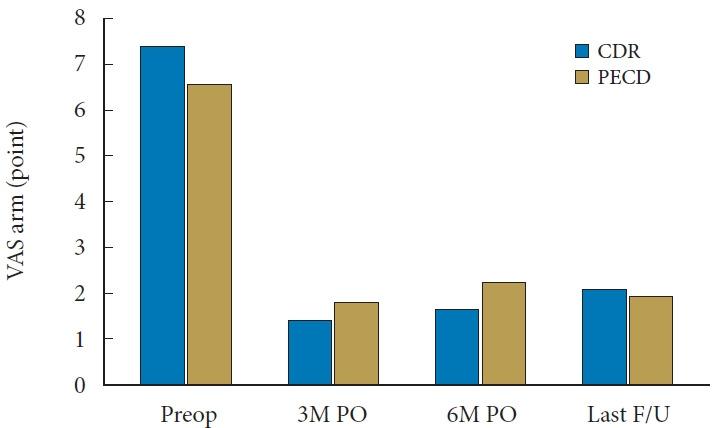
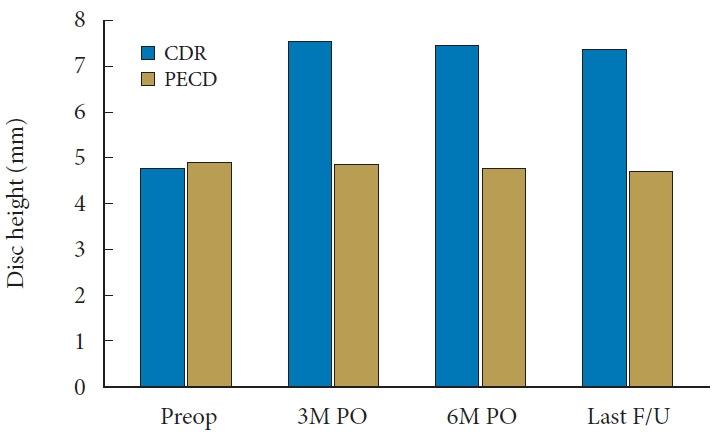
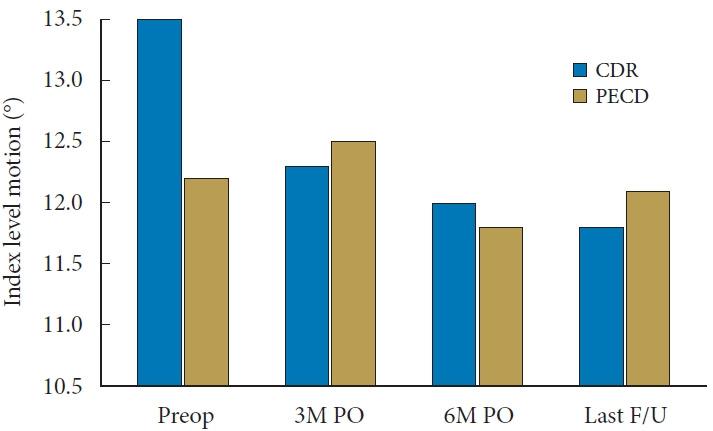
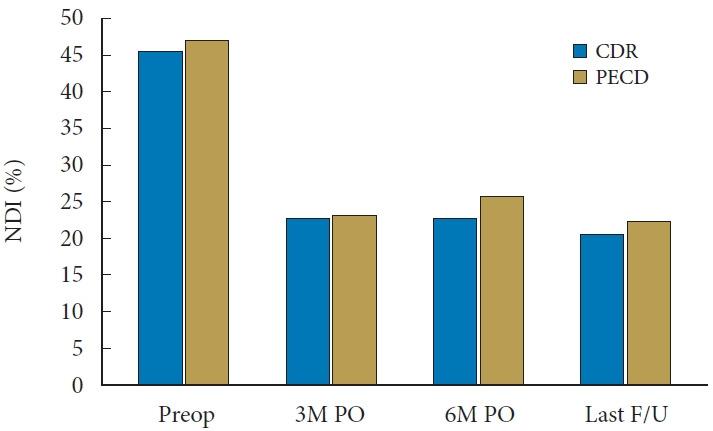
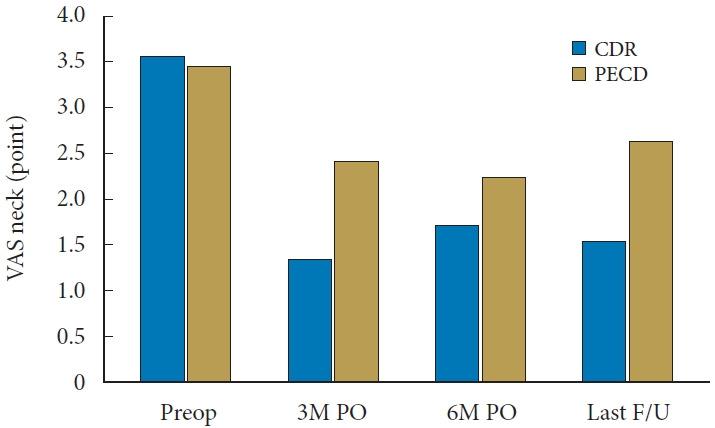
Patients undergoing CDR or PECD were included, with 30 cases in each group. Matched pairs were compared in terms of demographic data and preoperative measurements. CDR was associated with shorter operative times, whereas PECD resulted in less intraoperative blood loss. The total complication rate was 5%. NDI and VAS for neck and arm were significantly improved in both groups, with no significant differences between the 2 groups. Satisfaction rates of good and excellent exceeded 87% in both groups. CDR was superior to PECD in the restoration of disc height. Early postoperative follow-up showed no significant difference in terms of index level motion. PECD demonstrated significantly shorter hospital stays and quicker return-to-work times (p<0.05).
CONCLUSION
PECD achieved equivalent clinical and radiologic outcomes compared with CDR when the certain criteria for surgery were met. Both techniques demonstrated the potential to maintain index level motion. Additionally, PECD resulted in less blood loss, shorter hospital stays, and faster return-to-work times. Conversely, CDR offered shorter operative times and better restoration of disc height.
目的
比较两种保留运动功能的手术——颈椎间盘置换术(CDR)和后路内镜下颈椎减压术(PECD)——治疗单侧神经根型颈椎病的临床和影像学结果。
方法
回顾性纳入2018年2月至2020年12月期间接受CDR或PECD手术的60例单侧神经根型颈椎病患者,将其配对。临床结果包括颈部和手臂疼痛的视觉模拟量表(VAS)评分、颈部功能障碍指数(NDI)和满意率。影像学结果为节段运动。收集术中数据、并发症和住院时间。比较术前和术后结果。
结果
纳入接受CDR或PECD手术的患者,每组30例。根据人口统计学数据和术前测量结果对配对患者进行比较。CDR手术时间较短,而PECD术中出血量较少。总并发症发生率为5%。两组的NDI以及颈部和手臂的VAS均显著改善,两组之间无显著差异。两组的优良满意率均超过87%。CDR在恢复椎间盘高度方面优于PECD。术后早期随访显示节段运动方面无显著差异。PECD的住院时间显著缩短,恢复工作时间更快(p<0.05)。
结论
当满足特定手术标准时,PECD与CDR相比可获得相当的临床和影像学结果。两种技术均显示出维持节段运动的潜力。此外,PECD出血量更少,住院时间更短,恢复工作时间更快。相反,CDR手术时间更短,椎间盘高度恢复更好。
 Zotero 插件