Kilili-Lesta Margarita, Giannakou Konstantinos, Voniati Louiza
Department of Health Sciences, European University Cyprus, Nicosia, Cyprus.
Autism Dev Lang Impair. 2024 Oct 1;9:23969415241286403. doi: 10.1177/23969415241286403. eCollection 2024 Jan-Dec.
Children with autism spectrum disorder (ASD) present with impairments in social interaction and stereotypic behaviors. About a third may exhibit delays in verbal expression beyond preschool age, potentially categorizing them as nonverbal/minimally verbal (NV/MV), a condition that can persist into adulthood and affect their quality of life. The risk and prognostic factors associated with this reduced verbal outcome remain uncertain. This study aims to identify such factors within children diagnosed with ASD in Cyprus.
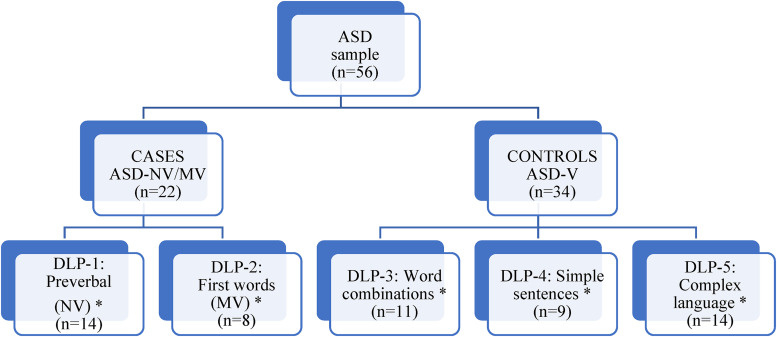
In this case-control study, 56 children aged 3-12 years, with an ASD diagnosis, participated. Among them, cases were 22 children classified as ASD-NV/MV, and controls were 34 children classified as verbal (ASD-V), matched by age group and gender. Retrospective information on familial, perinatal, and developmental risk and prognostic factors were collected to calculate the familial risk score (FRS), perinatal risk score (PRS), and developmental risk score (DRS). Early development information was collected for the Early Development Score (EDS) and Early Gesture Score (EGS), to measure the children's skill level as toddlers across milestones. A low EDS and/or low EGS reflected general developmental delays and decreased frequency of early gestures and were considered in the DRS. A parent report questionnaire was utilized to determine the current overall linguistic level and status of participants, distinguishing cases from controls.
Age group and gender-matched cases and controls were similar in socioeconomic status and demographic characteristics ( > .05). Among the various familial (e.g., sibling with ASD), perinatal (e.g., prematurity), and developmental (e.g., ASD regression) factors examined individually, as well as collectively as scores in a conditional logistic regression (CLR) model, only a high DRS ( = .03), due to low EDS ( = .04) was significantly associated with linguistic status. When considering all risk scores in a multivariate CLR model, children with a high DRS were more likely to belong to the cases than to the control group ( = .02). In a subsequent model with low EDS and low EGS, only the low EDS was significantly associated with the case group. Results showed that children with ASD and a low EDS, reflecting general delays in early development, were 4.5 times more likely to belong to the cases group than those with a high EDS ( = .02).
Early developmental delays in developmental milestones across various domains like gesture, motor, play, linguistic, cognition, and joint attention, in toddlerhood, were associated with later decreased verbal outcomes. Children in the sample with such early delays (low EDS), had a higher likelihood of persistent language delays (ASD-NV/MV) even at late school age. Future studies are needed to duplicate findings and explore possible contributing factors affecting linguistic outcome in ASD through prospective studies exploring within ASD differences.
These findings emphasized the importance of monitoring early development closely for children at risk for ASD, pre-diagnosis, to provide additional early support for those more likely to be ASD-NV/MV. Parents and specialists like pediatricians, educators, speech-language pathologists, among others, can track the EDS score of children at risk for ASD and refer to the appropriate specialists for early stimulation, intervention, and parent consultation promptly.
自闭症谱系障碍(ASD)儿童存在社交互动和刻板行为障碍。约三分之一的儿童可能在学龄前之后出现语言表达延迟,这可能使他们被归类为非言语/极少言语(NV/MV),这种情况可能持续到成年并影响他们的生活质量。与这种语言能力下降相关的风险和预后因素仍不确定。本研究旨在确定塞浦路斯被诊断为ASD的儿童中的此类因素。
在这项病例对照研究中,56名年龄在3至12岁、被诊断为ASD的儿童参与其中。其中,病例组为22名被归类为ASD-NV/MV的儿童,对照组为34名被归类为有言语能力(ASD-V)的儿童,按年龄组和性别进行匹配。收集有关家族、围产期和发育风险及预后因素的回顾性信息,以计算家族风险评分(FRS)、围产期风险评分(PRS)和发育风险评分(DRS)。收集早期发育信息以获取早期发育评分(EDS)和早期手势评分(EGS),以衡量儿童在幼儿期跨越各个发育阶段的技能水平。低EDS和/或低EGS反映了一般发育延迟以及早期手势频率降低,并被纳入DRS。使用一份家长报告问卷来确定参与者当前的总体语言水平和状况,以区分病例组和对照组。
年龄组和性别匹配的病例组和对照组在社会经济地位和人口统计学特征方面相似(P>0.05)。在单独检查的各种家族因素(如患有ASD的兄弟姐妹)、围产期因素(如早产)和发育因素(如ASD退化)中,以及在条件逻辑回归(CLR)模型中作为分数进行综合检查时,只有因低EDS(P = 0.04)导致的高DRS(P = 0.03)与语言状况显著相关。在多变量CLR模型中考虑所有风险评分时,DRS高的儿童比对照组儿童更有可能属于病例组(P = 0.02)。在随后包含低EDS和低EGS的模型中,只有低EDS与病例组显著相关。结果表明,ASD儿童中,反映早期发育一般延迟的低EDS儿童属于病例组的可能性是高EDS儿童的4.5倍(P = 0.02)。
幼儿期在手势、运动、玩耍、语言、认知和共同注意等各个领域的发育里程碑出现早期发育延迟,与后期语言能力下降有关。样本中出现此类早期延迟(低EDS)的儿童,即使在学龄后期,持续存在语言延迟(ASD-NV/MV)的可能性也更高。未来需要通过前瞻性研究重复这些发现,并探索影响ASD语言结局的可能因素,研究ASD内部的差异。
这些发现强调了在ASD风险儿童诊断前密切监测早期发育的重要性,以便为那些更有可能成为ASD-NV/MV的儿童提供额外的早期支持。家长以及儿科医生、教育工作者、言语语言病理学家等专家,可以跟踪有ASD风险儿童的EDS评分,并及时将其转介给合适的专家进行早期刺激、干预和家长咨询。
