Department of Gastroenterology, Chongqing General Hospital, Chongqing, China.
Department of Gastroenterology, Children's Hospital of Chongqing Medical University, National Clinical Research Center for Child Health and Disorders, Ministry of Education Key Laboratory of Child Development and Disorders, Chongqing Key Laboratory of Pediatrics, Chongqing Key Laboratory of Child Health and Nutrition, Chongqing, China.
Clin Exp Med. 2024 Oct 4;24(1):237. doi: 10.1007/s10238-024-01483-0.
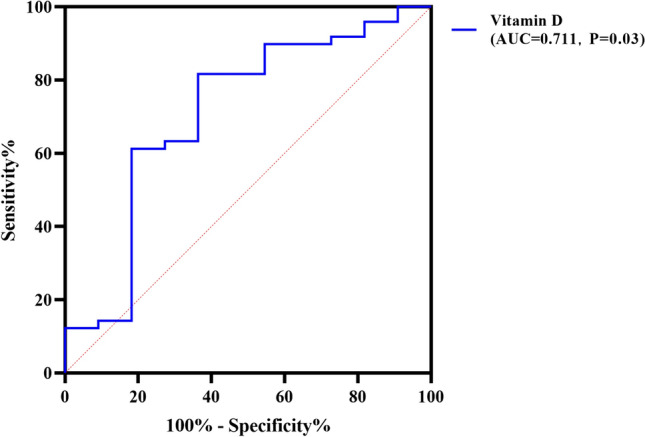
The aim was to evaluate predictors of clinical outcomes in infliximab (IFX)-treated Crohn's disease (CD) patients in western China and provide evidence for future treatment optimization. Our retrospective study included CD patients at Chongqing General Hospital from July 2022 to July 2023. Clinical data of CD patients at baseline and the endpoint (the seventh IFX treatment, 38 weeks) were collected. Baseline variables of IFX-treated patients with regard to clinical remission [Crohn's Disease Activity Index (CDAI) < 150] at endpoint were assessed, and the correlation of serum vitamin D (Vit-D) levels before initiating IFX therapy and CDAI at week 38 was analyzed. Sixty patients with IFX-treated CD were included. The Vit-D-deficient rate was 51.7% at baseline, 81.7% of patients achieved clinical remission, and 66.7% achieved endoscopic remission at week 38 of IFX treatment. Vit-D level at baseline was an independent predictors of clinical remission after IFX treatment (P < 0.05). Receiver operating characteristic curve analysis showed that when Vit-D concentration was 15.81 ng/ml, the area under the curve was 0.711 (95% CI 0.523-0.899, P = 0.03). The sensitivity and specificity were 81.6% and 63.6%, respectively. Vit-D level in the normal BMI, non-smoking, immunosuppressant-treated subgroup had independent predictive value for CDAI at endpoint (P < 0.05). Baseline Vit-D level predicted clinical remission in CD patients after IFX treatment, especially in those with normal body mass index, who do not smoke, and who take IFX in combination with immunosuppressants.
目的在于评估中国西部接受英夫利昔单抗(IFX)治疗的克罗恩病(CD)患者的临床结局预测因子,并为未来的治疗优化提供证据。本回顾性研究纳入了 2022 年 7 月至 2023 年 7 月期间在重庆医科大学附属第一医院就诊的 CD 患者。收集了患者基线和终点(第 7 次 IFX 治疗,38 周)的临床数据。评估了 IFX 治疗患者在终点时达到临床缓解(CDAI<150)的基线变量,并分析了起始 IFX 治疗前血清维生素 D(Vit-D)水平与第 38 周 CDAI 的相关性。纳入 60 例接受 IFX 治疗的 CD 患者。基线时 Vit-D 缺乏率为 51.7%,81.7%的患者达到临床缓解,66.7%的患者在 IFX 治疗第 38 周时达到内镜缓解。基线时 Vit-D 水平是 IFX 治疗后临床缓解的独立预测因子(P<0.05)。受试者工作特征曲线分析显示,当 Vit-D 浓度为 15.81ng/ml 时,曲线下面积为 0.711(95%CI 0.523-0.899,P=0.03)。敏感性和特异性分别为 81.6%和 63.6%。正常 BMI、不吸烟、接受免疫抑制剂治疗亚组的 Vit-D 水平对终点 CDAI 具有独立的预测价值(P<0.05)。基线 Vit-D 水平可预测 IFX 治疗后 CD 患者的临床缓解,尤其对正常体重指数、不吸烟和接受 IFX 联合免疫抑制剂治疗的患者具有预测价值。