Ward Jacob, Damante Mark, Wilson Seth, Coelho Vicente, Franceschelli Dominic, Elguindy Ahmed Nader, Thomas Evan M, Zhu Simeng, Blakaj Dukagjin, Beyer Sasha, Raval Raju, Singh Raj, Xu David S, Elder J Bradley, Palmer Joshua D, Chakravarthy Vikram B
The Ohio State University College of Medicine, Columbus, USA.
Department of Neurological Surgery, The Ohio State University Wexner Medical Center, Columbus, USA.
J Neurooncol. 2025 Jan;171(1):155-162. doi: 10.1007/s11060-024-04842-9. Epub 2024 Oct 4.
Spine metastases are a major burden of oncologic care, contributing to substantial morbidity. A well-established treatment paradigm for patients with metastatic epidural spinal cord compression includes separation surgery followed by stereotactic body radiotherapy (SBRT). Innovations in implant technology have brought about the incorporation of Carbon fiber-reinforced polyetheretherketone (CFR-PEEK) instrumentation for spinal fixation. We present our experience of CFR-PEEK instrumentation, comparing outcomes and complication profiles with a matched cohort of titanium instrumented cases for spine metastatic disease.
Oncology patients who underwent spinal fusion for metastatic spine disease from 2012 to 2023 were retrospectively reviewed. Ninety-nine cases with CFR-PEEK fusions were case-control matched with 50 titanium controls (2:1 ratio) based upon primary tumor type and spinal instability neoplastic score (SINS) location. Demographic, clinical, radiographic and progression free survival (PFS) were analyzed.
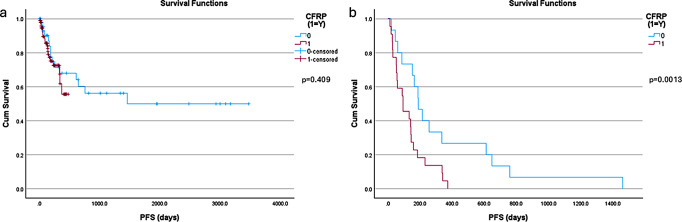
In the study years, 263 patients underwent spinal decompression and fusion, for which 148 patients met predetermined inclusion criteria. Of these, 49 had titanium instrumentation, and 99 had CFR-PEEK. Complication profiles, including hardware failure and infection were similar between the groups. There was no significant difference in PFS between all CFR-PEEK and titanium patients (143 days versus 214 days; p = 0.41). When comparing patients in which recurrence was noted, CFR-PEEK patients had recurrence detected two times earlier than titanium patients (94 days versus 189 days; p = 0.013).
In this case matched cohort, CFR-PEEK demonstrated decreased overall PFS suggestive of earlier local recurrence identification. Long-term studies are warranted for better evaluation of the impact on survival and systemic disease progression.
脊柱转移瘤是肿瘤治疗的一项主要负担,会导致严重的发病率。对于转移性硬膜外脊髓压迫患者,一种成熟的治疗模式包括减压手术,随后进行立体定向体部放疗(SBRT)。植入技术的创新带来了用于脊柱固定的碳纤维增强聚醚醚酮(CFR-PEEK)器械的应用。我们介绍我们使用CFR-PEEK器械的经验,将结果和并发症情况与一组匹配的脊柱转移性疾病钛合金器械病例进行比较。
对2012年至2023年因转移性脊柱疾病接受脊柱融合术的肿瘤患者进行回顾性研究。根据原发肿瘤类型和脊柱不稳定肿瘤评分(SINS)位置,将99例CFR-PEEK融合病例与50例钛合金对照病例进行病例对照匹配(2:1比例)。分析人口统计学、临床、影像学和无进展生存期(PFS)。
在研究期间,263例患者接受了脊柱减压和融合术,其中148例患者符合预定的纳入标准。其中,49例使用钛合金器械,99例使用CFR-PEEK。两组之间的并发症情况,包括器械故障和感染相似。所有CFR-PEEK患者和钛合金患者的PFS无显著差异(143天对214天;p = 0.41)。当比较有复发记录的患者时,CFR-PEEK患者复发检测时间比钛合金患者早两倍(94天对189天;p = 0.013)。
在这个病例匹配队列中,CFR-PEEK显示总体PFS降低,提示更早识别局部复发。需要进行长期研究以更好地评估对生存和全身疾病进展的影响。