Ide Takayuki, Araki Taisuke, Koizumi Tomonobu
Department of Pharmacy, Shinshu University Hospital, 3-1-1 Asahi Matsumoto-Shi, Nagano, 390-8621, Japan.
First Department of Internal Medicine, Shinshu University School of Medicine, 3-1-1 Asahi Matsumoto-Shi, Nagano, 390-8621, Japan.
Discov Oncol. 2024 Oct 5;15(1):527. doi: 10.1007/s12672-024-01416-z.
Thromboembolism (TE) is a well-known complication during chemotherapy in cancer patients. However, the risk of TE associated with immune checkpoint inhibitors (ICIs) is unknown. This study was performed to investigate the incidence of TE and associated risk factors in patients treated with ICIs.
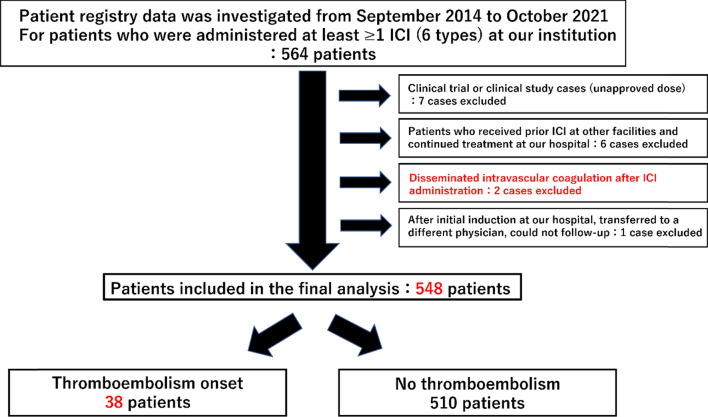
We conducted a retrospective chart survey of patients receiving at least one ICI at Shinshu University Hospital between September 2014 and October 2021. Age, sex, cancer type, body mass index, medical history, laboratory data at commencement of treatment, and medication data were obtained from electronic medical records. TE events (venous thromboembolism [VTE], arterial thromboembolism [ATE]) were identified after ICI initiation.
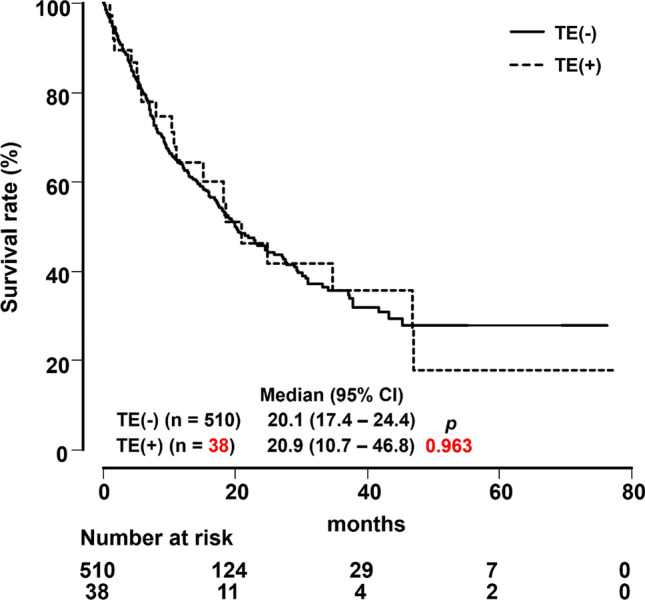
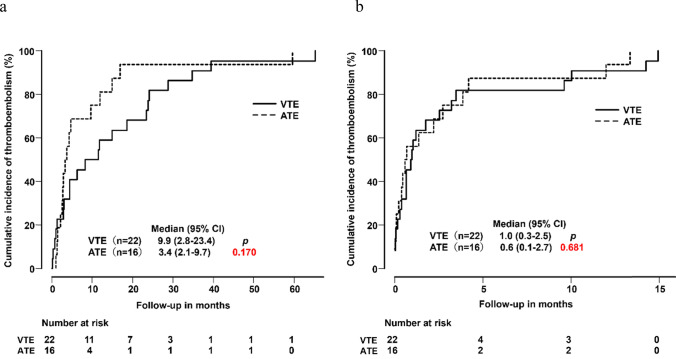
The study population consisted of 548 patients with a median age of 70.0 (19-89) years, 71.4% men, and a median follow-up of 15.1 months (range; 0.16-72.0 months). Nivolumab was the most commonly used ICI (45.8%), followed by pembrolizumab (23.9%), pembrolizumab plus anticancer drugs (7.8%), and nivolumab plus ipilimumab (5.1%). Thirty-eight cases of TE (6.9%) occurred (22 VTE, 16 ATE). Risk factors significantly associated with TE in multivariate logistic analysis were dyslipidemia (OR 2.44; 95% CI 1.17-5.09; p = 0.017), Khorana score ≥ 2 (HR 2.40; 95% CI 1.14-5.04; p = 0.021). Overall survival was not significantly different from patients without TE (p = 0.963).
These results suggested that the frequency of TE is higher than expected and should be considered and monitored in patients treated with ICIs.
血栓栓塞(TE)是癌症患者化疗期间一种众所周知的并发症。然而,与免疫检查点抑制剂(ICI)相关的TE风险尚不清楚。本研究旨在调查接受ICI治疗的患者中TE的发生率及相关危险因素。
我们对2014年9月至2021年10月期间在信州大学医院接受至少一剂ICI治疗的患者进行了回顾性病历调查。从电子病历中获取年龄、性别、癌症类型、体重指数、病史、治疗开始时的实验室数据和用药数据。在开始使用ICI后识别TE事件(静脉血栓栓塞 [VTE]、动脉血栓栓塞 [ATE])。
研究人群包括548例患者,中位年龄为70.0(19 - 89)岁,男性占71.4%,中位随访时间为15.1个月(范围:0.16 - 72.0个月)。纳武单抗是最常用的ICI(45.8%),其次是帕博利珠单抗(23.9%)、帕博利珠单抗加抗癌药物(7.8%)和纳武单抗加伊匹木单抗(5.1%)。发生了38例TE(6.9%)(22例VTE,16例ATE)。多因素逻辑分析中与TE显著相关的危险因素是血脂异常(OR 2.44;95% CI 1.17 - 5.09;p = 0.017)、科纳纳评分≥2(HR 2.40;95% CI 1.14 - 5.04;p = 0.021)。总体生存率与无TE的患者无显著差异(p = 0.963)。
这些结果表明,TE的发生率高于预期,在接受ICI治疗的患者中应予以考虑和监测。