School of Public Health, University of California, Berkeley, 2121 Berkeley Way, Berkeley, CA, 94720-7360, USA.
Wallace Center for Maternal, Child, and Adolescent Health, School of Public Health, University of California, Berkeley, 2121 Berkeley Way, Berkeley, CA, 94720-7360, USA.
Matern Child Health J. 2024 Nov;28(11):1990-1999. doi: 10.1007/s10995-024-03997-1. Epub 2024 Oct 5.
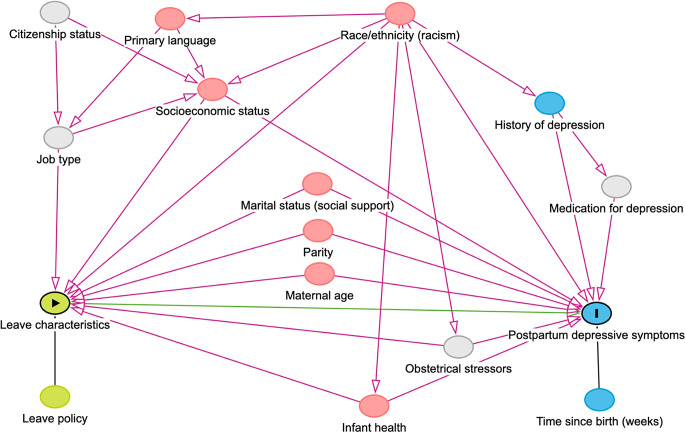
The United States is the only high-income country without a comprehensive national maternity leave policy guaranteeing paid, job-projected leave. The current study examined associations between maternity leave characteristics (duration of leave, payment status of leave) and postpartum depressive symptoms.
This study used a sample of 3,515 postpartum women from the New York City and New York State Pregnancy Risk Assessment Monitoring System (PRAMS) from 2016 to 2019. We used logistic regression to examine the association of leave duration and payment status with self-reported postpartum depressive symptoms between 2 and 6 months postpartum.
Compared to having at least some paid leave, having unpaid leave was associated with an increased odds of postpartum depressive symptoms, adjusting for leave duration and selected covariates (adjusted odds ratio [aOR] = 1.41, 95% confidence interval [CI]: 1.04-1.93). There was no significant difference in postpartum depressive symptoms between those with partially and those with fully paid leave. In contrast to prior literature, leave duration was not significantly associated with postpartum depressive symptoms (aOR = 0.99, 95% CI: 0.97-1.02 for each additional week of leave).
This study suggests that unpaid leave is associated with increased risk of postpartum depression, which can have long-term health effects for both mothers and children. Future studies can help to identify which communities could most benefit from paid leave and help to inform paid leave policies.
美国是唯一的高收入国家,没有全面的国家产假政策来保障带薪、有工作保障的休假。本研究调查了产假特征(休假时长、休假薪酬状况)与产后抑郁症状之间的关联。
本研究使用了 2016 年至 2019 年来自纽约市和纽约州妊娠风险评估监测系统(PRAMS)的 3515 名产后妇女的样本。我们使用逻辑回归检验了 2 至 6 个月产后报告的产后抑郁症状与休假时长和薪酬状况之间的关系。
与至少有部分带薪休假相比,无薪休假与产后抑郁症状的几率增加相关,调整了休假时长和选定的协变量(调整后的优势比[aOR] = 1.41,95%置信区间[CI]:1.04-1.93)。部分带薪休假和完全带薪休假之间的产后抑郁症状没有显著差异。与先前的文献不同,休假时长与产后抑郁症状无显著关联(每增加一周休假,aOR = 0.99,95%CI:0.97-1.02)。
本研究表明,无薪休假与产后抑郁风险增加有关,这可能对母亲和儿童的长期健康都有影响。未来的研究可以帮助确定哪些社区最需要带薪休假,并为带薪休假政策提供信息。