Pfizer Inc., 21717 30th Dr SE, Bothell, WA, 98021, USA.
Integrated Drug Development, Certara USA, Princeton, NJ, USA.
Clin Pharmacokinet. 2024 Oct;63(10):1477-1487. doi: 10.1007/s40262-024-01412-0. Epub 2024 Oct 5.
Tucatinib is a highly selective, oral, reversible, human epidermal growth factor receptor 2 (HER2)-specific tyrosine kinase inhibitor. Tucatinib is approved at a 300-mg twice-daily dose in adults in combination with trastuzumab and capecitabine for advanced HER2-postitive (HER2+) unresectable or metastatic breast cancer and in combination with trastuzumab for RAS wild-type HER2+ unresectable or metastatic colorectal cancer. This study sought to characterize the pharmacokinetics (PK) and assess sources of PK variability of tucatinib in healthy volunteers and in patients with HER2+ metastatic breast or colorectal cancers.
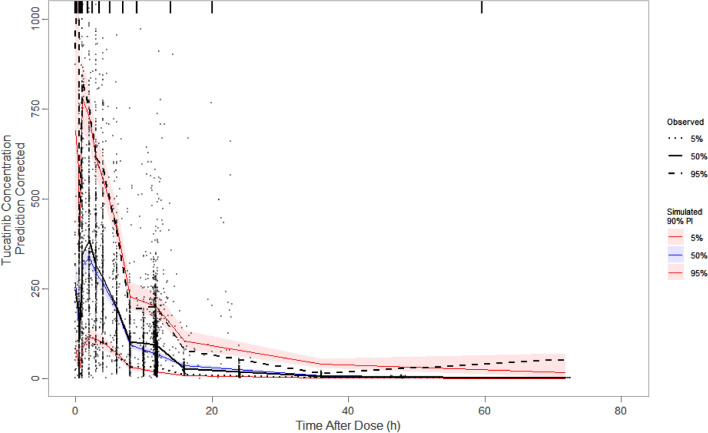
A population pharmacokinetic model was developed based on data from four healthy participant studies and three studies in patients with either HER2+ metastatic breast cancer or metastatic colorectal cancer using a nonlinear mixed-effects modeling approach. Clinically relevant covariates were evaluated to assess their impact on exposure, and overall model performance was evaluated by prediction-corrected visual predictive checks.
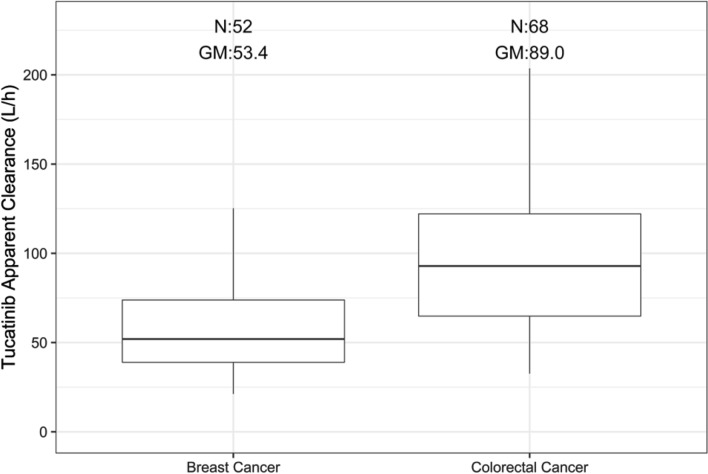
A two-compartment pharmacokinetic model with linear elimination and first-order absorption preceded by a lag time adequately described tucatinib pharmacokinetic profiles in 151 healthy participants and 132 patients. Tumor type was identified as a significant covariate affecting tucatinib bioavailability and clearance, resulting in a 1.2-fold and 2.1-fold increase in tucatinib steady-state exposure (area under the concentration-time curve) in HER2+ metastatic colorectal cancer and HER2+ metastatic breast cancer, respectively, compared with healthy participants. No other covariates, including mild renal or hepatic impairment, had an impact on tucatinib pharmacokinetics.
The impact of statistically significant covariates identified was not considered clinically meaningful. No tucatinib dose adjustments are required based on the covariates tested in the final population pharmacokinetic model.
NCT03723395, NCT03914755, NCT03826602, NCT03043313, NCT01983501, NCT02025192.
妥卡替尼是一种高度选择性的、口服的、可逆的、人表皮生长因子受体 2(HER2)特异性酪氨酸激酶抑制剂。妥卡替尼以 300mg 每日两次的剂量批准用于与曲妥珠单抗和卡培他滨联合用于不可切除或转移性 HER2 阳性(HER2+)乳腺癌,以及与曲妥珠单抗联合用于不可切除或转移性 RAS 野生型 HER2+结直肠癌的成人患者。本研究旨在描述健康志愿者和 HER2+转移性乳腺癌或结直肠癌患者中妥卡替尼的药代动力学(PK)特征,并评估 PK 变异性的来源。
采用非线性混合效应模型方法,基于来自四项健康参与者研究和三项 HER2+转移性乳腺癌或转移性结直肠癌患者研究的数据,建立群体 PK 模型。评估了临床相关协变量对暴露的影响,并通过预测校正可视化预测检查评估了整体模型性能。
妥卡替尼 PK 特征在 151 名健康参与者和 132 名患者中,用一个两室模型加线性消除和一级吸收,且吸收前有滞后时间来充分描述。肿瘤类型被确定为影响妥卡替尼生物利用度和清除率的显著协变量,与健康参与者相比,HER2+转移性结直肠癌和 HER2+转移性乳腺癌患者的妥卡替尼稳态暴露(浓度-时间曲线下面积)分别增加了 1.2 倍和 2.1 倍。其他协变量,包括轻度肾功能或肝功能损害,对妥卡替尼药代动力学没有影响。
所确定的具有统计学意义的协变量的影响不被认为具有临床意义。根据最终群体 PK 模型中测试的协变量,不需要调整妥卡替尼的剂量。
NCT03723395、NCT03914755、NCT03826602、NCT03043313、NCT01983501、NCT02025192。