Department of Radiology, The Sixth Affiliated Hospital, Sun Yat-Sen University, Guangzhou, People's Republic of China; Biomedical Innovation Center, The Sixth Affiliated Hospital, Sun Yat-sen University, Guangzhou, People's Republic of China.
Department of Radiology, Yunnan Cancer Hospital, The Third Affiliated Hospital of Kunming Medical University, Kunming, People's Republic of China.
ESMO Open. 2024 Oct;9(10):103735. doi: 10.1016/j.esmoop.2024.103735. Epub 2024 Oct 4.
Early-onset rectal cancer (EORC) is characterized by a unique disease process with different clinicopathological features compared with late-onset rectal cancer (LORC). Research on the risk of recurrence in EORC patients, however, is limited. We aim to develop a predictive model to accurately predict EORC recurrence risk.
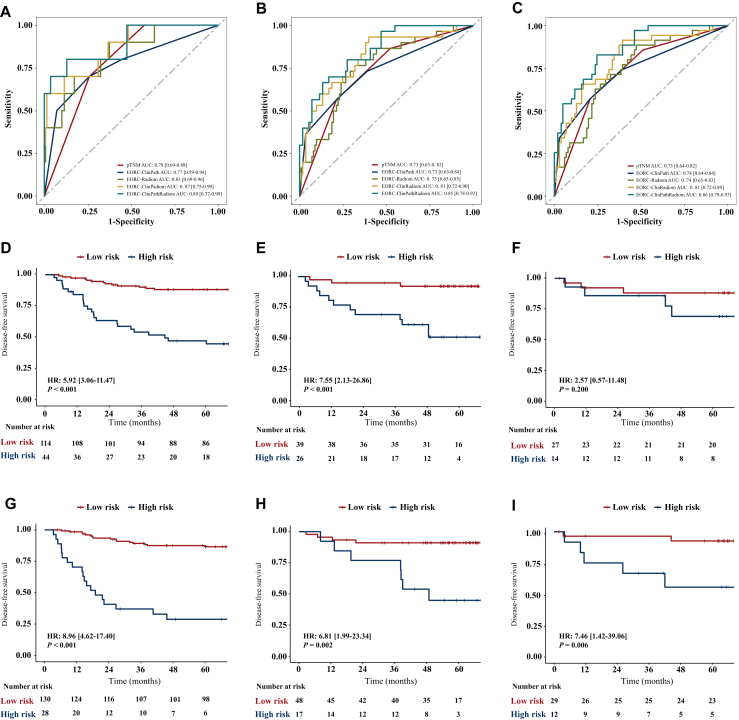
Rectal cancer patients who underwent radical surgery and T2-weighted imaging and diffusion-weighted imaging magnetic resonance imaging (MRI) were retrospectively enrolled from three medical institutions from November 2012 to November 2018. Differences in clinicopathological characteristics between EORC and LORC were compared. Five prediction models for disease-free survival were constructed based on clinicopathological variables and five radiomic features from pretreatment MRI of the EORC. A fixed cut-off value calculated in the training set was used to stratify EORC patients into high-risk and low-risk groups of post-operative recurrence. Model performance was evaluated by concordance index (C-index) and receiver operating characteristic curve.
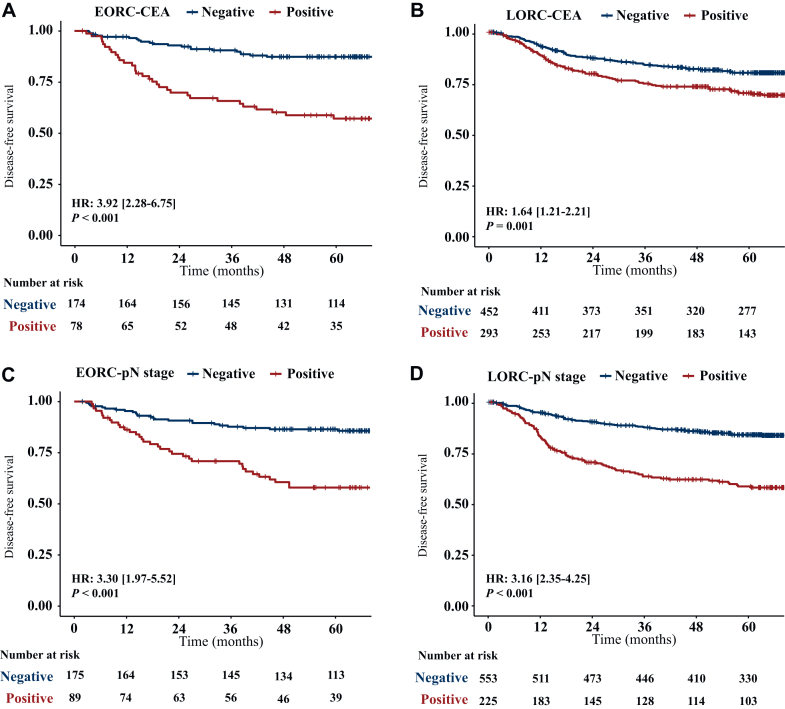
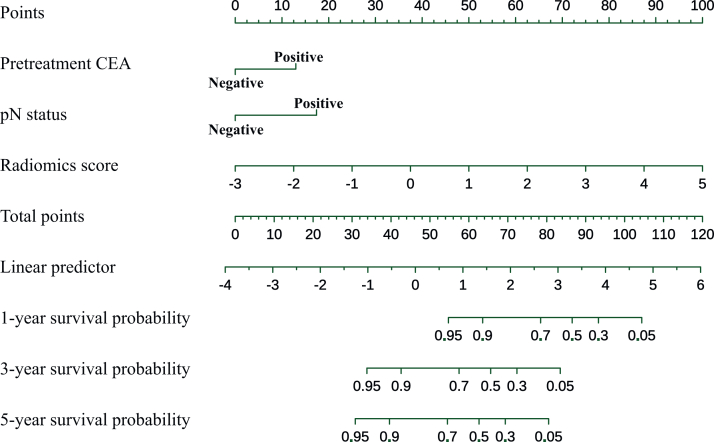
A total of 264 EORC patients (median age, 43 years, 163 males) and 778 LORC patients (median age, 62 years, 520 males) were enrolled. Pretreatment positive carcinoembryonic antigen [hazard ratio (HR) = 2.84, P = 0.006], pathological positive lymph node status (pN positive) [HR = 2.86, P = 0.011] and MRI-based radiomics score [HR = 2.72, P < 0.001] are independent risk factors for disease-free survival in EORC patients. The EORC-ClinPathRadiom model, constructed by integrating the clinicopathological characteristics and MRI-based radiomics features of EORC, showed C-index of 0.82, 0.82, and 0.81 in the training, internal, and external test sets, respectively. This model effectively stratified EORC patients into high risk and low risk of recurrence (HRs for the training, internal, and external test sets were 8.96, 6.81, and 7.46, respectively).
The EORC-ClinPathRadiom model can effectively predict and stratify the risk of post-operative recurrence in EORC patients.
早发性直肠癌(EORC)的疾病进程具有独特的特点,与晚发性直肠癌(LORC)相比,具有不同的临床病理特征。然而,对于 EORC 患者复发风险的研究是有限的。我们旨在开发一种预测模型,以准确预测 EORC 复发风险。
回顾性纳入 2012 年 11 月至 2018 年 11 月三家医疗机构接受根治性手术和 T2 加权成像及弥散加权成像磁共振成像(MRI)的直肠癌患者。比较 EORC 和 LORC 患者的临床病理特征差异。基于 EORC 患者术前 MRI 的临床病理变量和 5 个放射组学特征构建 5 种无病生存预测模型。在训练集中计算固定截断值,将 EORC 患者分层为术后复发的高危和低危组。通过一致性指数(C-index)和受试者工作特征曲线评估模型性能。
共纳入 264 例 EORC 患者(中位年龄 43 岁,男性 163 例)和 778 例 LORC 患者(中位年龄 62 岁,男性 520 例)。术前阳性癌胚抗原[风险比(HR)=2.84,P=0.006]、病理阳性淋巴结状态(pN 阳性)[HR=2.86,P=0.011]和基于 MRI 的放射组学评分[HR=2.72,P<0.001]是 EORC 患者无病生存的独立危险因素。EORC-ClinPathRadiom 模型,由 EORC 的临床病理特征和基于 MRI 的放射组学特征集成构建,在训练、内部和外部测试集中的 C-index 分别为 0.82、0.82 和 0.81。该模型有效地将 EORC 患者分为复发高风险和低风险组(训练、内部和外部测试集的 HR 分别为 8.96、6.81 和 7.46)。
EORC-ClinPathRadiom 模型可有效预测和分层 EORC 患者术后复发风险。