Hughes R T, Prasad J J, Razavian N B, Ververs J D, Snavely A C, Nightingale C L, Weaver K E, Chan M D, Farris M K
Department of Radiation Oncology, Wake Forest University School of Medicine, Winston Salem, North Carolina, United States.
Department of Psychology, Colorado State University College of Natural Sciences, Fort Collins, Colorado, United States.
Clin Oncol (R Coll Radiol). 2024 Dec;36(12):809-816. doi: 10.1016/j.clon.2024.09.006. Epub 2024 Sep 20.
During the COVID-19 public health emergency, we previously identified decreased rates of radiotherapy (RT) peer review (PR) discussion and plan changes in virtual versus in-person PR conferences. To expand on these findings, we continued to prospectively collect data on all PR conferences from 2021 to 2023 and performed a follow-up analysis before and after the transition back to in-person PR.
A prospectively maintained database of weekly PR cases was queried for consecutive cases reviewed before and after the transition from virtual to in-person conferences. Rates of PR discussion and change recommendations were summarized and compared between the virtual and in-person groups. A survey was developed and administered to assess participants' perceived levels of engagement, opinions on optimal PR format, and preferences for future meetings before and 3 months after the transition back to in-person PR.
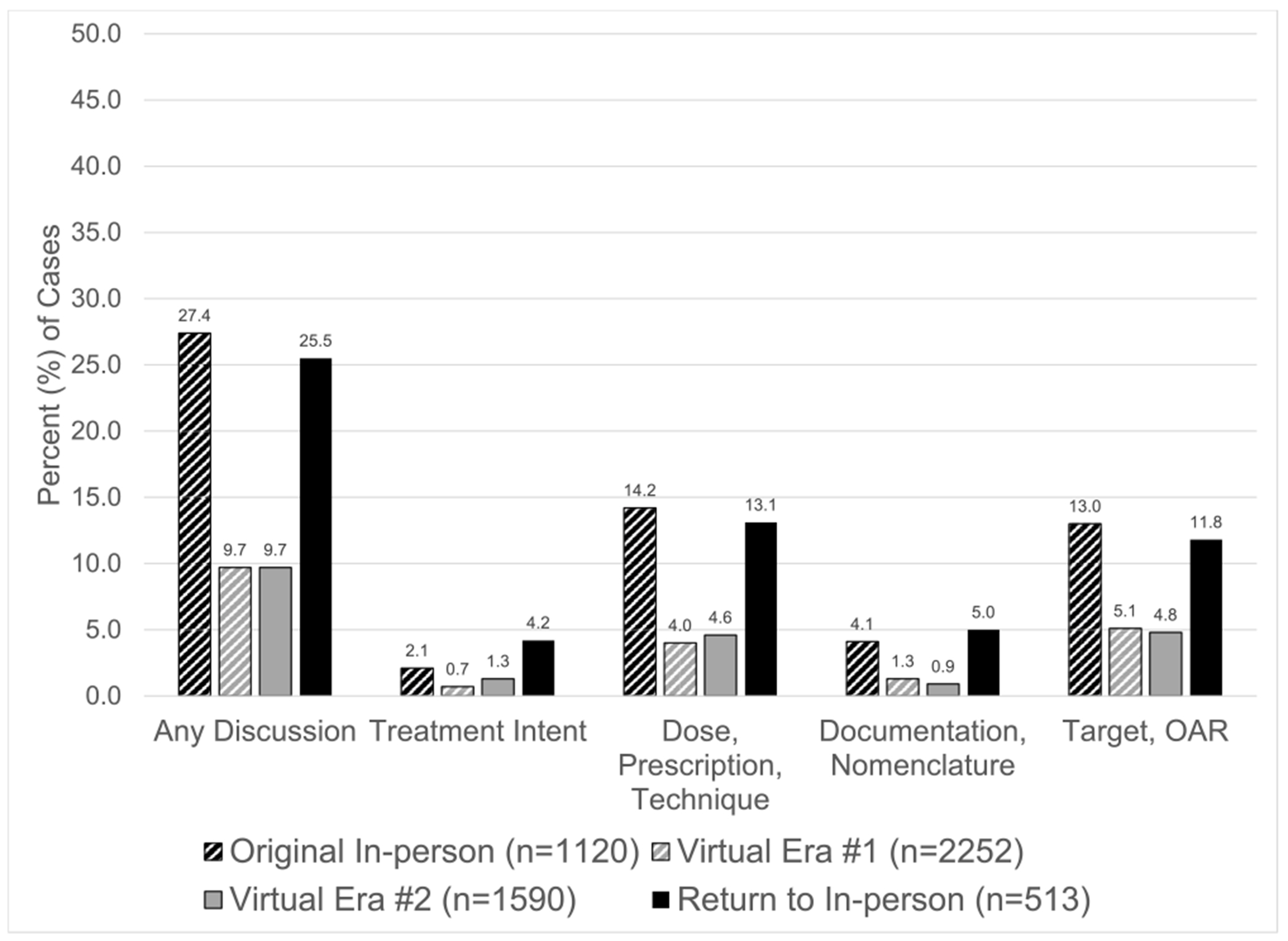
In total, 2,103 RT plans were reviewed: 1,590 virtually and 513 after the transition back to in-person. There was no difference in faculty attendance between groups. The proportion of cases with PR discussion increased from virtual (9.8%) to in-person (25.5%) format (p < 0.001). In the virtual group, 8.1% of cases had 1 topic and 1.7% had 2+ topics discussed. This increased to 15.8% and 9.7% during in-person PR, respectively (p < 0.001). The rate of change recommendation also increased from 1.5% (virtual) to 3.3% (in-person, p = 0.016). Among cases with at least 1 topic discussed, there was no difference in changes. Survey-reported distraction significantly decreased from virtual to in-person PR (p < 0.001).
Upon returning to in-person PR conferences, peer discussion and plan change recommendations significantly increased and returned to pre-pandemic levels, and participants' perceived levels of distraction were reduced. In an increasingly virtual world, additional efforts to develop best practices that maximize PR discussion and minimize distraction outside virtual conferences are warranted.
在新冠疫情公共卫生紧急事件期间,我们之前发现与面对面同行评审(PR)会议相比,虚拟PR会议中放射治疗(RT)同行评审讨论和计划变更的发生率有所下降。为了进一步阐述这些发现,我们继续前瞻性收集2021年至2023年所有PR会议的数据,并在恢复面对面PR会议前后进行了随访分析。
查询前瞻性维护的每周PR病例数据库,获取从虚拟会议过渡到面对面会议前后连续审查的病例。总结并比较虚拟组和面对面组的PR讨论率和变更建议率。在恢复面对面PR会议前及之后3个月,开展并实施一项调查,以评估参与者的参与度感知水平、对最佳PR形式的看法以及对未来会议形式的偏好。
总共审查了2103份RT计划:1590份通过虚拟方式审查,513份在恢复面对面审查后审查。两组教员出席率无差异。PR讨论病例的比例从虚拟形式(9.8%)增加到面对面形式(25.5%)(p<0.001)。在虚拟组中,8.1%的病例讨论了1个主题,1.7%的病例讨论了2个及以上主题。在面对面PR会议期间,这一比例分别增至15.8%和9.7%(p<0.001)。变更建议率也从1.5%(虚拟)增至3.3%(面对面,p=0.016)。在至少讨论了1个主题的病例中,变更情况无差异。调查显示,从虚拟PR会议到面对面PR会议,分心情况显著减少(p<0.001)。
恢复面对面PR会议后,同行讨论和计划变更建议显著增加并恢复到疫情前水平,且参与者感知的分心程度降低。在日益虚拟化的世界中,有必要做出额外努力来制定最佳实践,以在虚拟会议之外最大限度地增加PR讨论并减少分心。