High-Dimensional Neurology Group, UCL Queen Square Institute of Neurology, University College London, London, UK.
Victor Horsley Department of Neurosurgery, National Hospital for Neurology and Neurosurgery, London, UK.
Sci Rep. 2024 Oct 5;14(1):23238. doi: 10.1038/s41598-024-73750-9.
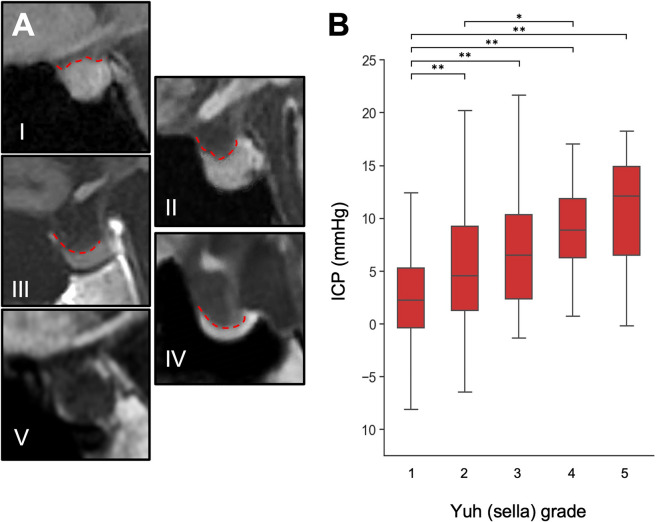
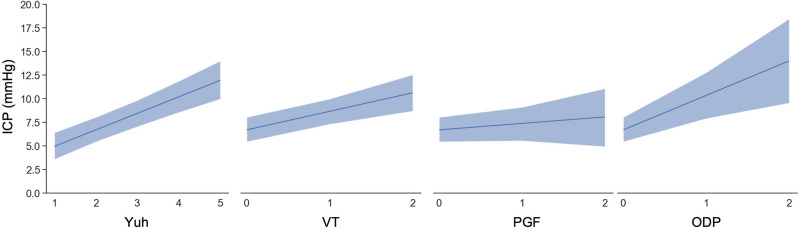
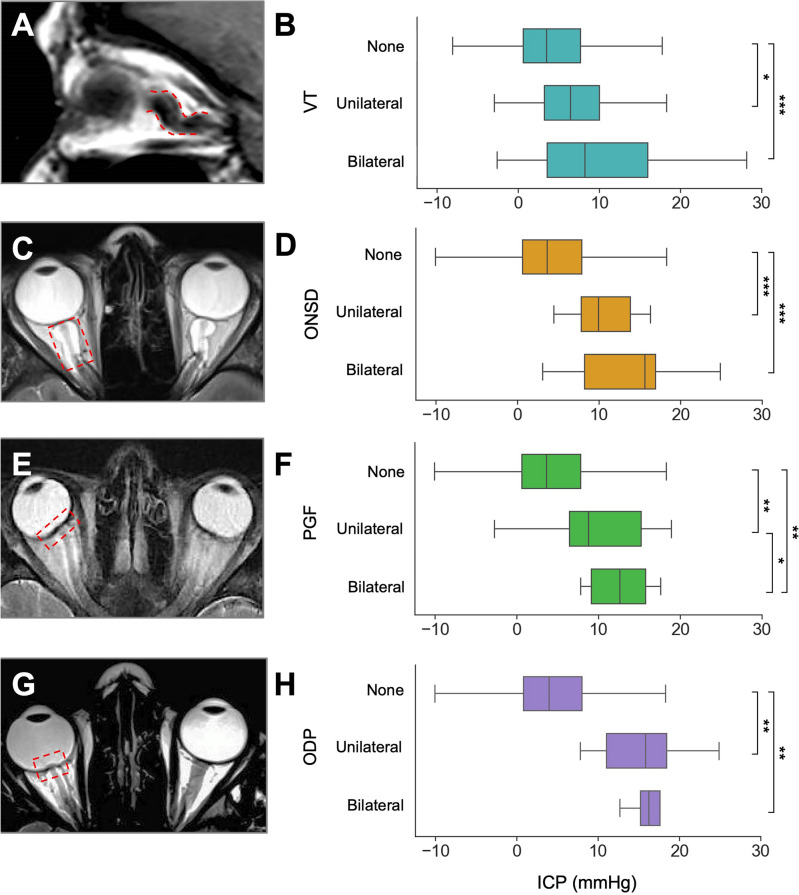
Intracranial pressure (ICP) is a physiological parameter that conventionally requires invasive monitoring for accurate measurement. Utilising multivariate predictive models, we sought to evaluate the utility of non-invasive, widely accessible MRI biomarkers in predicting ICP and their reversibility following cerebrospinal fluid (CSF) diversion. The retrospective study included 325 adult patients with suspected CSF dynamic disorders who underwent brain MRI scans within three months of elective 24-h ICP monitoring. Five MRI biomarkers were assessed: Yuh sella grade, optic nerve vertical tortuosity (VT), optic nerve sheath distension, posterior globe flattening and optic disc protrusion (ODP). The association between individual biomarkers and 24-h ICP was examined and reversibility of each following CSF diversion was assessed. Multivariate models incorporating these radiological biomarkers were utilised to predict 24-h median intracranial pressure. All five biomarkers were significantly associated with median 24-h ICP (p < 0.0001). Using a pair-wise approach, the presence of each abnormal biomarker was significantly associated with higher median 24-h ICP (p < 0.0001). On multivariate analysis, ICP was significantly and positively associated with Yuh sella grade (p < 0.0001), VT (p < 0.0001) and ODP (p = 0.003), after accounting for age and suspected diagnosis. The Bayesian multiple linear regression model predicted 24-h median ICP with a mean absolute error of 2.71 mmHg. Following CSF diversion, we found pituitary sella grade to show significant pairwise reversibility (p < 0.001). ICP was predicted with clinically useful precision utilising a compact Bayesian model, offering an easily interpretable tool using non-invasive MRI data. Brain MRI biomarkers are anticipated to play a more significant role in the screening, triaging, and referral of patients with suspected CSF dynamic disorders.
颅内压(ICP)是一种生理参数,传统上需要进行有创监测才能进行准确测量。我们利用多变量预测模型,旨在评估非侵入性、广泛可获得的 MRI 生物标志物在预测 ICP 及其在脑脊液(CSF)分流后的可逆转性方面的效用。这项回顾性研究纳入了 325 名疑似 CSF 动力学障碍的成年患者,这些患者在 24 小时 ICP 监测后的三个月内接受了脑部 MRI 扫描。评估了 5 种 MRI 生物标志物:蝶鞍 Yuh 分级、视神经垂直迂曲(VT)、视神经鞘扩张、后眼球变平及视盘突出(ODP)。检查了各个生物标志物与 24 小时 ICP 的相关性,并评估了每种生物标志物在 CSF 分流后的可逆转性。利用纳入这些影像学生物标志物的多变量模型来预测 24 小时的颅内压中位数。所有 5 种生物标志物与 24 小时 ICP 中位数均显著相关(p<0.0001)。采用两两比较的方法,每个异常生物标志物的存在均与较高的 24 小时 ICP 中位数显著相关(p<0.0001)。在多变量分析中,在考虑年龄和疑似诊断后,ICP 与蝶鞍 Yuh 分级(p<0.0001)、VT(p<0.0001)和 ODP(p=0.003)呈显著正相关。贝叶斯多元线性回归模型对 24 小时 ICP 中位数进行预测,平均绝对误差为 2.71mmHg。CSF 分流后,我们发现垂体蝶鞍分级具有显著的两两可逆转性(p<0.001)。使用紧凑的贝叶斯模型,ICP 可利用具有临床实用精度的预测,提供了一种使用非侵入性 MRI 数据的易于解释的工具。预计 MRI 生物标志物将在疑似 CSF 动力学障碍患者的筛查、分类和转诊中发挥更重要的作用。