Institute of Marine Research, Bergen, Norway.
Institute of Marine Research, Matre Research Station, Matredal, Norway.
Heredity (Edinb). 2024 Dec;133(6):426-436. doi: 10.1038/s41437-024-00727-9. Epub 2024 Oct 5.
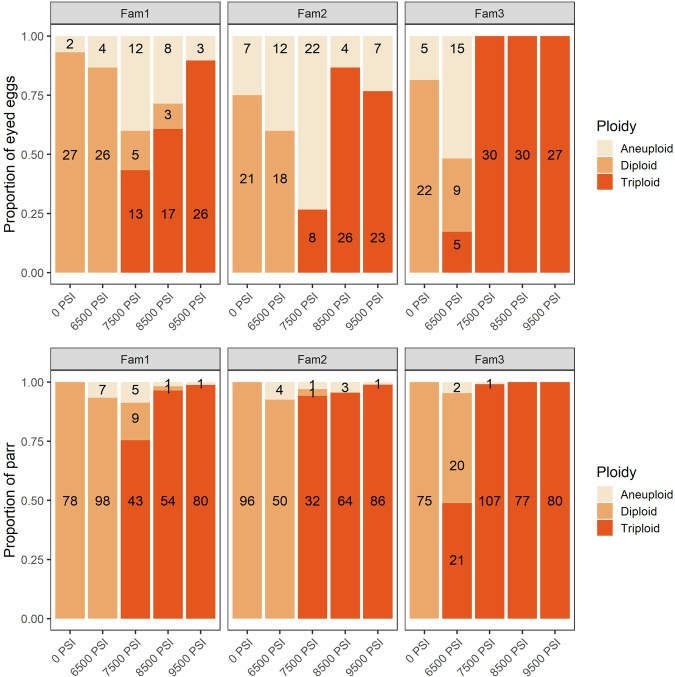
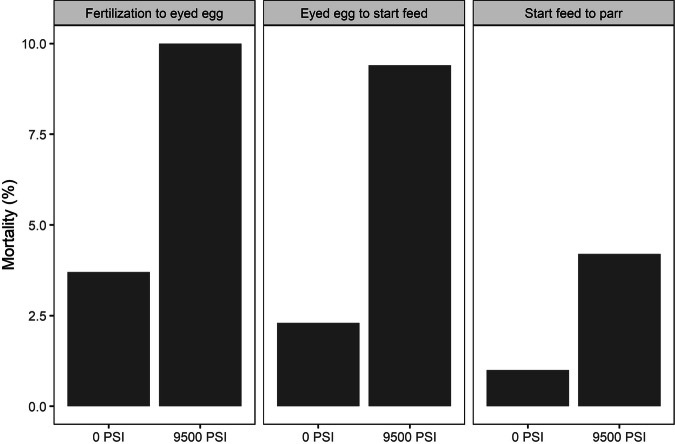
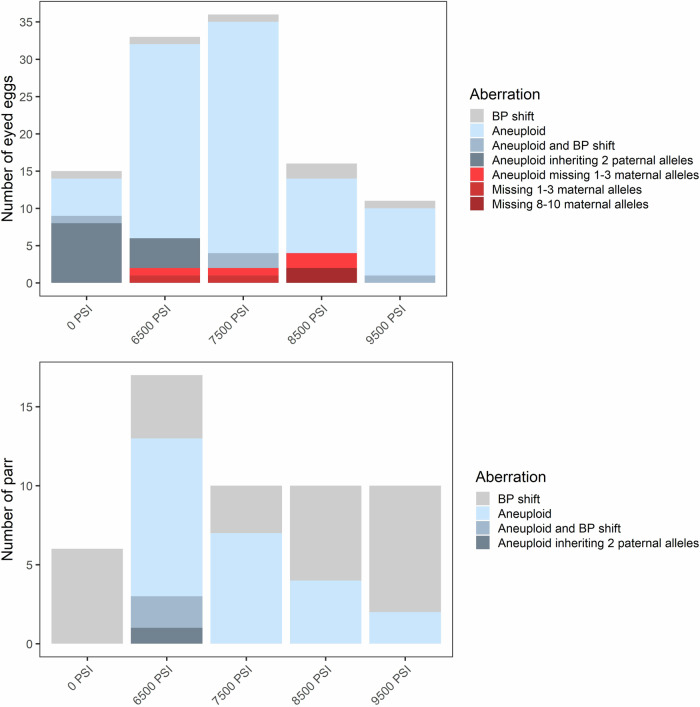
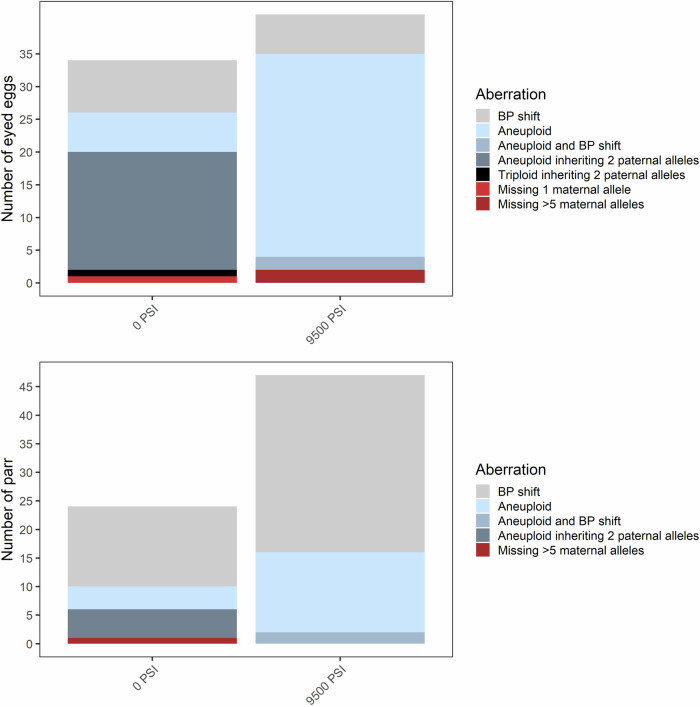
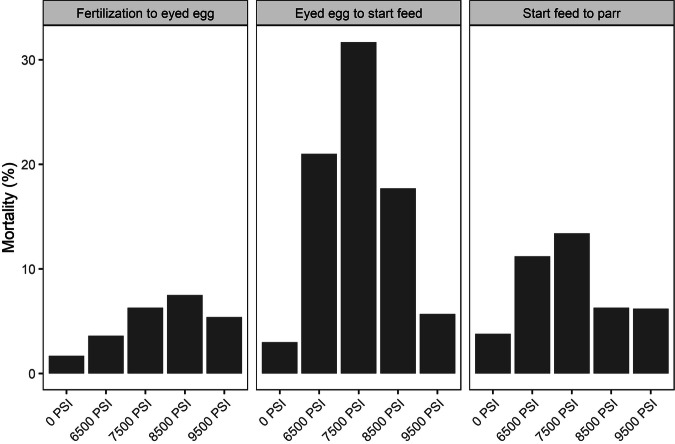
In commercial aquaculture, the production of triploid fish is currently the most practical approach to prevent maturation and farm-to-wild introgression following escapes. However, triploids often exhibit poor welfare, and the underlying mechanisms remain unclear. Inheritance issues associated with sub-optimal hydrostatic pressure treatments used to induce triploidy, or the genetic background of parental fish, have been speculated to contribute. We tested this by quantifying the frequency and type of chromosomal aberrations in Atlantic salmon subjected to a gradient of sub-optimal pressure treatments (Experiment 1) and from multiple mothers (Experiment 2). From these experiments, we genotyped a subsample of ~900 eyed eggs and all ~3300 surviving parr across ~20 microsatellites. In contrast to the low frequency of chromosomal aberrations in the diploid (no hydrostatic pressure) and triploid (full 9500 PSI treatment) controls, eyed eggs subjected to sub-optimal pressure treatments (6500-8500 PSI) had a higher incidence of chromosomal aberrations such as aneuploidy and uniparental disomy, corresponding to lower triploidization success and higher egg mortality rates. We also observed maternal effects on triploidization success and incidence of chromosomal aberrations, with certain half-sibling families exhibiting more aberrations than others. Chromosomal aberrations were rare among surviving parr, suggesting a purge of maladapted individuals during early development. This study demonstrates that sub-optimal hydrostatic pressure treatments and maternal effects not only influence the success of triploidization treatments, but may also affect the incidence of chromosomal aberrations and early mortality. The results have important implications for aquaculture breeding programs and their efforts to prevent farm-to-wild introgression.
在商业水产养殖中,生产三倍体鱼类是目前防止成熟和逃逸后野外杂交最实用的方法。然而,三倍体通常表现出较差的福利,其潜在机制尚不清楚。与诱导三倍体的次优静水压力处理相关的遗传问题,或亲本鱼类的遗传背景,被认为是造成这种情况的原因。我们通过量化大西洋鲑鱼在次优压力处理梯度下(实验 1)和来自多个母亲(实验 2)中染色体异常的频率和类型来检验这一点。从这些实验中,我们对大约 900 个有眼卵和大约 3300 个存活的幼鱼进行了大约 20 个微卫星的基因型分析。与二倍体(无静水压力)和三倍体(完全 9500PSI 处理)对照中染色体异常的低频率相比,处于次优压力处理(6500-8500PSI)下的有眼卵具有更高的染色体异常发生率,如非整倍体和单亲二倍体,这对应于较低的三倍体化成功率和较高的卵死亡率。我们还观察到母体效应对三倍体化成功率和染色体异常发生率的影响,某些半同胞家族比其他家族表现出更多的异常。存活的幼鱼中染色体异常很少见,这表明在早期发育过程中,适应不良的个体被清除。本研究表明,次优静水压力处理和母体效应不仅影响三倍体化处理的成功率,还可能影响染色体异常和早期死亡率的发生率。研究结果对水产养殖育种计划及其防止野外杂交的努力具有重要意义。