Toraason Erik, Adler Victoria L, Libuda Diana E
University of Oregon, Department of Biology, Institute of Molecular Biology, Eugene, Oregon, United States of America.
PLoS Genet. 2022 Nov 7;18(11):e1010282. doi: 10.1371/journal.pgen.1010282. eCollection 2022 Nov.
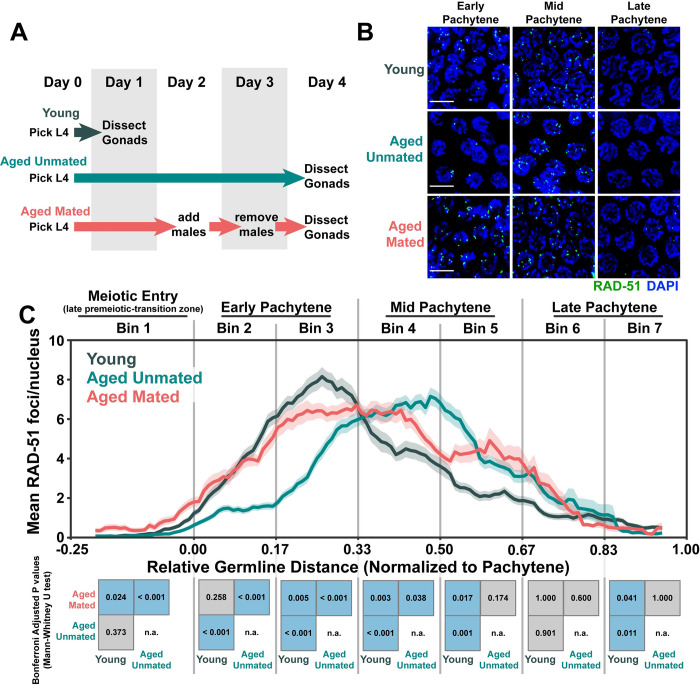
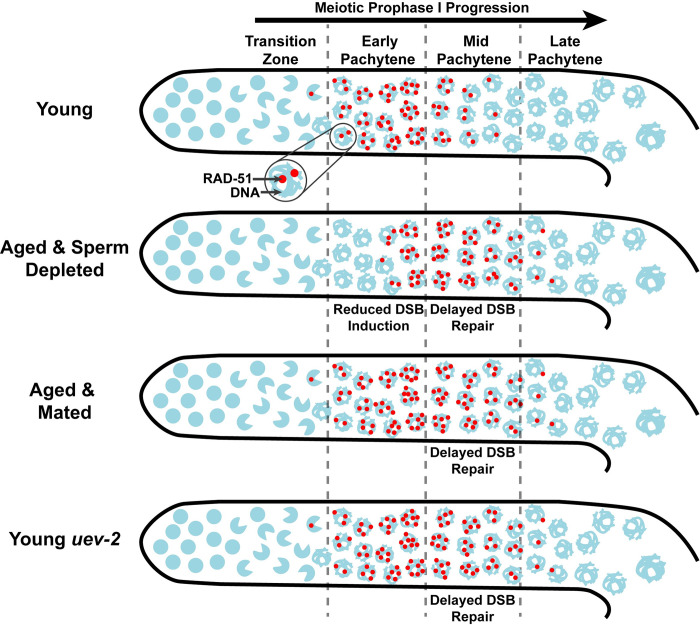
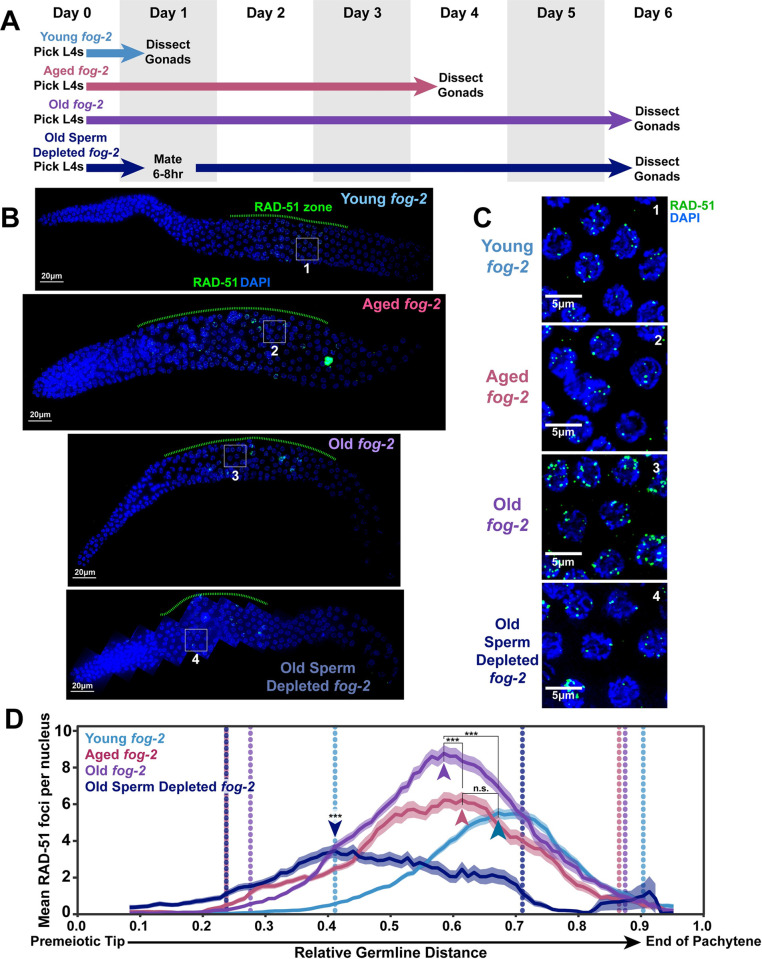
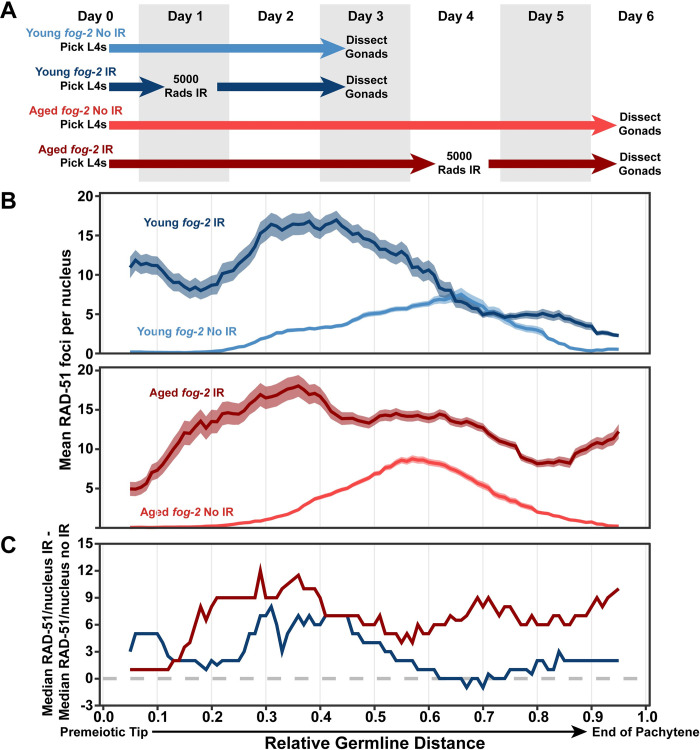
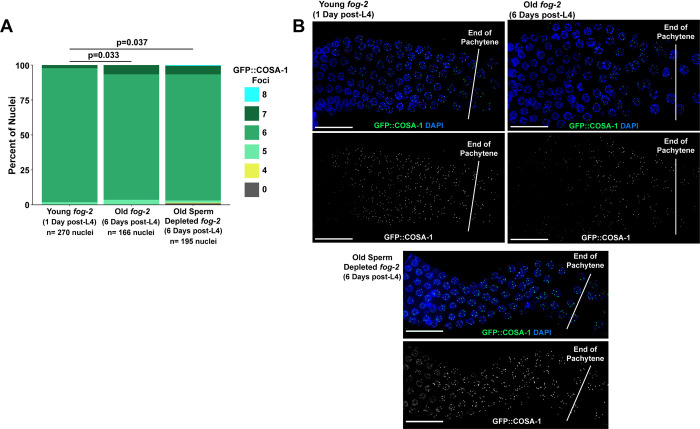
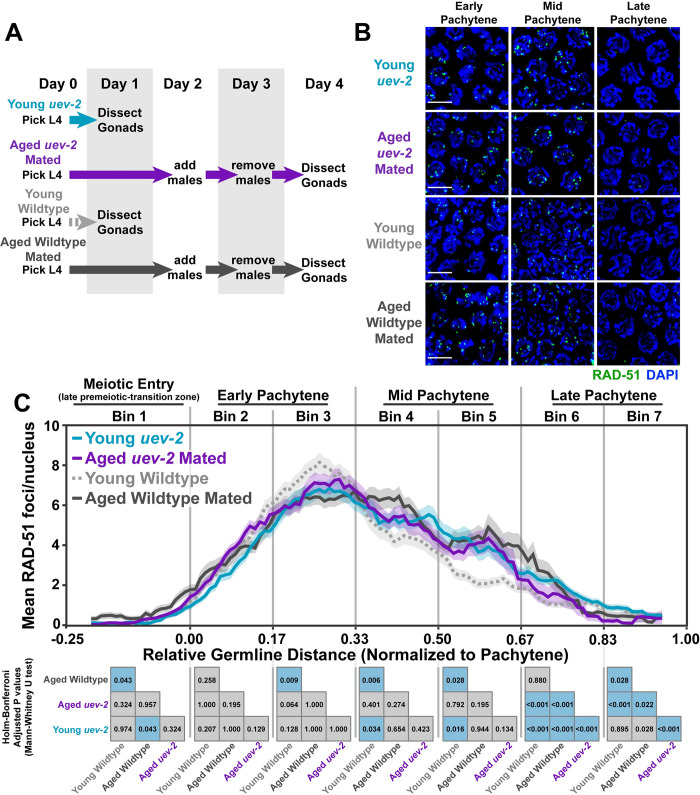
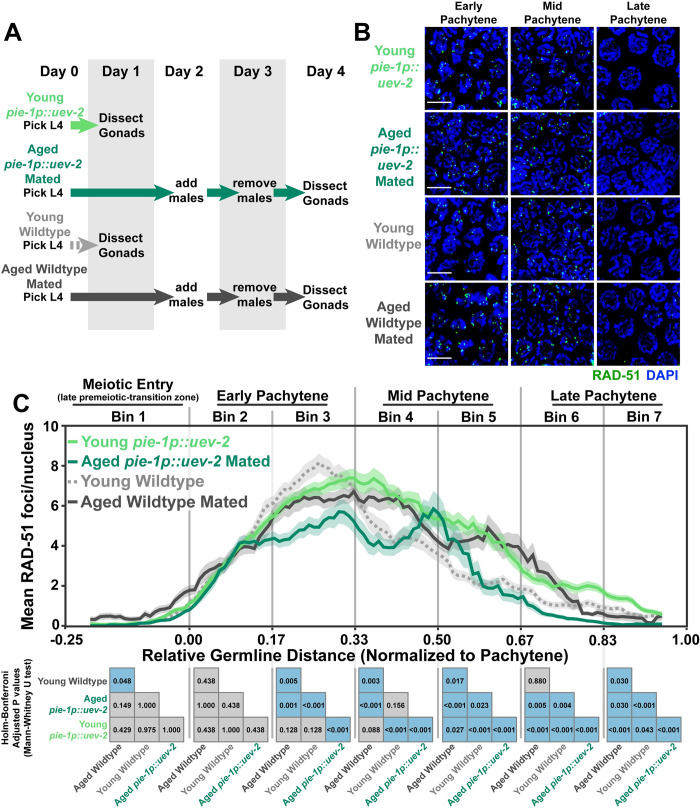
Female reproductive aging is associated with decreased oocyte quality and fertility. The nematode Caenorhabditis elegans is a powerful system for understanding the biology of aging and exhibits age-related reproductive defects that are analogous to those observed in many mammals, including dysregulation of DNA repair. C. elegans germline function is influenced simultaneously by both reproductive aging and signals triggered by limited supplies of sperm, which are depleted over chronological time. To delineate the causes of DNA repair defects in aged C. elegans germlines, we assessed both DNA double strand break (DSB) induction and repair during meiotic prophase I progression in aged germlines which were depleted of self-sperm, mated, or never exposed to sperm. We find that germline DSB induction is dramatically reduced only in hermaphrodites which have exhausted their endogenous sperm, suggesting that a signal due specifically to sperm depletion downregulates DSB formation. We also find that DSB repair is delayed in aged germlines regardless of whether hermaphrodites had either a reduction in sperm supply or an inability to endogenously produce sperm. These results demonstrate that in contrast to DSB induction, DSB repair defects are a feature of C. elegans reproductive aging independent of sperm presence. Finally, we demonstrate that the E2 ubiquitin-conjugating enzyme variant UEV-2 is required for efficient DSB repair specifically in young germlines, implicating UEV-2 in the regulation of DNA repair during reproductive aging. In summary, our study demonstrates that DNA repair defects are a feature of C. elegans reproductive aging and uncovers parallel mechanisms regulating efficient DSB formation in the germline.
雌性生殖衰老与卵母细胞质量和生育能力下降有关。秀丽隐杆线虫是研究衰老生物学的有力模型系统,它表现出与许多哺乳动物中观察到的类似的与年龄相关的生殖缺陷,包括DNA修复失调。秀丽隐杆线虫的生殖系功能同时受到生殖衰老和精子供应有限引发的信号的影响,而精子供应会随着时间的推移而耗尽。为了阐明衰老的秀丽隐杆线虫生殖系中DNA修复缺陷的原因,我们评估了在减数分裂前期I进程中,老年生殖系中DNA双链断裂(DSB)的诱导和修复情况,这些老年生殖系要么自身精子已耗尽,要么已交配,要么从未接触过精子。我们发现,只有在内源精子已耗尽的雌雄同体线虫中,生殖系DSB的诱导才会显著减少,这表明特定于精子耗尽的信号会下调DSB的形成。我们还发现,无论雌雄同体线虫的精子供应减少还是无法内源性产生精子,老年生殖系中的DSB修复都会延迟。这些结果表明,与DSB诱导不同,DSB修复缺陷是秀丽隐杆线虫生殖衰老的一个特征,与精子的存在无关。最后,我们证明E2泛素结合酶变体UEV-2是年轻生殖系中有效DSB修复所必需的,这表明UEV-2参与了生殖衰老过程中DNA修复的调控。总之,我们的研究表明DNA修复缺陷是秀丽隐杆线虫生殖衰老的一个特征,并揭示了调节生殖系中有效DSB形成的平行机制。