Department of Molecular Endocrinology, National Research Institute for Child Health and Development, 2-10-1 Okura, Setagaya-Ku, Tokyo, 157-8535, Japan.
Department of Pediatrics, Nagasaki University Graduate School of Biomedical Sciences, 1-7-1 Sakamoto, Nagasaki, 852-8102, Japan.
Clin Epigenetics. 2024 Oct 5;16(1):138. doi: 10.1186/s13148-024-01744-5.
Multi-locus imprinting disturbance (MLID) with methylation defects in various differentially methylated regions (DMRs) has recently been identified in approximately 150 cases with imprinting disorders (IDs), and deleterious variants have been found in genes related to methylation maintenance of DMRs, such as those encoding proteins constructing the subcortical maternal complex (SCMC), in a small fraction of patients and/or their mothers. However, integrated methylation analysis for DMRs and sequence analysis for MLID-causative genes in MLID cases and their mothers have been performed only in a single study focusing on Beckwith-Wiedemann syndrome (BWS) and Silver-Russell syndrome (SRS) phenotypes.
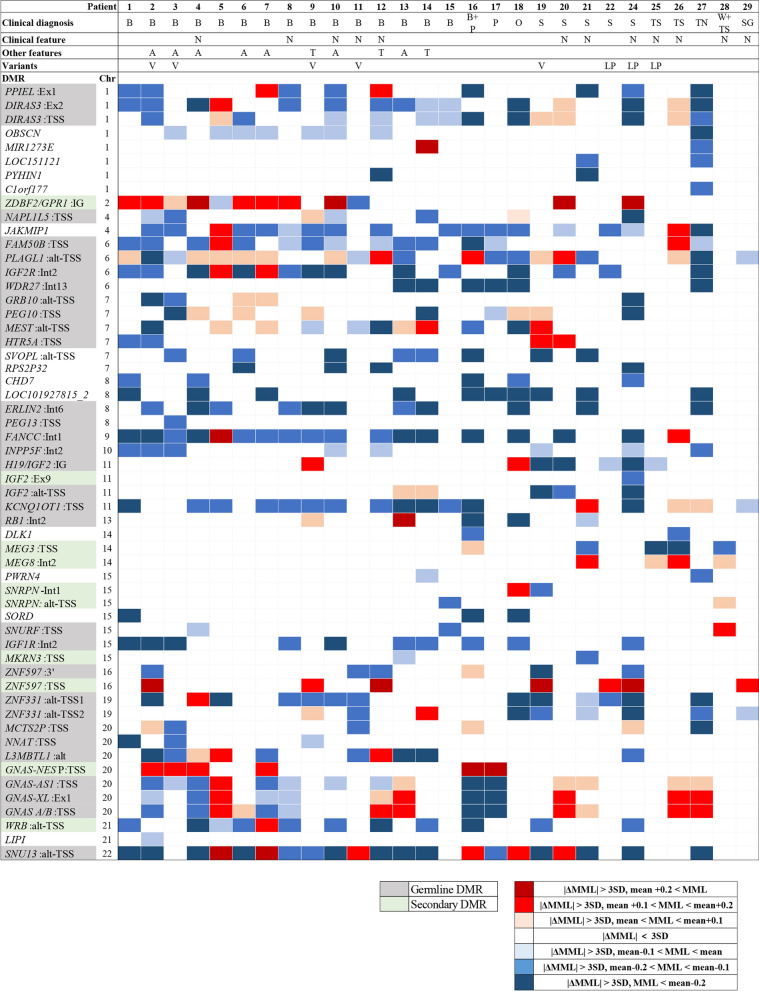
Of 783 patients with various IDs we have identified to date, we examined a total of 386 patients with confirmed epimutation and 71 patients with epimutation or uniparental disomy. Consequently, we identified MLID in 29 patients with epimutation confirmed by methylation analysis for multiple ID-associated DMRs using pyrosequencing and/or methylation-specific multiple ligation-dependent probe amplification. MLID was detected in approximately 12% of patients with BWS phenotype and approximately 5% of patients with SRS phenotype, but not in patients with Kagami-Ogata syndrome, Prader-Willi syndrome, or Angelman syndrome phenotypes. We next conducted array-based methylation analysis for 78 DMRs and whole-exome sequencing in the 29 patients, revealing hypomethylation-dominant aberrant methylation patterns in various DMRs of all the patients, eight probably deleterious variants in genes for SCMC in the mothers of patients, and one homozygous deleterious variant in ZNF445 in one patient. These variants did not show gene-specific methylation disturbance patterns. Clinically, neurodevelopmental delay and/or intellectual developmental disorder (ND/IDD) was observed in about half of the MLID patients, with no association with the identified methylation disturbance patterns and genetic variants. Notably, seven patients with BWS phenotype were conceived by assisted reproductive technology (ART).
The frequency of MLID was 7.5% (29/386) in IDs caused by confirmed epimutation. Furthermore, we revealed diverse patterns of hypomethylation-dominant methylation defects, nine deleterious variants, ND/IDD complications in about half of the MLID patients, and a high frequency of MLID in ART-conceived patients.
最近在大约 150 例印迹障碍(ID)患者中发现了多基因印迹干扰(MLID),其特征为各种差异甲基化区域(DMR)的甲基化缺陷,并且在与 DMR 甲基化维持相关的基因中发现了有害变异,例如那些编码构建皮质下母本复合物(SCMC)的蛋白的基因,在一小部分患者及其母亲中。然而,对 MLID 病例及其母亲的 DMR 进行整合甲基化分析和 MLID 致病基因的序列分析,仅在一项针对 Beckwith-Wiedemann 综合征(BWS)和 Silver-Russell 综合征(SRS)表型的研究中进行。
在迄今为止我们已确定的 783 例各种 ID 患者中,我们共检查了 386 例经证实存在印记外显子的患者和 71 例存在印记外显子或单亲二倍体的患者。因此,我们通过焦磷酸测序和/或甲基化特异性多重连接依赖性探针扩增,对使用多个 ID 相关 DMR 进行甲基化分析证实存在印记外显子的 29 例患者进行了 MLID 鉴定。在 BWS 表型患者中约检测到 12%,在 SRS 表型患者中约检测到 5%,但在 Kagami-Ogata 综合征、Prader-Willi 综合征或 Angelman 综合征患者中未检测到。我们随后对 29 例患者进行了 78 个 DMR 的基于阵列的甲基化分析和全外显子测序,结果显示所有患者的各种 DMR 均存在以低甲基化为主的异常甲基化模式,29 例患者的母亲中有 8 个可能为致病性的 SCMC 基因变异,1 例患者存在 ZNF445 的纯合性致病性变异。这些变异未显示出基因特异性的甲基化干扰模式。临床方面,约一半的 MLID 患者出现神经发育迟缓或智力发育障碍(ND/IDD),与鉴定出的甲基化干扰模式和遗传变异无关。值得注意的是,7 例 BWS 表型患者通过辅助生殖技术(ART)受孕。
在经证实存在印记外显子的 ID 中,MLID 的频率为 7.5%(29/386)。此外,我们揭示了以低甲基化为主的甲基化缺陷、9 个致病性变异、约一半的 MLID 患者出现 ND/IDD 并发症、ART 受孕患者 MLID 发生率高的多样化模式。