Department of Radiation Oncology, Roy J. and Lucille A. Carver College of Medicine, The University of Iowa, Iowa City, IA, USA.
College of Public Health, The University of Iowa, Iowa City, IA, USA.
Redox Biol. 2024 Nov;77:103375. doi: 10.1016/j.redox.2024.103375. Epub 2024 Oct 2.
Patients with metastatic pancreatic ductal adenocarcinoma (PDAC) have poor 5-year survival. Pharmacological ascorbate (P-AscH, high dose, intravenous, vitamin C) has shown promise as an adjunct to chemotherapy. We hypothesized adding P-AscH to gemcitabine and nab-paclitaxel would increase survival in patients with metastatic PDAC.
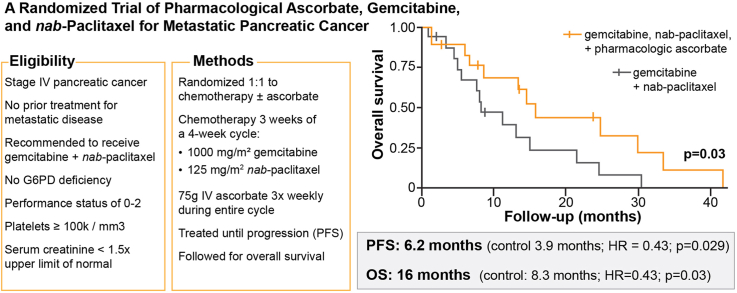
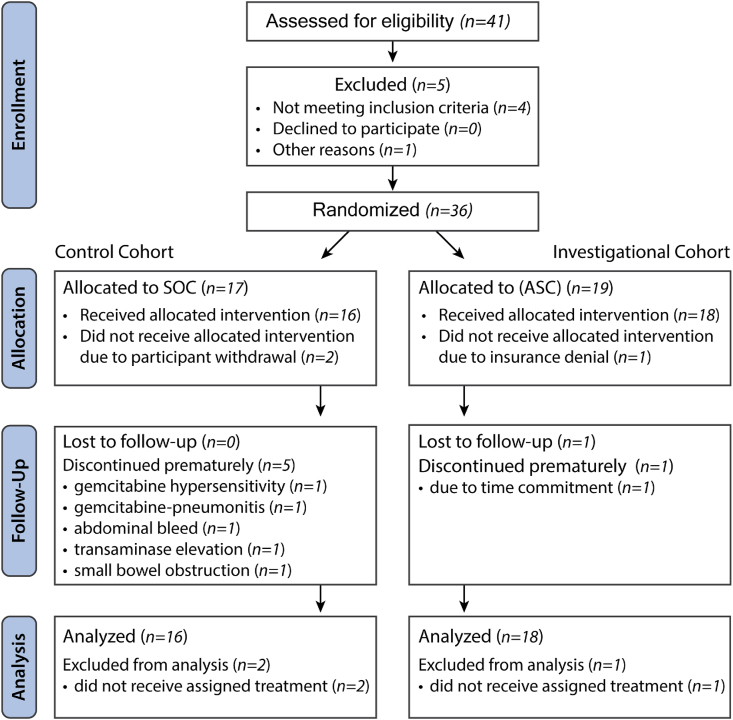
Patients diagnosed with stage IV pancreatic cancer randomized 1:1 to gemcitabine and nab-paclitaxel only (SOC, control) or to SOC with concomitant P-AscH, 75 g three times weekly (ASC, investigational). The primary outcome was overall survival with secondary objectives of determining progression-free survival and adverse event incidence. Quality of life and patient reported outcomes for common oncologic symptoms were captured as an exploratory objective. Thirty-six participants were randomized; of this 34 received their assigned study treatment. All analyses were based on data frozen on December 11, 2023.
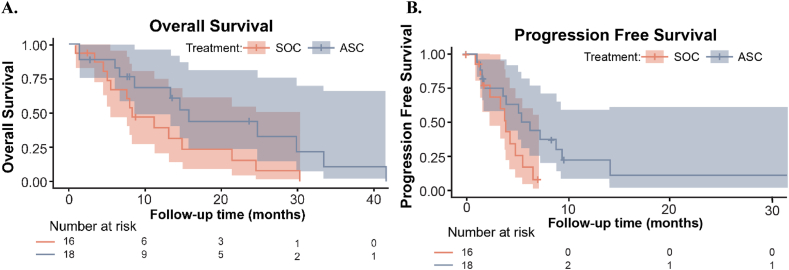
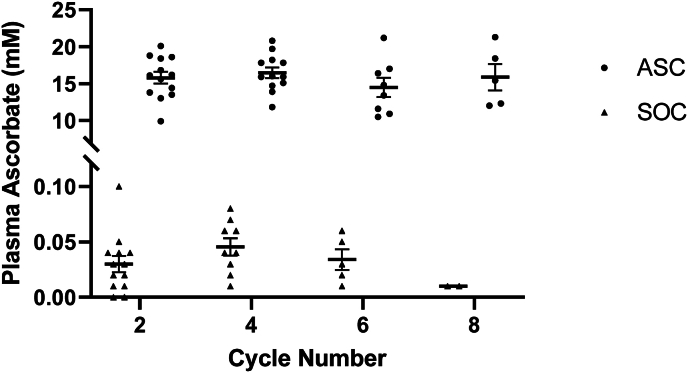
Intravenous P-AscH increased serum ascorbate levels from micromolar to millimolar levels. P-AscH added to the gemcitabine + nab-paclitaxel (ASC) increased overall survival to 16 months compared to 8.3 months with gemcitabine + nab-paclitaxel (SOC) (HR = 0.46; 90 % CI 0.23, 0.92; p = 0.030). Median progression free survival was 6.2 (ASC) vs. 3.9 months (SOC) (HR = 0.43; 90 % CI 0.20, 0.92; p = 0.029). Adding P-AscH did not negatively impact quality of life or increase the frequency or severity of adverse events.
P-AscH infusions of 75 g three times weekly in patients with metastatic pancreatic cancer prolongs overall and progression free survival without detriment to quality of life or added toxicity (ClinicalTrials.gov number NCT02905578).
转移性胰腺导管腺癌(PDAC)患者的 5 年生存率较差。药物化学计量的抗坏血酸(P-AscH,高剂量,静脉内,维生素 C)作为化疗的辅助手段显示出一定的前景。我们假设在吉西他滨和 nab-紫杉醇中添加 P-AscH 会增加转移性 PDAC 患者的生存。
将诊断为 IV 期胰腺癌的患者以 1:1 的比例随机分配至仅接受吉西他滨和 nab-紫杉醇(SOC,对照组)或 SOC 联合同时给予 P-AscH,每周 3 次,每次 75g(ASC,研究组)。主要终点是总生存,次要终点是确定无进展生存期和不良事件发生率。还作为探索性目标,采集了生活质量和患者报告的常见肿瘤症状的结果。36 名参与者被随机分配;其中 34 名接受了他们分配的研究治疗。所有分析均基于 2023 年 12 月 11 日冻结的数据进行。
静脉内 P-AscH 将血清抗坏血酸水平从毫摩尔提高到了毫摩尔水平。与吉西他滨+ nab-紫杉醇(SOC)相比,ASC 增加了总体生存率,从 8.3 个月延长至 16 个月(HR=0.46;90%CI 0.23,0.92;p=0.030)。中位无进展生存期为 6.2 个月(ASC)与 3.9 个月(SOC)(HR=0.43;90%CI 0.20,0.92;p=0.029)。添加 P-AscH 并未对生活质量产生负面影响,也没有增加不良事件的频率或严重程度。
每周 3 次给予 75g 的 P-AscH 输注可延长转移性胰腺癌患者的总生存期和无进展生存期,而不会降低生活质量或增加毒性(ClinicalTrials.gov 编号:NCT02905578)。