Gondode Prakash Gyandev, Mahor Vaishali, Rani Deepa, Ramkumar Rupavath, Yadav Pooja
Department of Anaesthesiology Pain medicine and Critical care, All India Institute of Medical Sciences, New Delhi, India.
Department of Anesthesiology, Vardhaman Mahavir Medical College, New Delhi, India.
Indian J Palliat Care. 2024 Jul-Sep;30(3):284-287. doi: 10.25259/IJPC_44_2024. Epub 2024 Aug 9.
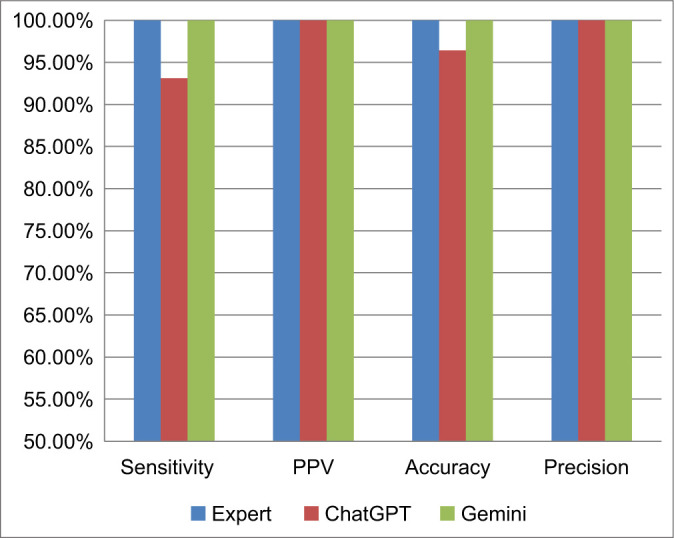
Palliative care plays a crucial role in comprehensive healthcare, yet misconceptions among patients and caregivers hinder access to services. Artificial Intelligence (AI) chatbots offer potential solutions for debunking myths and providing accurate information. This study aims to evaluate the effectiveness of AI chatbots, ChatGPT and Google Gemini, in debunking palliative care myths. Thirty statements reflecting common palliative care misconceptions were compiled. ChatGPT and Google Gemini generated responses to each statement, which were evaluated by a palliative care expert for accuracy. Sensitivity, positive predictive value, accuracy, and precision were calculated to assess chatbot performance. ChatGPT accurately classified 28 out of 30 statements, achieving a true-positive rate of 93.3% and a true-negative rate of 3.3%. Google Gemini achieved perfect accuracy, correctly classifying all 30 statements. Statistical tests showed no significant difference between chatbots' classifications. Both ChatGPT and Google Gemini demonstrated high accuracy in debunking palliative care myths. These findings suggest that AI chatbots have the potential to effectively dispel misconceptions and improve patient education and awareness in palliative care.
姑息治疗在综合医疗保健中发挥着关键作用,但患者和护理人员中的误解阻碍了服务的获取。人工智能(AI)聊天机器人为揭穿神话和提供准确信息提供了潜在的解决方案。本研究旨在评估AI聊天机器人ChatGPT和谷歌Gemini在揭穿姑息治疗神话方面的有效性。编制了30条反映姑息治疗常见误解的陈述。ChatGPT和谷歌Gemini对每条陈述生成了回复,由一位姑息治疗专家对其准确性进行评估。计算敏感性、阳性预测值、准确性和精确性以评估聊天机器人的性能。ChatGPT准确分类了30条陈述中的28条,真阳性率为93.3%,真阴性率为3.3%。谷歌Gemini达到了完美的准确性,正确分类了所有30条陈述。统计测试表明聊天机器人的分类之间没有显著差异。ChatGPT和谷歌Gemini在揭穿姑息治疗神话方面都表现出了很高的准确性。这些发现表明,AI聊天机器人有潜力有效消除误解,并改善姑息治疗中的患者教育和意识。