Zhang Wei, Zhang Jin, Yan Jie, Ge Qian, Lu Xiao-Hong, Chen Shao-Xing, Xu Wen-Jie, Sun Jing-Chao, Li Jin-Feng, Liu Zi-Chen, Wang Qiang, Zhou Xiang-Nan, Li Yan, Wang Ji-Guang
Department of Cardiovascular Medicine, State Key Laboratory of Medical Genomics, Shanghai Key Laboratory of Hypertension, The Shanghai Institute of Hypertension, Ruijin Hospital, Shanghai Jiao Tong University School of Medicine, Shanghai, China.
Shenzhen Salubris Pharmaceuticals Co, Ltd, Shenzhen, Guangdong, China.
JACC Asia. 2024 Aug 13;4(9):697-707. doi: 10.1016/j.jacasi.2024.06.002. eCollection 2024 Sep.
The prevalence of hypertension still increases with the very rapidly increasing longevity in some countries, such as China. The control rate remains low.
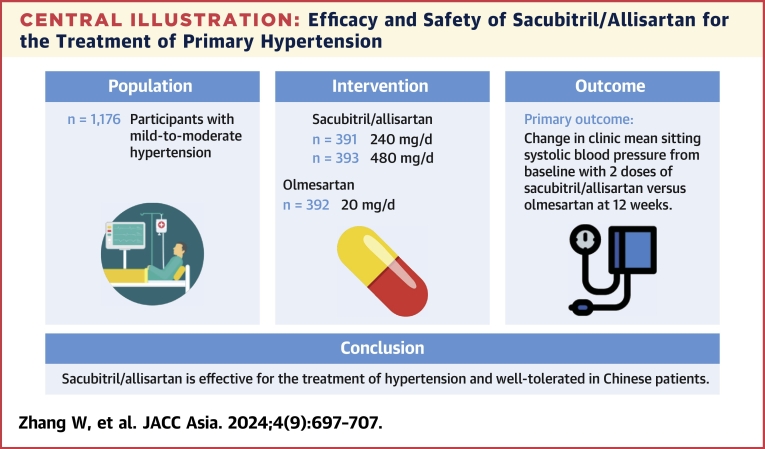
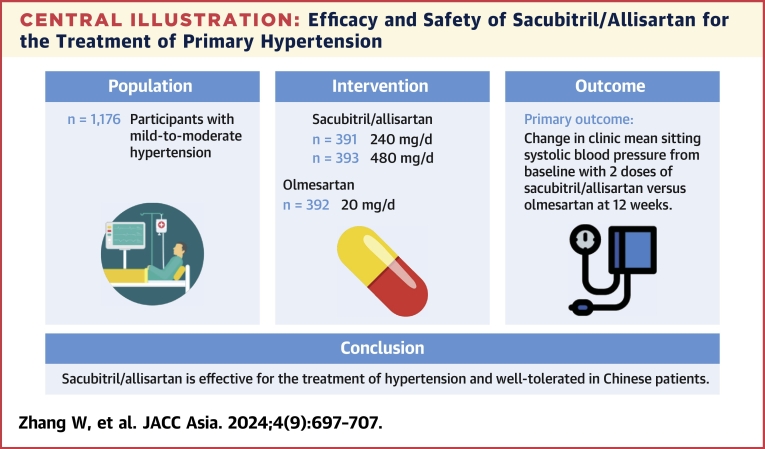
This randomized, double-blind, phase 3 study assessed the efficacy and safety of sacubitril/allisartan, compared with olmesartan in Chinese patients with mild-to-moderate hypertension.
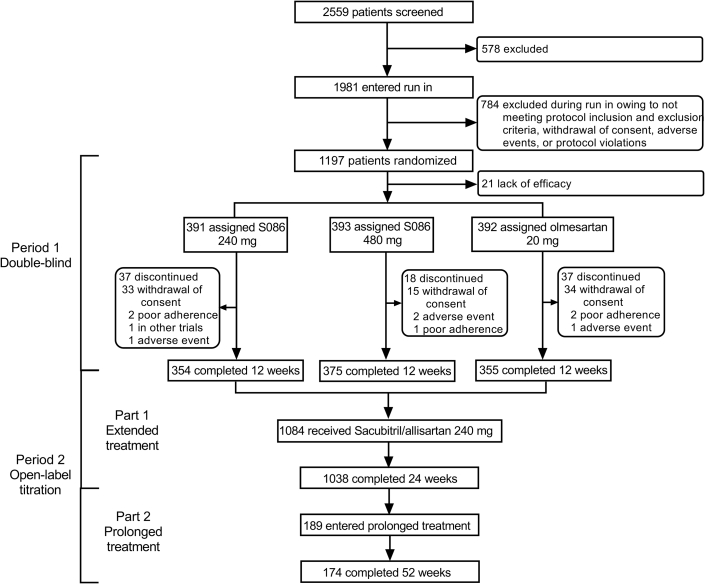
Eligible patients aged 18 to 75 years (n = 1,197) with mild-to-moderate hypertension were randomized to receive sacubitril/allisartan 240 mg (n = 399), sacubitril/allisartan 480 mg (n = 399), or olmesartan 20 mg (n = 399) once daily for 12 weeks. Patients who completed the 12-week treatment then received another 12-week extended treatment (n = 1,084) and 28-week prolonged treatment (n = 189). The primary end point was a reduction in clinic mean sitting systolic blood pressure (msSBP) from baseline at 12 weeks.
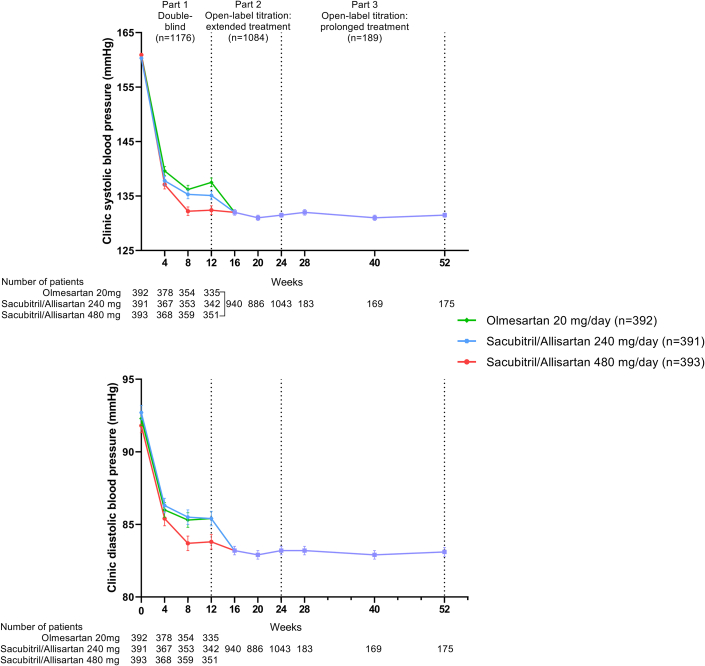
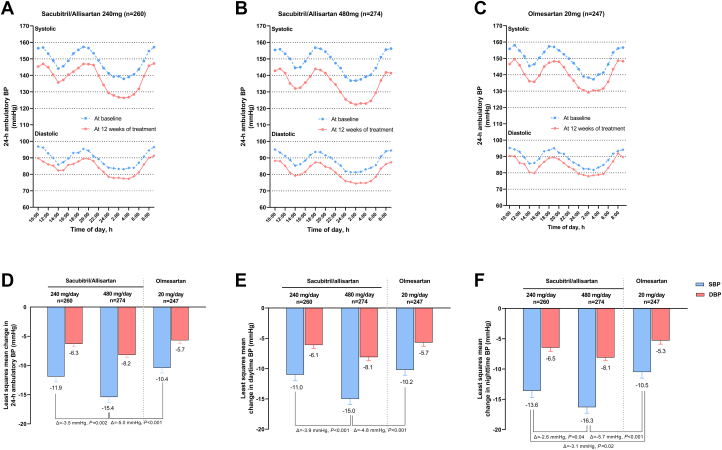
Sacubitril/allisartan 240 mg/d provided a greater reduction in msSBP than olmesartan at 12 weeks (between-group difference: -1.9 mm Hg [95% CI: -4.2 to 0.4 mm Hg]; = 0.0007, for noninferiority). Sacubitril/allisartan 480 mg/d provided a significantly greater reduction in msSBP than olmesartan at 12 weeks (between-treatment difference: -5.0 mm Hg [95% CI: -7.3 to -2.8 mm Hg]; < 0.001, for superiority). Greater reductions in 24-hour, and daytime and nighttime systolic and diastolic blood pressure were also observed with both doses of sacubitril/allisartan compared with olmesartan ( ≤ 0.001 for 480 mg/d). The blood pressure reductions tended to be dose-dependent for sacubitril/allisartan. Sacubitril/allisartan was well tolerated, and no cases of angioedema or death were reported.
Sacubitril/allisartan is effective for the treatment of hypertension and well tolerated in Chinese patients.
在一些国家,如中国,随着人均寿命的迅速延长,高血压患病率仍在上升。控制率仍然很低。
这项随机、双盲、3期研究评估了沙库巴曲/阿利沙坦与奥美沙坦相比,在中国轻至中度高血压患者中的疗效和安全性。
符合条件的18至75岁(n = 1197)轻至中度高血压患者被随机分为每日一次接受240mg沙库巴曲/阿利沙坦(n = 399)、480mg沙库巴曲/阿利沙坦(n = 399)或20mg奥美沙坦(n = 399)治疗,为期12周。完成12周治疗的患者随后接受另外12周的延长治疗(n = 1084)和28周的长期治疗(n = 189)。主要终点是12周时诊室平均坐位收缩压(msSBP)较基线的降低值。
在12周时,240mg/d的沙库巴曲/阿利沙坦降低msSBP的幅度大于奥美沙坦(组间差异:-1.9mmHg[95%CI:-4.2至0.4mmHg];非劣效性检验P = 0.0007)。在12周时,480mg/d的沙库巴曲/阿利沙坦降低msSBP的幅度显著大于奥美沙坦(治疗组间差异:-5.0mmHg[95%CI:-7.3至-2.8mmHg];优效性检验P<0.001)。与奥美沙坦相比,两种剂量的沙库巴曲/阿利沙坦在24小时、日间和夜间的收缩压和舒张压降低幅度也更大(480mg/d组P≤0.001)。沙库巴曲/阿利沙坦的血压降低呈剂量依赖性。沙库巴曲/阿利沙坦耐受性良好,未报告血管性水肿或死亡病例。
沙库巴曲/阿利沙坦对中国高血压患者有效且耐受性良好。