Nakagawa Suguru, Kanda Satoru, Ishii Kiyoshi
Ophthalmology, Saitama Red Cross Hospital, Saitama, JPN.
Cureus. 2024 Oct 2;16(10):e70688. doi: 10.7759/cureus.70688. eCollection 2024 Oct.
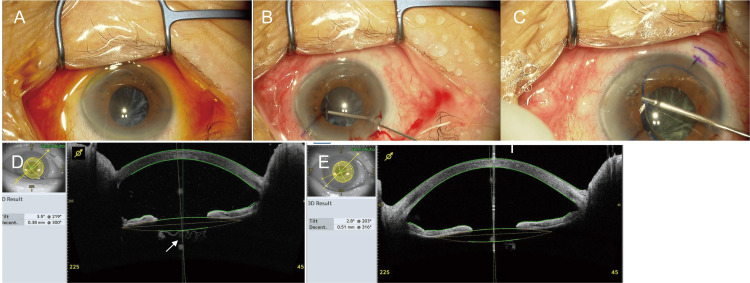
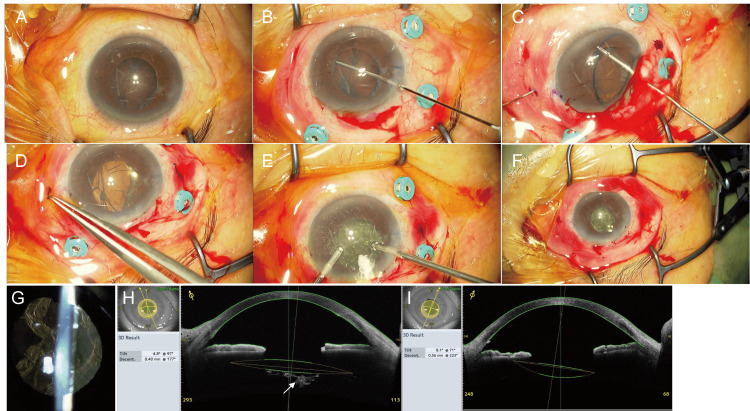
We describe three cases of pseudoexfoliation syndrome (PEX) in which good outcomes were achieved after secondary intrascleral intraocular lens (IOL) fixation with capsule preservation for aphakic eyes. Three Japanese patients with PEX underwent phacoemulsification and aspiration (PEA) owing to challenges in IOL intracapsular fixation caused by zonular weakness. Case 1 involved an 83-year-old man with PEX. Six weeks post-PEA, 30-gauge needles were inserted to exit between the capsule and the iris. The IOL was fixed intrasclerally using the double-needle technique. Case 2 involved a 90-year-old man with PEX. The same abovementioned double-needle intrascleral IOL fixation procedure was performed eight weeks post-PEA. Intraoperative vitreous prolapse into the anterior chamber was observed, and anterior vitrectomy was performed. Case 3 involved an 80-year-old man with PEX. Seven weeks post-PEA, the patient underwent the same double-needle intrascleral IOL fixation procedure. Good IOL fixation was achieved in all patients without postoperative iris capture. No serious complications, including retinal detachment and vitreous hemorrhage, were observed. Preserving the capsule during secondary IOL scleral fixation for aphakic eyes can effectively reduce intraoperative vitreous prolapse, minimize surgical invasiveness, suppress iris flutter, and prevent capture of the pupillary IOL, making it a meaningful and acceptable approach, although the long-term risks, such as potential lens capsule drop, should be studied further.
我们描述了三例假剥脱综合征(PEX)病例,这些无晶状体眼在采用保留晶状体囊的巩膜内人工晶状体(IOL)二期固定术后取得了良好效果。三名患有PEX的日本患者由于悬韧带薄弱导致IOL囊内固定困难,因而接受了超声乳化吸除术(PEA)。病例1为一名83岁患有PEX的男性。PEA术后六周,插入30号针头,使其在晶状体囊和虹膜之间穿出。采用双针技术将IOL固定于巩膜内。病例2为一名90岁患有PEX的男性。PEA术后八周进行了上述相同的双针巩膜内IOL固定手术。术中观察到玻璃体脱垂至前房,遂进行了前部玻璃体切除术。病例3为一名80岁患有PEX的男性。PEA术后七周,该患者接受了相同的双针巩膜内IOL固定手术。所有患者IOL固定良好,术后均未出现虹膜夹持。未观察到包括视网膜脱离和玻璃体出血在内的严重并发症。对于无晶状体眼,在二期IOL巩膜固定术中保留晶状体囊可有效减少术中玻璃体脱垂,将手术创伤降至最低,抑制虹膜震颤,并防止瞳孔区IOL夹持,使其成为一种有意义且可接受的方法,尽管诸如潜在晶状体囊脱落等长期风险仍需进一步研究。