Möhn Nora, Grote-Levi Lea, Wattjes Mike P, Bonifacius Agnes, Holzwart Dennis, Hopfner Franziska, Nay Sandra, Tischer-Zimmermann Sabine, Saßmann Mieke Luise, Schwenkenbecher Philipp, Sühs Kurt-Wolfram, Mahmoudi Nima, Warnke Clemens, Zimmermann Julian, Hagin David, Goudeva Lilia, Blasczyk Rainer, Koch Armin, Maecker-Kolhoff Britta, Eiz-Vesper Britta, Höglinger Günter, Skripuletz Thomas
Department of Neurology, Hannover Medical School, Hannover, Germany.
Department of Diagnostic and Interventional Neuroradiology, Hannover Medical School, Hannover, Germany.
JAMA Neurol. 2024 Oct 7;81(11):1187-98. doi: 10.1001/jamaneurol.2024.3324.
Progressive multifocal leukoencephalopathy (PML) is a life-threatening viral infection with no approved antiviral treatment.
To determine whether restoring the compromised immune system of patients with PML with directly isolated allogeneic virus-specific (DIAVIS) T cells is a promising therapeutic strategy, especially if other curative options are absent.
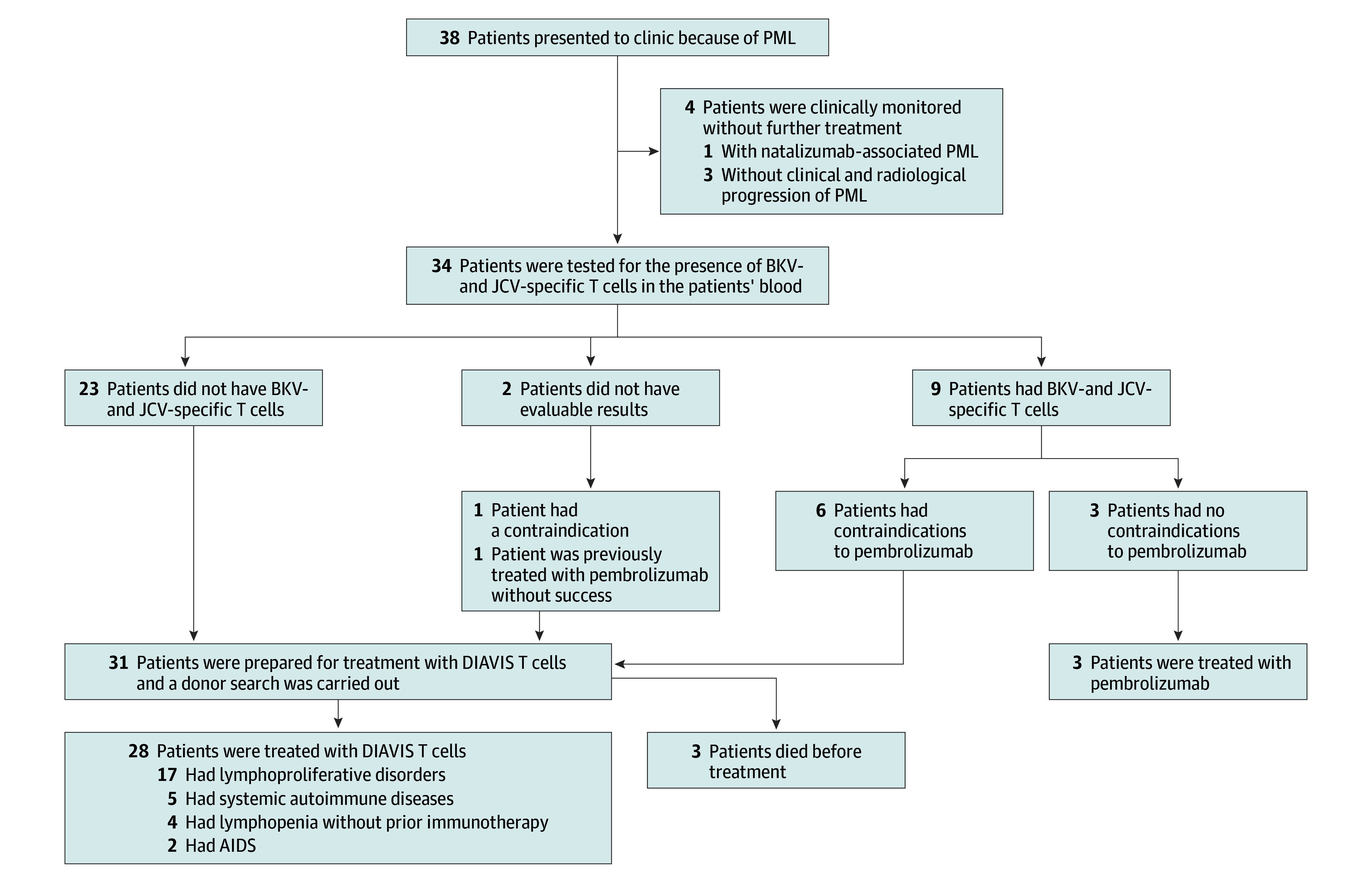
DESIGN, SETTING, AND PARTICIPANTS: A retrospective case series of patients with PML who were treated with DIAVIS T cells was conducted between March 2020 and February 2022. T cells were isolated from healthy donors within 24 hours and targeted against the BK polyomavirus. Patients with PML were treated monocentrically. Eligibility for treatment with DIAVIS T cells was assessed for patients with confirmed PML, and exclusion criteria included stable PML disease and previous treatment with natalizumab.
Fresh DIAVIS T cells were administered with a maximum dose of 2 × 10⁴ CD3+ cells/kg body weight. Remaining T cells were cryopreserved in divided doses and administered in additional treatments approximately 2 and 6 weeks later.
Primary outcome measures were clinical response and survival of patients, compared with the outcomes of a historical reference group of PML cases receiving best supportive treatment (BST) and with recently published real-world data of patients with PML who were treated with immune checkpoint inhibition.
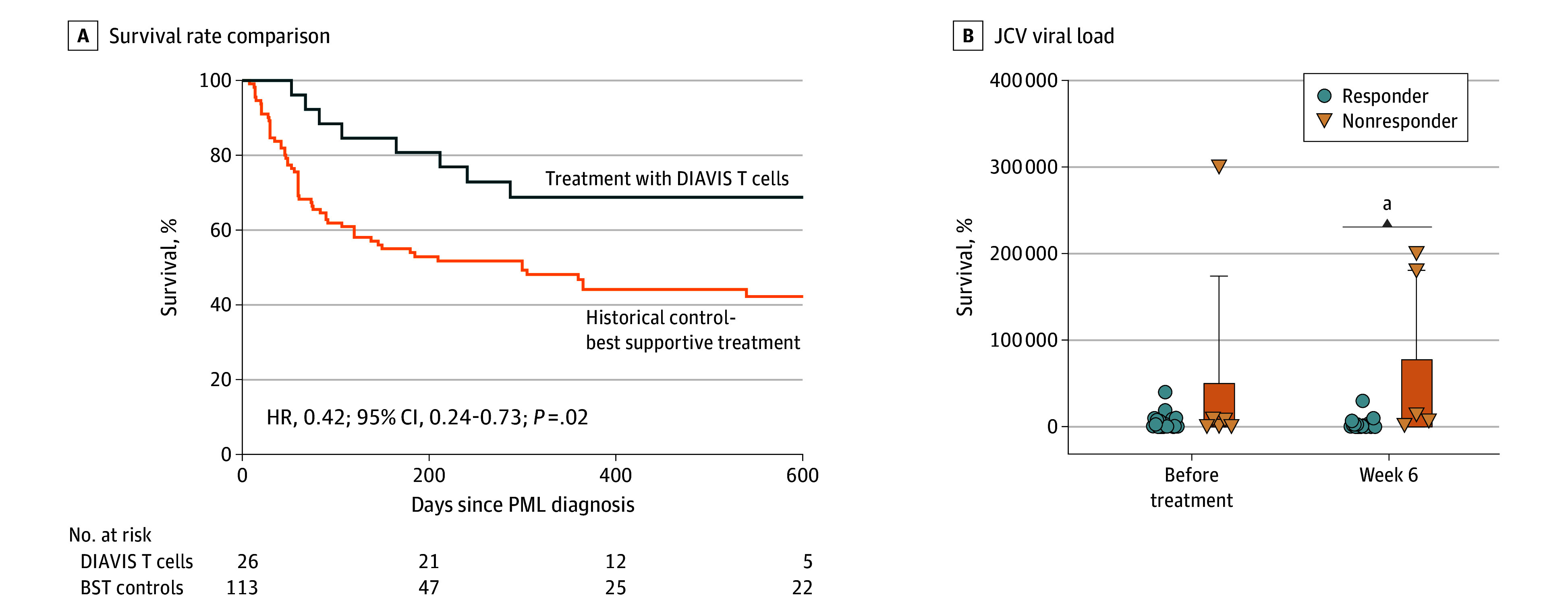
The study cohort consisted of 28 patients (median [IQR] age, 60 [51-72] years; 20 male [71.4%]). Twenty-two patients (79%) treated with DIAVIS T cells showed response, resulting in significant clinical stabilization or improvement and a reduction in viral load. Six individuals (21%) were classified as nonresponders, deteriorated rapidly, and died, as did 2 other patients during a 12-month follow-up. Older age was the only predictor of a poor treatment response. Survival analysis revealed better 12-month survival rates (hazard ratio, 0.42; 95% CI, 0.24-0.73; P =.02) from diagnosis for patients treated with DIAVIS T cells (18 of 26 [69%]; 12-mo survival rate, 69%) compared with historical controls with BST (57 of 113 [50%]; 12-mo survival rate, including censored data, 45%).
This case series of DIAVIS T-cell therapy in PML provides first class IV evidence suggesting efficacy to reduce mortality and improve functional outcome. Further prospective studies are required to confirm these results.
进行性多灶性白质脑病(PML)是一种危及生命的病毒感染,目前尚无获批的抗病毒治疗方法。
确定用直接分离的同种异体病毒特异性(DIAVIS)T细胞恢复PML患者受损的免疫系统是否是一种有前景的治疗策略,特别是在没有其他治愈选择的情况下。
设计、设置和参与者:对2020年3月至2022年2月期间接受DIAVIS T细胞治疗的PML患者进行了一项回顾性病例系列研究。T细胞在24小时内从健康供体中分离出来,并靶向BK多瘤病毒。PML患者接受单中心治疗。对确诊为PML的患者评估其接受DIAVIS T细胞治疗的资格,排除标准包括PML病情稳定和既往接受那他珠单抗治疗。
给予新鲜的DIAVIS T细胞,最大剂量为2×10⁴ CD3⁺细胞/千克体重。剩余的T细胞分剂量冷冻保存,并在大约2周和6周后进行额外治疗时给予。
主要结局指标是患者的临床反应和生存率,与接受最佳支持治疗(BST)的PML病例历史参考组的结局以及最近发表的接受免疫检查点抑制治疗的PML患者的真实世界数据进行比较。
研究队列包括28名患者(中位[四分位间距]年龄,60[51 - 72]岁;20名男性[71.4%])。接受DIAVIS T细胞治疗的22名患者(79%)显示有反应,导致临床显著稳定或改善以及病毒载量降低。6名个体(21%)被归类为无反应者,病情迅速恶化并死亡,在12个月的随访期间另有2名患者死亡。年龄较大是治疗反应不佳的唯一预测因素。生存分析显示,与接受BST的历史对照组相比,接受DIAVIS T细胞治疗的患者从诊断开始的12个月生存率更高(风险比,0.42;95%置信区间,0.24 - 0.73;P = 0.02)(26名患者中的18名[69%];12个月生存率,69%),而接受BST的历史对照组为113名患者中的57名[50%];12个月生存率,包括删失数据,45%)。
这个PML患者的DIAVIS T细胞治疗病例系列提供了一级IV类证据,表明其在降低死亡率和改善功能结局方面的疗效。需要进一步的前瞻性研究来证实这些结果。