Psychological Sciences Research Institute (IPSY), UC Louvain, Louvain-la-Neuve, Belgium.
Université Clermont Auvergne, CNRS, LAPSCO, Clermont-Ferrand, France.
PLoS One. 2024 Oct 7;19(10):e0311225. doi: 10.1371/journal.pone.0311225. eCollection 2024.
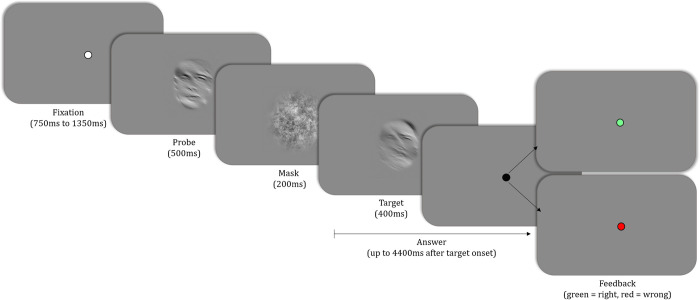
Humans preferentially rely on horizontal cues when recognizing face identity. The reasons for this preference are largely elusive. Past research has proposed the existence of two main sources of face identity information: shape and surface reflectance. The access to surface and shape is disrupted by picture-plane inversion while contrast negation selectively impedes access to surface cues. Our objective was to characterize the shape versus surface nature of the face information conveyed by the horizontal range. To do this, we tracked the effects of inversion and negation in the orientation domain. Participants performed an identity recognition task using orientation-filtered (0° to 150°, 30° steps) pictures of familiar male actors presented either in a natural upright position and contrast polarity, inverted, or negated. We modelled the inversion and negation effects across orientations with a Gaussian function using a Bayesian nonlinear mixed-effects modelling approach. The effects of inversion and negation showed strikingly similar orientation tuning profiles, both peaking in the horizontal range, with a comparable tuning strength. These results suggest that the horizontal preference of human face recognition is due to this range yielding a privileged access to shape and surface cues, i.e. the two main sources of face identity information.
人类在识别面部身份时更倾向于依赖水平线索。这种偏好的原因在很大程度上难以捉摸。过去的研究提出了面部身份信息的两个主要来源:形状和表面反射率。当图片平面倒置时,会干扰对表面和形状的访问,而对比度反转选择性地阻碍了对表面线索的访问。我们的目标是描述水平范围传达的面部信息的形状与表面特征。为此,我们在方向域中跟踪了反转和否定的影响。参与者使用熟悉的男性演员的定向过滤(0°至 150°,30°步长)图片进行身份识别任务,这些图片以自然直立位置和对比度极性呈现,也可以进行倒置或反转。我们使用贝叶斯非线性混合效应建模方法,使用高斯函数对各个方向的反转和否定效果进行建模。反转和否定的影响显示出惊人相似的方向调谐曲线,都在水平范围内达到峰值,调谐强度相当。这些结果表明,人类面部识别的水平偏好是由于该范围能够优先访问形状和表面线索,即面部身份信息的两个主要来源。