Department of Environmental Science and Engineering, Arak University, Arak, Iran.
Research and Development Department of Arvin Zist Pooya Lab, Tehran, 1563794747, Iran.
Sci Rep. 2024 Oct 7;14(1):23281. doi: 10.1038/s41598-024-73142-z.
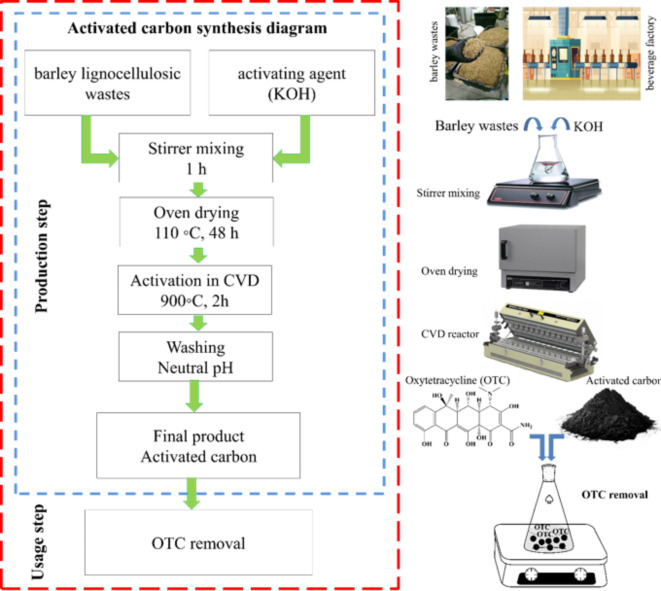
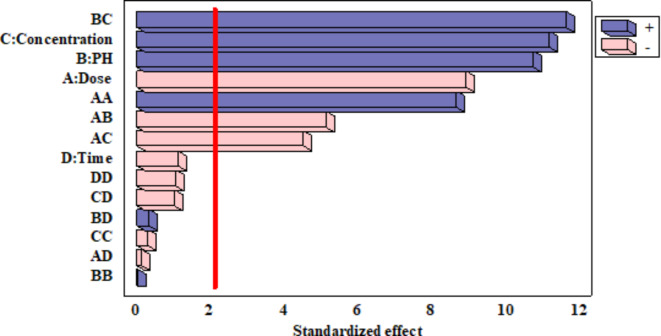
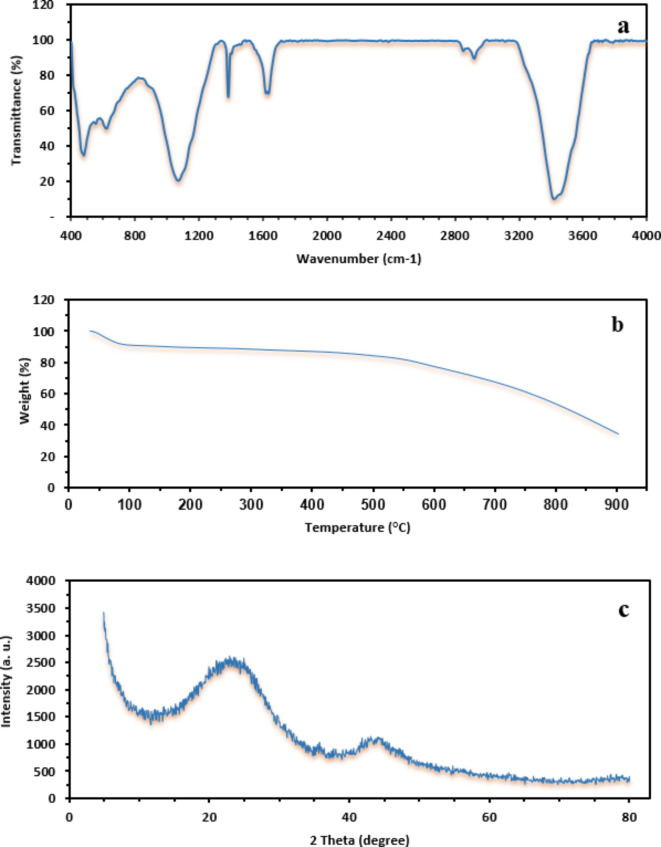
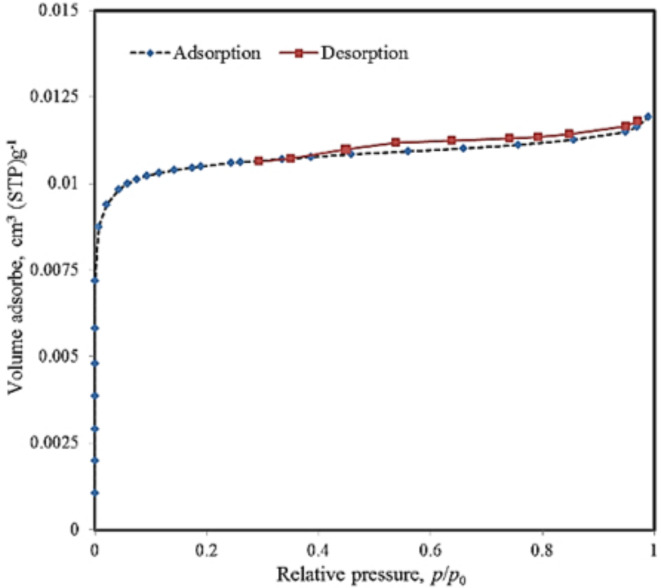
The excessive presence of antibiotics such as Oxytetracycline (OTC) in the wastewater has increased health problems due to their toxic impact on the aquatic ecosystem. Therefore, their removal has become an important topic. This study aims to produce high surface area-activated carbon derived from low-cost and environmentally friendly barley lignocellulosic wastes to remove OTC from aqueous solutions. The synthesized barley wastes-activated carbon (BW-AC) was characterized using Fourier-Transform Infrared spectroscopy, Thermal Gravimetric Analysis, X-ray diffraction analysis, N adsorption/desorption isotherms, and Scanning Electron Microscopy. A Central Composite Design under the Response Surface Methodology (CCD-RSM) was applied to optimize the operational parameters (adsorbent dosage, pH, OTC initial concentration, and contact time) affecting the adsorption capacity as the response factor. The optimum condition of OTC adsorption by BW-AC was the adsorbent dosage of 16.25 mg, pH of 8.25, initial concentration of 62.50 mg/L, and contact time of 23.46 min. An analysis of variance (ANOVA) was performed to investigate the significance of the designed quadratic model and evaluate the parameters interactions. The linear regression coefficient (R) of 0.975 shows a good correlation between predicted and actual results. The adsorption isotherms were used to determine the contaminant distribution over the adsorbent surface, and the equilibrium data was best described by the Freundlich isotherm due to the R value of 0.99 compared to other isotherms and β parameter of 0.23 in Redlich-Peterson equation. Moreover, the n value of 1.25 in Freundlich equation and E value of 0.31 in Dubinin-Radushkevich equation indicates a physical nature of adsorption process. According to the equations results, the maximum adsorption capacity of BW-AC for OTC removal was 500 mg/g, based on the Langmuir isotherm equation. In addition, the thermodynamic studies indicated an endothermic process based on the 0.31 value of ΔH° and spontaneous nature due to the negative amount of ΔG° within the temperature range of 288-318 K. Consequently, the prepared BW-AC can be deemed as a highly effective adsorbent with a large surface area, resulting in significant capacity for removing OTC. This synthesized BW-AC can serve as an environmentally friendly adsorbent for affordable wastewater treatment and is poised to make valuable contributions to future research in this field.
废水中抗生素(如土霉素)的过度存在增加了健康问题,因为它们对水生生态系统具有毒性影响。因此,去除抗生素已成为一个重要的课题。本研究旨在利用低成本和环保的大麦木质纤维素废物生产高比表面积活性炭,以去除水溶液中的土霉素。合成的大麦废物活性炭(BW-AC)采用傅里叶变换红外光谱、热重分析、X 射线衍射分析、N 吸附/解吸等温线和扫描电子显微镜进行了表征。响应面法(RSM)下的中心复合设计(CCD-RSM)用于优化吸附容量作为响应因子的操作参数(吸附剂用量、pH 值、土霉素初始浓度和接触时间)。BW-AC 吸附土霉素的最佳条件为吸附剂用量 16.25mg、pH 值 8.25、初始浓度 62.50mg/L 和接触时间 23.46min。方差分析(ANOVA)用于研究设计的二次模型的显著性并评估参数间的相互作用。线性回归系数(R)为 0.975,表明预测结果与实际结果之间具有良好的相关性。吸附等温线用于确定污染物在吸附剂表面上的分布,平衡数据最好用 Freundlich 等温线描述,因为与其他等温线相比,R 值为 0.99,Redlich-Peterson 方程中的 β参数为 0.23。此外, Freundlich 方程中的 n 值为 1.25,Dubinin-Radushkevich 方程中的 E 值为 0.31,表明吸附过程具有物理性质。根据方程的结果,根据 Langmuir 等温线方程,BW-AC 对土霉素去除的最大吸附容量为 500mg/g。此外,热力学研究表明,基于ΔH°值为 0.31,这是一个吸热过程,由于在 288-318K 的温度范围内ΔG°为负值,这是一个自发过程。因此,所制备的 BW-AC 可以被认为是一种具有大表面积的高效吸附剂,对去除土霉素具有很大的容量。这种合成的 BW-AC 可以作为一种环保的吸附剂,用于经济实惠的废水处理,并有望为该领域的未来研究做出有价值的贡献。