Department of Urology, The First Affiliated Hospital of Zhengzhou University, Zhengzhou, 450001, Henan, People's Republic of China.
Henan Engineering Research Center of Tumor Molecular diagnosis and treatment, Zhengzhou, 450001, Henan, People's Republic of China.
Sci Rep. 2024 Oct 7;14(1):23338. doi: 10.1038/s41598-024-73420-w.
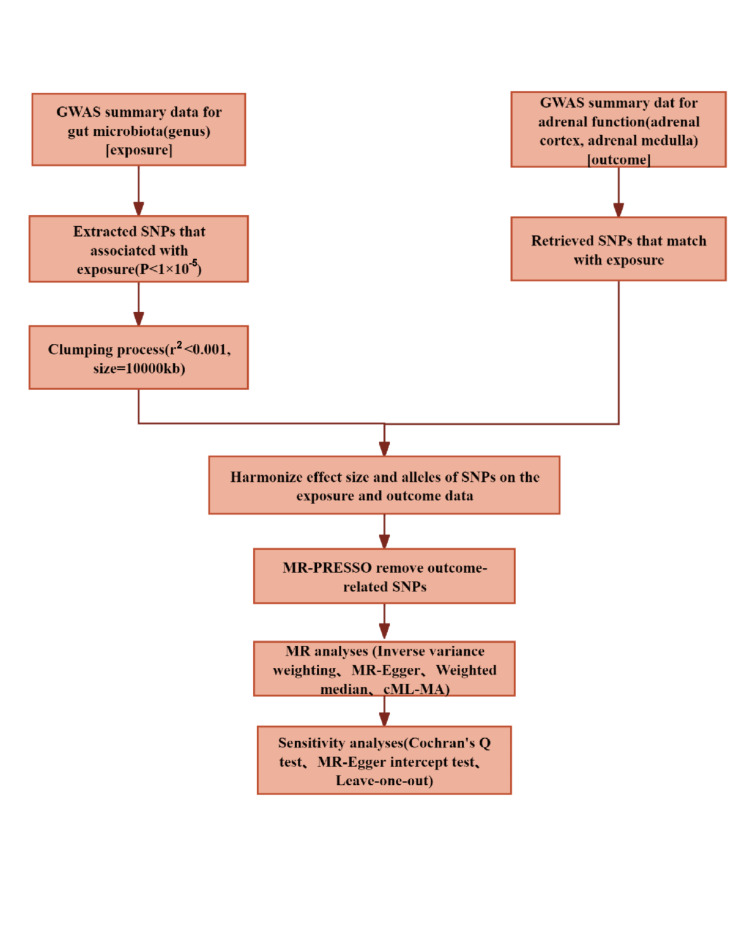
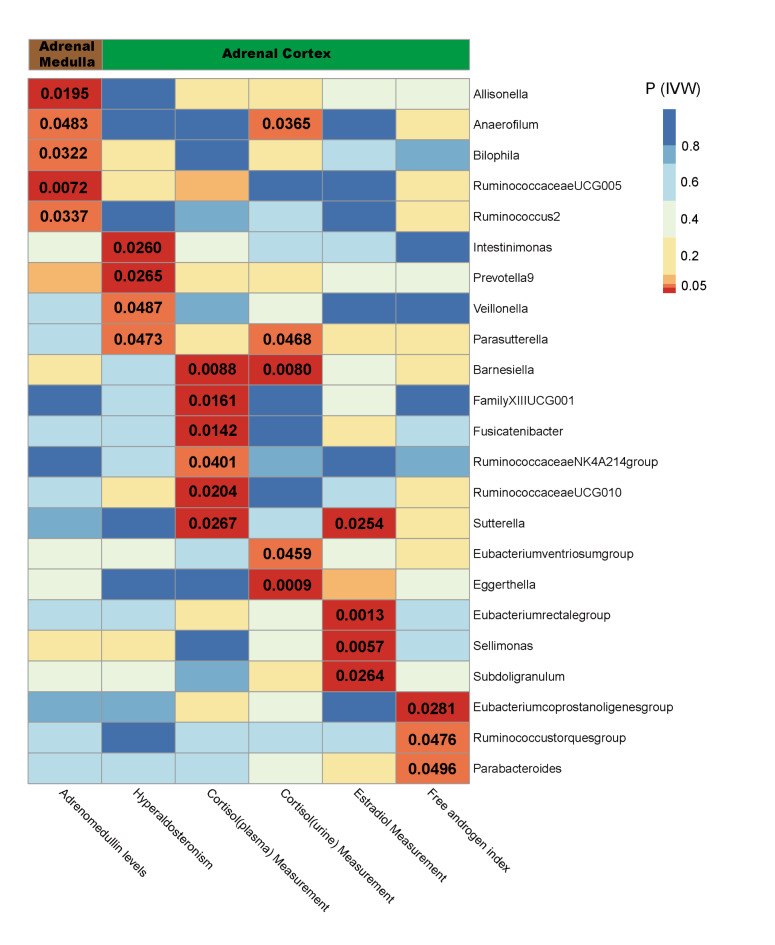
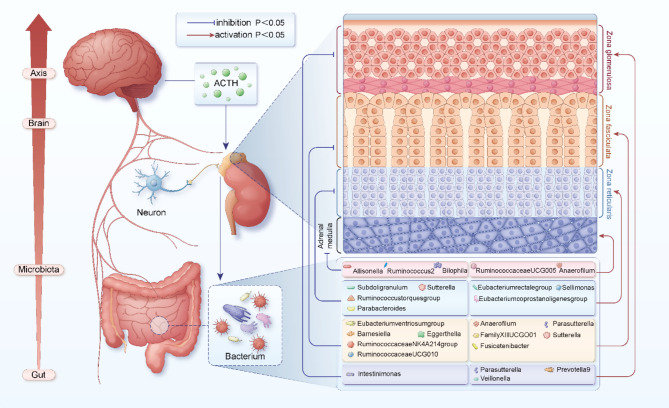
Some studies have reported that the gut microbiota can influence adrenal-related hormone levels. However, the causal effects of the gut microbiota on adrenal function remain unknown. Therefore, we employed a two-sample Mendelian randomization (MR) study to systematically investigate the impact of gut microbiota on the function of different regions of the adrenal gland. The summary statistics for gut microbiota and adrenal-related hormones used in the two-sample MR analysis were derived from publicly available genome-wide association studies (GWAS). In the MR analysis, inverse variance weighting (IVW) was used as the primary method, with MR-Egger, weighted median, and cML-MA serving as supplementary methods for causal inference. Sensitivity analyses such as the MR-Egger intercept test, Cochran's Q test, and leave-one-out analysis were used to assess pleiotropy and heterogeneity. We identified 27 causal relationships between 23 gut microbiota and adrenal function using the IVW method. Among these, Sellimonas enhanced the function of the adrenal cortex reticularis zone (beta = 0.008, 95% CI: 0.002-0.013, P = 0.0057). The cML-MA method supported our estimate (beta = 0.009, 95% CI: 0.004-0.013, P = 2 × 10). Parasutterella, Sutterella, and Anaerofilum affect the functioning of different regions of the adrenal gland. Notably, pleiotropy was not observed. Our findings revealed that the gut microbiota is causally associated with adrenal function. This enhances our understanding of the gut-microbiota-brain axis and provides assistance in the early diagnosis and treatment of adrenal-related diseases in clinical practice.
一些研究报告称,肠道微生物群可以影响与肾上腺相关的激素水平。然而,肠道微生物群对肾上腺功能的因果影响尚不清楚。因此,我们采用两样本孟德尔随机化(MR)研究系统地研究了肠道微生物群对肾上腺不同区域功能的影响。两样本 MR 分析中使用的肠道微生物群和与肾上腺相关的激素的汇总统计数据来自公开的全基因组关联研究(GWAS)。在 MR 分析中,逆方差加权(IVW)被用作主要方法,MR-Egger、加权中位数和 cML-MA 作为因果推断的补充方法。敏感性分析,如 MR-Egger 截距检验、Cochran's Q 检验和逐一排除分析,用于评估异质性和多效性。我们使用 IVW 方法确定了 23 种肠道微生物群与肾上腺功能之间的 27 种因果关系。其中,Sellimonas 增强了肾上腺皮质网状带的功能(beta=0.008, 95% CI: 0.002-0.013, P=0.0057)。cML-MA 方法支持我们的估计(beta=0.009, 95% CI: 0.004-0.013, P=2×10)。Parasutterella、Sutterella 和 Anaerofilum 影响肾上腺不同区域的功能。值得注意的是,没有观察到多效性。我们的发现表明,肠道微生物群与肾上腺功能有因果关系。这增强了我们对肠道-微生物群-大脑轴的理解,并为临床实践中肾上腺相关疾病的早期诊断和治疗提供了帮助。