Institute for the Advancement of Higher Education, Hokkaido University, Sapporo, Japan.
KIKAI Institute for Coral Reef Sciences, Kikai Town, Japan.
Sci Rep. 2024 Oct 7;14(1):23332. doi: 10.1038/s41598-024-74219-5.
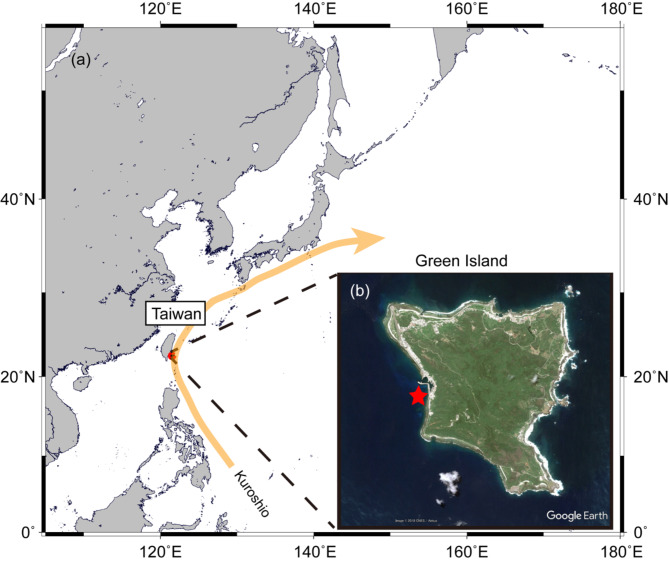
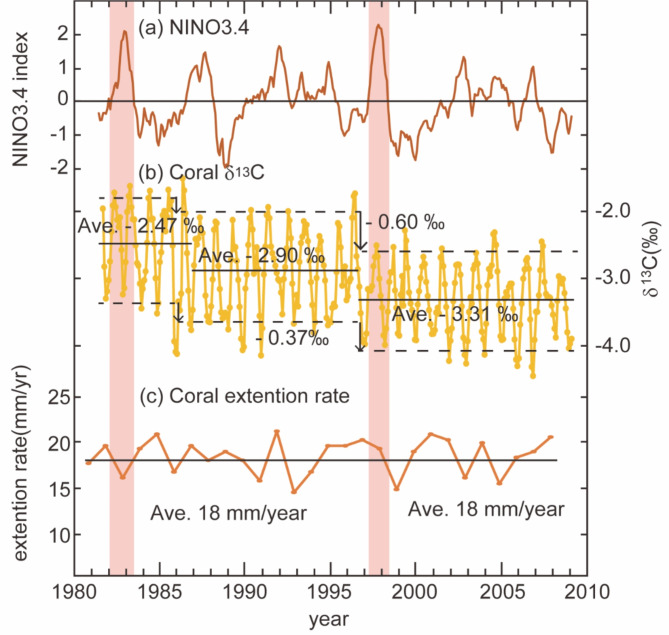
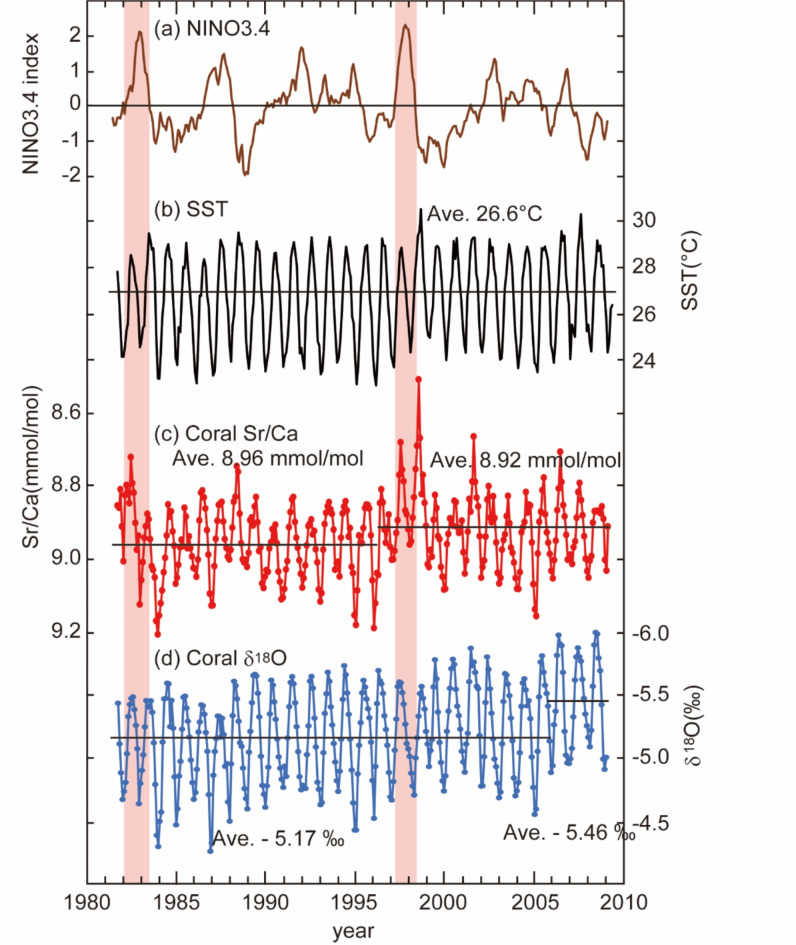
The 1997/1998 El Niño event caused mass coral bleaching and mortality in many tropical and subtropical regions, including corals on Green Island, Taiwan, in the northwestern Pacific Ocean. This study analyzed coral carbon isotope ratios (δC), oxygen isotope ratios (δO), and Sr/Ca ratios for 29 years, including the 1997/1998 El Niño period, to examine how high water temperature events are recorded in coral geochemical indicators. Sr/Ca ratios in coral skeletons from Green Island show the lowest peak, means the highest temperature during the 1997/1998 El Niño period. However, we couldn't observe high-temperature events on δO. Furthermore, a negative δC shift was observed after El Niño events. The regime shift of δC might have been caused by temporal bleaching and/or a decrease in symbiotic algae due to high water temperature stress under the continuous decrease in δC in DIC due to the Suess effect.
1997/1998 年厄尔尼诺事件导致包括西北太平洋绿岛在内的许多热带和亚热带地区的大量珊瑚白化和死亡。本研究分析了 29 年来的珊瑚碳同位素比值 (δC)、氧同位素比值 (δO) 和 Sr/Ca 比值,包括 1997/1998 年厄尔尼诺事件,以检验高温水事件是如何在珊瑚地球化学指标中记录的。绿岛珊瑚骨骼中的 Sr/Ca 比值显示出最低的峰值,这意味着在 1997/1998 年厄尔尼诺事件期间温度最高。然而,我们无法在 δO 上观察到高温事件。此外,在厄尔尼诺事件之后观察到了负的 δC 偏移。δC 的状态转变可能是由于时间上的白化和/或由于 Suess 效应导致 DIC 中 δC 持续减少,以及高温水胁迫下共生藻类减少所致。