Department of Hematology, The First Hospital of Jilin University, ChangChun, Jilin, China.
Front Immunol. 2024 Sep 23;15:1466859. doi: 10.3389/fimmu.2024.1466859. eCollection 2024.
To retrospectively analyze the characteristics of newly diagnosed marginal zone lymphoma (MZL) patients, evaluate the efficacy of different treatment regimens, and explore prognostic factors in the era of immunotherapy.
We reviewed the clinical data of newly diagnosed MZL patients treated at the Department of Hematology, The First Hospital of Jilin University, from October 2013 to October 2023. Survival differences between groups were analyzed using the log-rank test, and prognostic factors were identified.
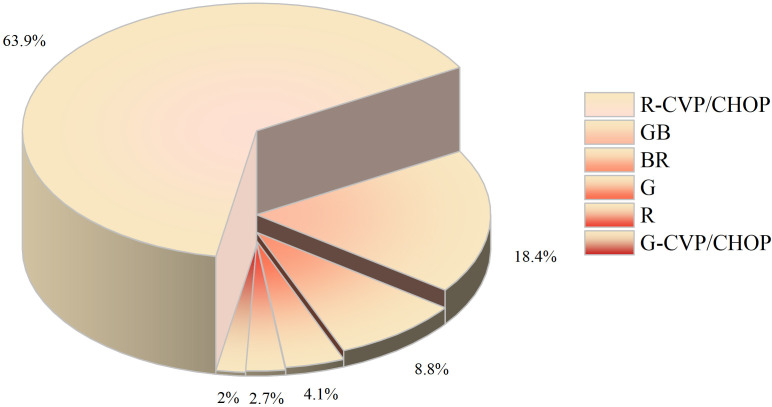
A total of 265 newly diagnosed MZL patients were included, with a median age of 59 years (range 22-90). The most common pathological type was mucosa-associated lymphoid tissue (MALT) lymphoma, accounting for 66.0% of cases. Among the 147 MZL patients included in the efficacy analysis, the median follow-up was 43.4 months. Both the median progression-free survival (PFS) and overall survival (OS) were not reached. The 5-year PFS and OS rates were 76.0% and 86.6%, respectively. Patients who achieved complete response (CR) after induction therapy had significantly better PFS (=0.0045), OS (<0.001), and time to next treatment (TTNT) (=0.0045) compared to those who did not achieve CR. A subgroup analysis was conducted on 51 MZL patients with high tumor burden who received ≥4 cycles of treatment. It was found that the CR rate (CRR) in patients receiving obinutuzumab (G) ± chemotherapy was significantly higher than in those receiving rituximab (R) ± chemotherapy (93.8% . 48.6%, =0.002). Multivariate analysis revealed that disease progression or death within 24 months of initial treatment (POD24) was an independent risk factor affecting OS (<0.001). Patients who experienced POD24 had a median survival of only 19.7 months, with a 3-year OS rate of just 37.6%, whereas those without POD24 had a 3-year OS rate of 97.3%.
MZL is predominantly seen in middle-aged and elderly patients and is a specific indolent B-cell lymphoma, with MALT lymphoma being the most common subtype. Achieving CR after induction therapy significantly prolongs survival in MZL patients. Compared to R ± chemotherapy, G ± chemotherapy achieves a higher CRR in high tumor burden MZL patients. In the era of immunotherapy, POD24 is an independent prognostic factor for MZL.
回顾性分析新诊断边缘区淋巴瘤(MZL)患者的特征,评估不同治疗方案的疗效,并探讨免疫治疗时代的预后因素。
我们回顾了 2013 年 10 月至 2023 年 10 月期间在吉林大学第一医院血液科治疗的新诊断 MZL 患者的临床资料。使用对数秩检验分析组间生存差异,并确定预后因素。
共纳入 265 例新诊断 MZL 患者,中位年龄 59 岁(范围 22-90)。最常见的病理类型为黏膜相关淋巴组织(MALT)淋巴瘤,占 66.0%。在纳入疗效分析的 147 例 MZL 患者中,中位随访时间为 43.4 个月。无进展生存期(PFS)和总生存期(OS)均未达到。5 年 PFS 和 OS 率分别为 76.0%和 86.6%。诱导治疗后达到完全缓解(CR)的患者 PFS(=0.0045)、OS(<0.001)和下一次治疗时间(TTNT)(=0.0045)明显优于未达到 CR 的患者。对 51 例接受≥4 个周期治疗的高肿瘤负荷 MZL 患者进行亚组分析发现,接受奥滨尤妥珠单抗(G)±化疗的患者的 CR 率(CRR)明显高于接受利妥昔单抗(R)±化疗的患者(93.8% vs. 48.6%,=0.002)。多因素分析显示,初始治疗后 24 个月内疾病进展或死亡(POD24)是影响 OS 的独立危险因素(<0.001)。经历 POD24 的患者中位生存期仅为 19.7 个月,3 年 OS 率仅为 37.6%,而未经历 POD24 的患者 3 年 OS 率为 97.3%。
MZL 主要发生在中老年患者,是一种特定的惰性 B 细胞淋巴瘤,MALT 淋巴瘤是最常见的亚型。诱导治疗后达到 CR 可显著延长 MZL 患者的生存。与 R ± 化疗相比,G ± 化疗可使高肿瘤负荷 MZL 患者获得更高的 CRR。在免疫治疗时代,POD24 是 MZL 的独立预后因素。