Graduate School of Life Science, Hokkaido University, Kita 21, Nishi 11, Kita-Ku , Sapporo 001-0021, Japan.
Faculty of Advanced Life Science, Hokkaido University, Kita 21, Nishi 11, Kita-Ku , Sapporo 001-0021, Japan.
Open Biol. 2024 Oct;14(10):240126. doi: 10.1098/rsob.240126. Epub 2024 Oct 9.
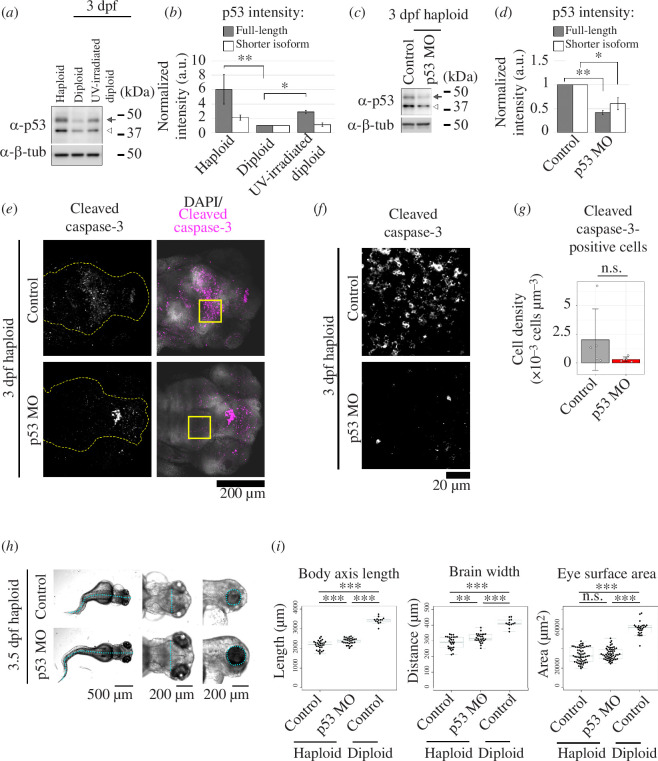
Haploid larvae in non-mammalian vertebrates are lethal, with characteristic organ growth retardation collectively called 'haploid syndrome'. In contrast to mammals, whose haploid intolerance is attributed to imprinting misregulation, the cellular principle of haploidy-linked defects in non-mammalian vertebrates remains unknown. Here, we investigated cellular defects that disrupt the ontogeny of gynogenetic haploid zebrafish larvae. Unlike diploid control larvae, haploid larvae manifested unscheduled cell death at the organogenesis stage, attributed to haploidy-linked p53 upregulation. Moreover, we found that haploid larvae specifically suffered the gradual aggravation of mitotic spindle monopolarization during 1-3 days post-fertilization, causing spindle assembly checkpoint-mediated mitotic arrest throughout the entire body. High-resolution imaging revealed that this mitotic defect accompanied the haploidy-linked centrosome loss occurring concomitantly with the gradual decrease in larval cell size. Either resolution of mitotic arrest or depletion of p53 partially improved organ growth in haploid larvae. Based on these results, we propose that haploidy-linked mitotic defects and cell death are parts of critical cellular causes shared among vertebrates that limit the larval growth in the haploid state, contributing to an evolutionary constraint on allowable ploidy status in the vertebrate life cycle.
非哺乳动物脊椎动物的单倍体幼虫是致命的,其特征性器官生长迟缓统称为“单倍体综合征”。与哺乳动物不同,哺乳动物的单倍体不耐受归因于印记调控失调,而非哺乳动物脊椎动物中单倍体相关缺陷的细胞原理仍然未知。在这里,我们研究了破坏雌核单倍体斑马鱼幼虫发生的细胞缺陷。与二倍体对照幼虫不同,单倍体幼虫在器官发生阶段表现出非计划性细胞死亡,这归因于单倍体相关的 p53 上调。此外,我们发现单倍体幼虫在受精后 1-3 天特别遭受有丝分裂纺锤体单极化的逐渐加重,导致整个身体的有丝分裂检查点介导的有丝分裂停滞。高分辨率成像显示,这种有丝分裂缺陷伴随着单倍体相关的中心体丢失,同时伴随着幼虫细胞大小的逐渐减小。有丝分裂停滞的解决或 p53 的耗尽部分改善了单倍体幼虫的器官生长。基于这些结果,我们提出单倍体相关的有丝分裂缺陷和细胞死亡是限制单倍体幼虫生长的脊椎动物之间共同的关键细胞原因的一部分,这对脊椎动物生命周期中允许的倍性状态的进化限制做出了贡献。