Division of Endocrinology and Metabolism, Department of Internal Medicine, Soonchunhyang University College of Medicine, #170 Jomaru-ro, Wonmi-gu, Bucheon-si, Gyeonggi-do, 420-767, South Korea.
Department of Obstetrics and Gynecology, CHA Bundang Medical Center, CHA University, Seongnam, South Korea.
Sci Rep. 2024 Oct 8;14(1):23385. doi: 10.1038/s41598-024-74390-9.
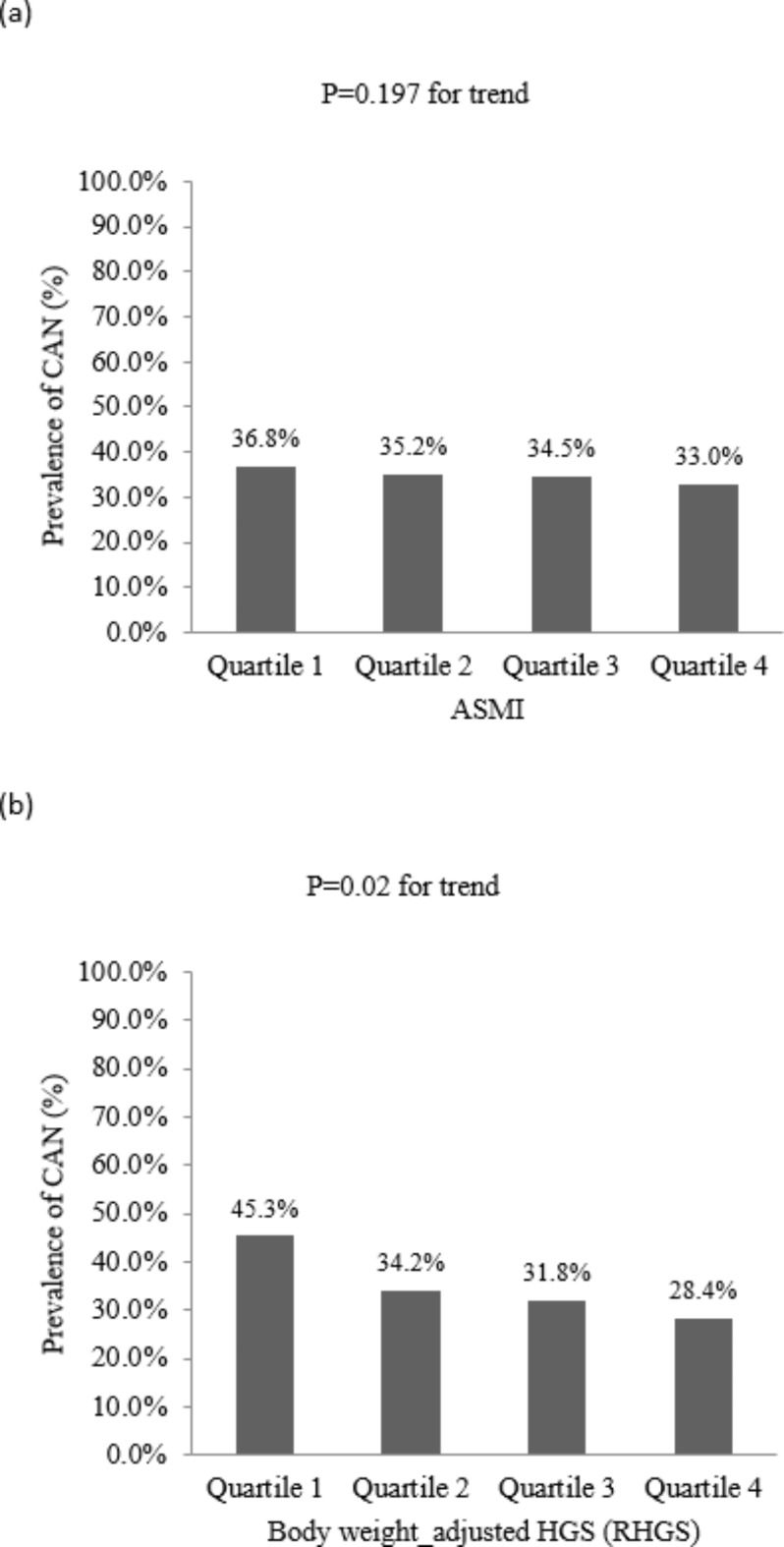
Several studies have investigated whether sarcopenia is associated with diabetic microvascular complications, but very few have examined associations between sarcopenia and cardiovascular autonomic neuropathy (CAN) in patients with type 2 diabetes mellitus (T2DM). Therefore, we investigated associations of muscle strength (handgrip strength [HGS]) and mass (appendicular skeletal muscle mass index [ASMI]) and CAN in patients with T2DM. We enrolled 342 patients in this retrospective, cross-sectional study. Cardiovascular reflex tests were used to assess CAN according to Ewing's protocol. Relative HGS was determined after normalizing absolute HGS to body weight (HGS/body weight [kg]). We defined low HGS and low ASMI according to a consensus report of the Asian Group for Sarcopenia. Logistic regression analyses were carried out to assess the associations between relative HGS or ASMI quartiles and the presence of CAN in patients with T2DM. The prevalence rates of CAN, low HGS, and low ASMI in the study subjects were 34.8%, 17.3%, and 18.7%, respectively. Low HGS was significantly more prevalent in patients with CAN than those without CAN (23.5% vs. 13.9%, p = 0.025). The CAN scores were significantly and negatively correlated with relative HGS but not with ASMI. Relative HGS was negative correlated with age, glycated hemoglobin, fasting plasma glucose, hsCRP, body mass index, and HOMA-IR and positively correlated with ASMI. The prevalence of CAN gradually increased with decreasing quartile of relative HGS (28.4% in Q4, 31.8% in Q3, 34.2% in Q2, and 45.3% in Q1, p = 0.02 for trend). Multivariable-adjusted prevalence ratios (PRs) for CAN, determined by comparing the first, second, and third quartiles with the fourth quartile of relative HGS, were 4.4 with a 95% confidence interval (95% CI) of [1.1 to 17.3]), 2.3 (95% CI [0.8 to 6.9]), and 1.2 (95% CI [0.4 to 3.7]), respectively. The prevalence of CAN and the PRs (95% [CI]) for CAN based on ASMI were not statistically significant. Our findings suggest that low muscle strength rather than low muscle mass was significantly associated with the presence of CAN. Therefore, HGS testing could help identify patients who would benefit from screening for earlier diagnosis of CAN.
一些研究调查了肌少症是否与糖尿病微血管并发症有关,但很少有研究探讨肌少症与 2 型糖尿病患者的心血管自主神经病变(CAN)之间的关系。因此,我们调查了 2 型糖尿病患者肌肉力量(手握力 [HGS])和质量(四肢骨骼肌质量指数 [ASMI])与 CAN 之间的关系。我们对这项回顾性、横断面研究纳入了 342 名患者。根据 Ewing 的方案,使用心血管反射测试来评估 CAN。绝对 HGS 与体重标准化后,得到相对 HGS(HGS/体重 [kg])。我们根据亚洲肌少症小组的共识报告,定义了低 HGS 和低 ASMI。使用逻辑回归分析评估了 T2DM 患者中相对 HGS 或 ASMI 四分位数与 CAN 存在之间的关系。研究对象的 CAN、低 HGS 和低 ASMI 的患病率分别为 34.8%、17.3%和 18.7%。与无 CAN 患者相比,有 CAN 的患者中低 HGS 的患病率显著更高(23.5%比 13.9%,p=0.025)。CAN 评分与相对 HGS 呈显著负相关,与 ASMI 无关。相对 HGS 与年龄、糖化血红蛋白、空腹血糖、hsCRP、体重指数和 HOMA-IR 呈负相关,与 ASMI 呈正相关。随着相对 HGS 四分位数的降低,CAN 的患病率逐渐升高(Q4 为 28.4%,Q3 为 31.8%,Q2 为 34.2%,Q1 为 45.3%,p=0.02 趋势)。多变量调整后,CAN 的患病率比(PR),通过比较相对 HGS 的第一、二和三分位数与第四分位数,分别为 4.4(95%CI[1.1 至 17.3])、2.3(95%CI[0.8 至 6.9])和 1.2(95%CI[0.4 至 3.7])。基于 ASMI 的 CAN 患病率和 PR(95%CI)均无统计学意义。我们的研究结果表明,低肌肉力量而非低肌肉质量与 CAN 的存在显著相关。因此,HGS 测试可能有助于确定需要筛查以早期诊断 CAN 的患者。